Black Holes & Singularities
The Biggest Black Holes in the Universe, Ranked
From the 4-million-solar-mass heart of our galaxy to a 100-billion-solar-mass monster that strains physics itself — a tour of the heavyweight champions of the cosmos.
Black holes come in sizes that break intuition. The one at the center of our galaxy, Sagittarius A*, holds 4.3 million Suns — and it is a lightweight. The true heavyweights, the ultramassive black holes anchoring the biggest galaxies, reach tens of billions of solar masses. Here they are, ranked by best current estimates — with the caveat that weighing these monsters relies on indirect models, so the order is always provisional.
5. Sagittarius A* — 4.3 million Suns
Our own galactic center. Decades of tracking stars whipping around it — work that won the 2020 Nobel Prize — pinned its mass precisely. It is the runt of this list, and a useful yardstick: everything else on this list dwarfs it by factors of thousands.
4. M87* — 6.5 billion Suns
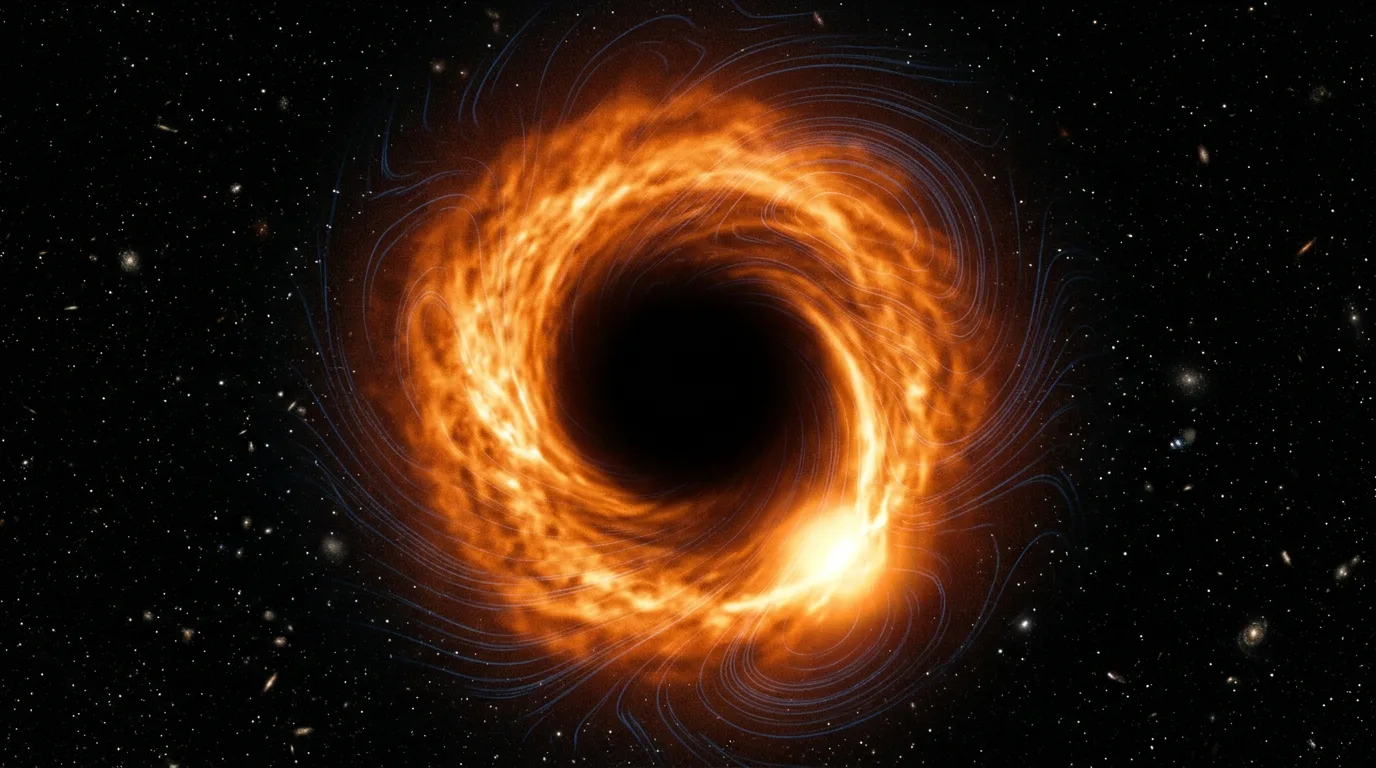
The first black hole ever imaged, by the Event Horizon Telescope in 2019. Its famous shadow spans a region larger than our entire solar system, and its jet punches 5,000 light-years into intergalactic space.
3. Holmberg 15A* and S5 0014+81 — ~40 billion Suns each
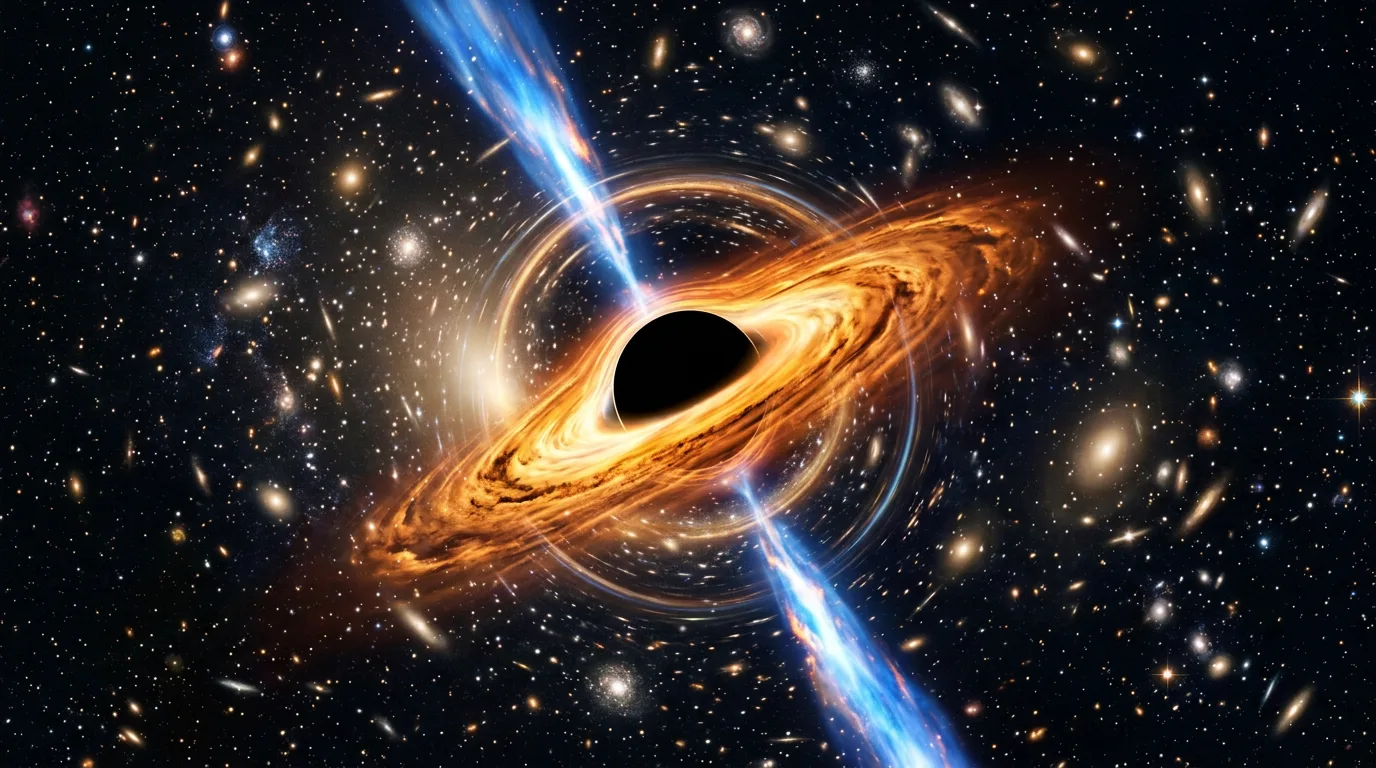
A tie for bronze. Holmberg 15A* anchors one of the most massive galaxies known, while S5 0014+81 is a blazar — a galaxy whose jet points straight at us — whose brilliance once made it the most luminous object ever found: it shines with the power of 300 trillion Suns because it is feeding so violently.
2. TON 618 — ~66 billion Suns
For years the undisputed champion. This quasar — a black hole feeding so violently it outshines its galaxy — sits about 10 billion light-years away and is so luminous it outshines its entire host galaxy; its event horizon has a radius of roughly 1,300 times the Earth–Sun distance. Light itself takes over two weeks to cross from one side of the shadow to the other.
1. Phoenix A — up to 100 billion Suns
The current record holder, sitting at the heart of the Phoenix Cluster 5.8 billion light-years away. Joint measurements from NASA’s Chandra X-ray telescope and the ALMA radio observatory suggest it could reach 100 billion solar masses — near the theoretical ceiling where accretion disks become unstable and tear themselves into stars. Its event horizon would span nearly 2,000 AU in radius, about fifty times the orbit of Pluto. If the high end of the estimate holds, Phoenix A is not just the biggest known black hole; it is evidence our models of how black holes grow are missing something.
“Every record on this list is a measurement fighting the limits of its method. The ranking will change — the monsters will only get bigger.”
How the monsters are weighed
Nobody puts a black hole on a scale. The rankings rest on three very different tricks, each with its own failure modes. Watching stars’ orbits — the method that nailed M87* and Sgr A* — only works nearby. Echo-mapping (reverberation mapping) watches gas clouds echo the flicker of the accretion disk, trading precision for reach. And the heavyweights like Phoenix A are weighed by their violence: the energy their jets pumped into surrounding gas over hundreds of millions of years sets a minimum mass for the black hole powering them. Every number on this list carries error bars you could drive a galaxy through, which is why the ordering shuffles as methods improve.
The growth ceiling
Theory says black holes should stop growing somewhere around 50 to 100 billion solar masses. Above that, the accretion disk gets so luminous that radiation pressure fragments it into stars before the gas can fall in — the disk eats itself instead of feeding the hole. Phoenix A sits right at that ceiling, which is what makes it interesting rather than merely big. Objects at the limit are either telling us the ceiling is higher than calculated, or that something bypasses it: chains of mergers between already-massive holes, direct-collapse seeds that start huge, or episodes of super-Eddington feasting — feeding faster than the theoretical limit — where the limit is briefly ignored.
The next record-breaker is probably already in the data, mismeasured or unrecognized. Wider surveys keep turning up overmassive black holes in the early universe, and each one tightens the tension between how fast black holes can grow and how fast they apparently did. The ranking is a snapshot of an unfinished argument — and the monsters, as always, will only get bigger.
Honorable mentions
Below the top five, the leaderboard is a brawl. The most intriguing outsider is IC 1101, one of the largest galaxies known, which may harbor a 100-billion-solar-mass monster of its own — an estimate hotly disputed, and one that would rival Phoenix A if confirmed. The ordering shifts with every new method because each technique sees a different shadow of the same beast.
Why ultramassive holes shape galaxies
These monsters are not passive trophies; they sculpt their surroundings. The observed lockstep between black hole mass and galaxy size — astronomers call it the M-sigma relation — says the two grow together, regulated by feedback: jets and winds from the accretion disk heat surrounding gas and throttle star formation. In the Phoenix Cluster, the black hole’s jets are fighting an inflow of cooling gas that dumps hundreds of solar masses per year toward the center. It is a thermostat the size of a galaxy cluster, and the black hole is the dial. Understanding the biggest holes is understanding why galaxies look the way they do.