Black Holes & Singularities
What’s Inside a Black Hole? The Singularity Problem
Past the event horizon, our best theories collapse into contradiction. Firewalls, fuzzballs, and wormholes — a tour of physics’ most guarded secret.
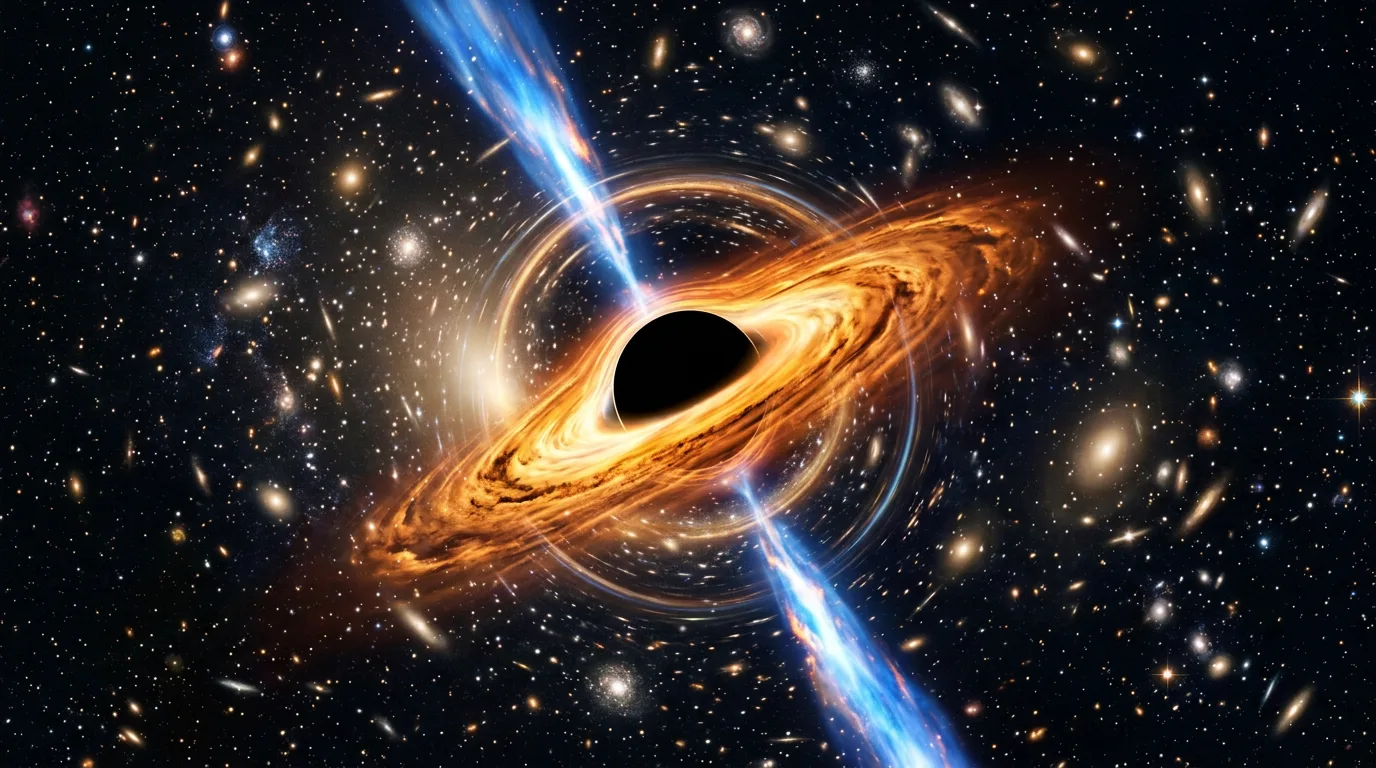
Every black hole hides the same embarrassment: at its center, Einstein’s equations predict a singularity — a point where matter is crushed to infinite density and spacetime ends. Infinities in physics are not answers; they are surrender flags, marking the exact spot where general relativity breaks and a quantum theory of gravity must take over. What actually sits inside is the most hotly contested question in fundamental physics.
Crossing the horizon: the fall inward
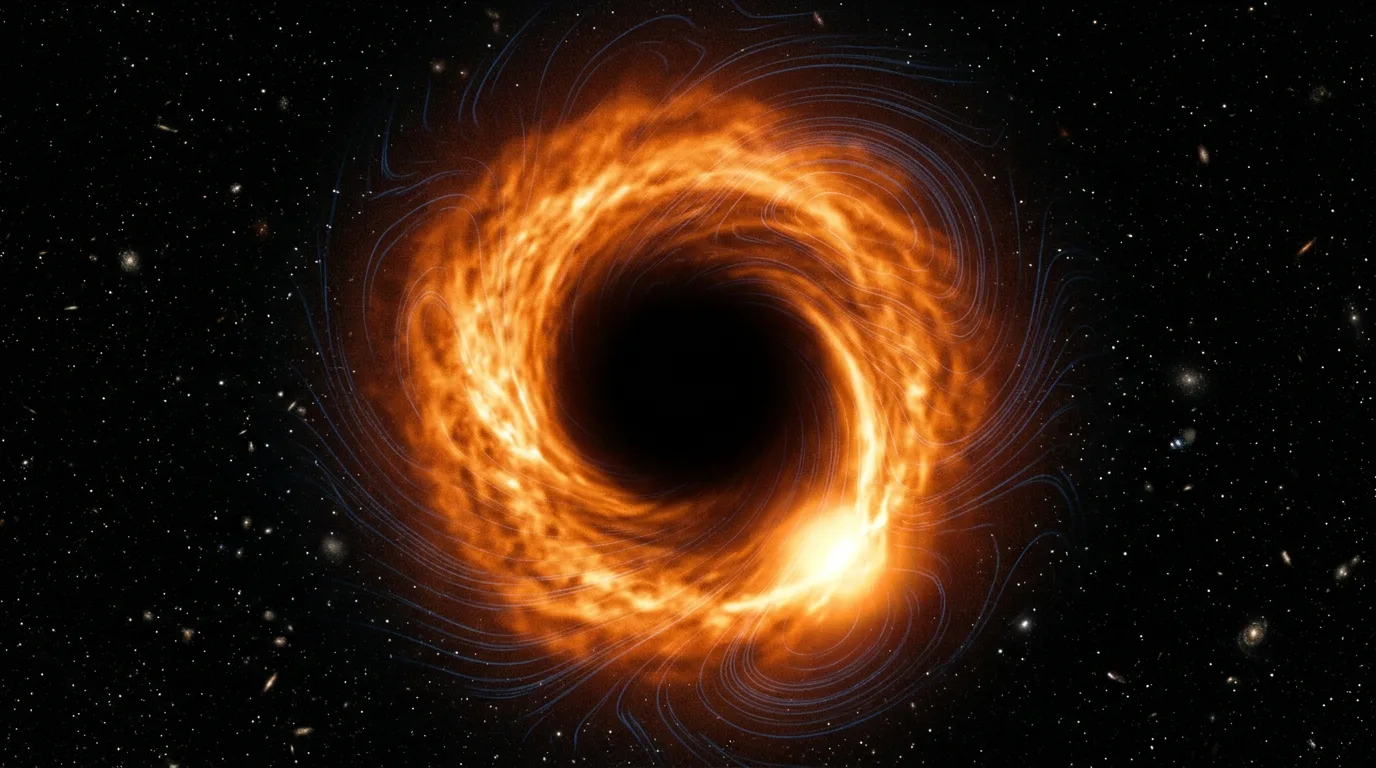
Crossing the event horizon — the point of no return — of a supermassive black hole would, surprisingly, feel like nothing at all: no wall, no flash. Tidal forces near a giant’s horizon are gentle; you would sail through unaware that escape had just become geometrically impossible. Inside, though, all paths bend toward the center — spacetime itself flows inward faster than light can fight it. The stretching — spaghettification — intensifies as tides grow without bound, and the singularity is not a place you travel to but a moment in your future, as unavoidable as tomorrow. The last light you would see is the entire history of the outside universe, compressed and shifted toward bluer light. Then the equations stop, and so, presumably, do you.
The information paradox
The deeper crisis is not the singularity but information. Stephen Hawking showed that black holes slowly evaporate, leaking featureless thermal radiation. If that radiation carries no imprint of what fell in, then information is destroyed — which quantum mechanics forbids. For decades this was a genuine paradox with no resolution. Then, starting in 2019, new “island” models of the hole’s interior showed how information could be encoded in the radiation after all. The emerging consensus is that information escapes; the singularity, whatever it is, does not get to delete the universe’s ledger.
- Firewall (2012): quantum entanglement may make the horizon itself a wall of fire — infallers burn, not sail
- Fuzzballs (Mathur): no singularity at all, just a tangled ball of strings the size of the horizon
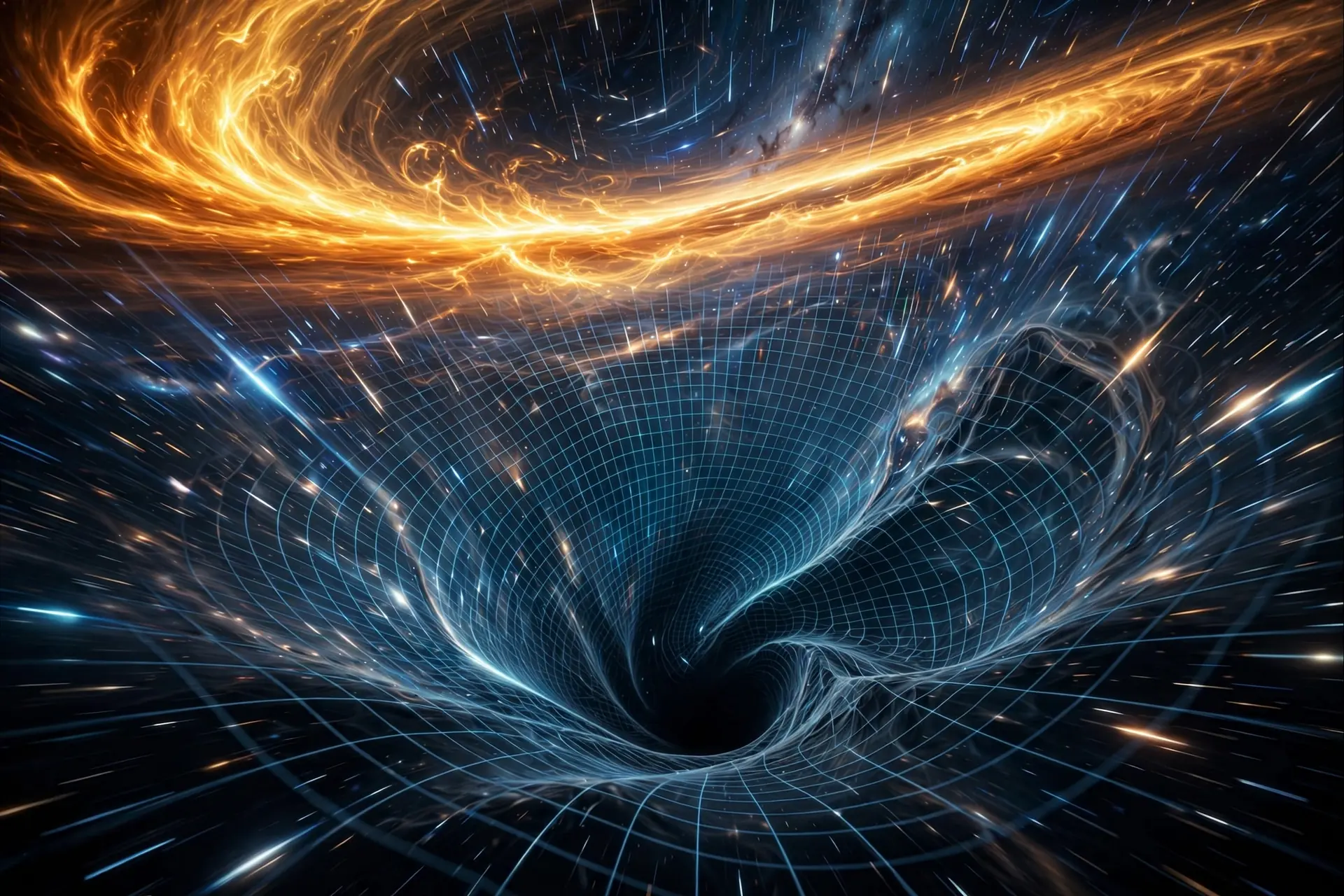
- ER = EPR (2013): entangled particles may be connected by microscopic wormholes — spacetime from entanglement
- Gravastars: a speculative alternative where collapse halts into a dark-energy core
“The singularity is where our equations stop describing nature and start describing their own failure.”
Why it matters
Nobody will ever visit a singularity and report back — the interior is sealed from the universe by definition. Yet the argument matters enormously, because whichever resolution wins will be our first true theory of quantum gravity, the framework that unites the physics of the tiny with the physics of the cosmic. Black holes are nature’s locked laboratories. The keyhole is the paradox; the prize is a new theory of everything.
What the alternatives actually say
Each rival theory preserves something by sacrificing something else. String theory’s fuzzballs, proposed by Samir Mathur, say there is no interior at all: the black hole is a tangled ball of strings, and the "horizon" is just where the fuzz ends — information is never lost because it was never inside. The firewall paradox, from Almheiri, Marolf, Polchinski, and Sully, reaches the opposite verdict: saving quantum mechanics requires a wall of high-energy particles at the horizon, which would incinerate infalling astronauts and break Einstein’s equivalence principle — the idea that falling feels like floating. Loop quantum gravity predicts a bounce: collapse halts at the Planck scale, the smallest meaningful size in physics, and rebounds, potentially into a white hole — a black hole in reverse, spewing matter out — in another region of spacetime. Two wilder ideas round out the list: ER = EPR proposes that entangled particles are linked by microscopic wormholes, making spacetime itself out of entanglement; gravastars imagine collapse halting into a core of dark energy instead of a singularity at all.
Could we ever test this?
Direct observation is impossible by definition, but the theories leak predictions at the edges. Some analyses of gravitational wave data claim faint "echoes" after black hole mergers — reflections off a fuzzball surface or firewall — though the statistics remain disputed. The Event Horizon Telescope could, in principle, measure shadow sizes that deviate from general relativity’s predictions by a few percent. And in laboratories, physicists build analog black holes: ultra-cold atom clouds (Bose-Einstein condensates) with sound-based stand-ins for event horizons (sonic horizons) that emit analog Hawking radiation, letting us test the mathematics of the paradox on a tabletop. None of these will photograph a singularity. But they may tell us which theory survives contact with reality — and that is how the map gets redrawn.