Missions
Project Starshot: Sailing to Alpha Centauri at 20% Light Speed
A gram-scale chip riding a laser-pushed sail could reach another star system in twenty years. The physics checks out — the engineering is the adventure.
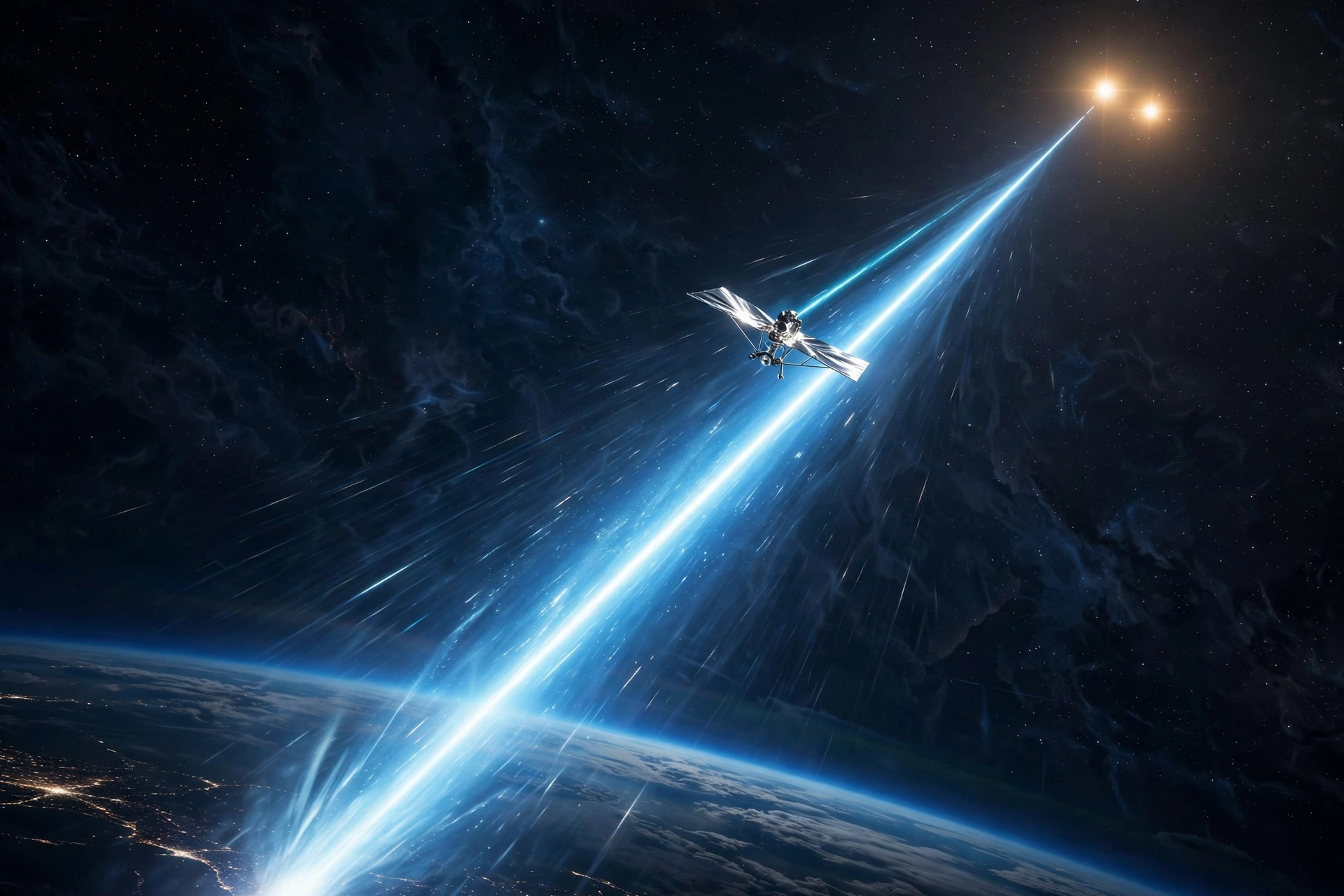
Chemical rockets will never take us to the stars — the distances are simply too cruel. But light has no such limits. Breakthrough Starshot, announced in 2016 with $100 million in initial funding, proposes the first credible interstellar mission: a fleet of gram-scale StarChips, each attached to a four-meter lightsail, accelerated by a 100-gigawatt grid of Earth-based lasers firing in perfect sync (a phased array) to twenty percent of light speed. At that velocity, the 4.37-light-year crossing to Alpha Centauri takes about twenty years, plus four more for the photos to fly home.
Why light works
A lightsail needs no fuel — photons do the pushing. Because the spacecraft masses almost nothing, even the gentle pressure of light, concentrated by the most powerful laser array ever conceived, can accelerate it at tens of thousands of times Earth’s gravity for a few minutes. By the time the laser lets go, the little craft is the fastest object humanity has ever built, covering the Earth–Moon distance in about six seconds.
The hard parts
The physics is sound; everything else is an expedition into the unknown. The laser array would be a kilometer-scale facility costing billions, firing through a turbulent atmosphere with self-correcting mirrors (adaptive optics) pushed far beyond anything built. The sail must reflect nearly all of that megawatt-per-square-meter blast or vaporize instantly. At a fifth of light speed, a collision with a single micron-sized dust grain strikes with the energy of a rifle bullet. And once the probe screams past Alpha Centauri, there is no way to slow down — it gets one high-speed flyby, snapping pictures as it goes.
- Speed: 60,000 km/s — 20% the speed of light
- Travel time: ~20 years to Alpha Centauri, 4.37 light-years away
- Spacecraft: ~1 gram chip + 4-meter sail, thousands launched as a fleet
- Signal home: a watt-scale onboard laser, caught by the same giant array acting as receiver
“Starshot is not a plan to build a starship. It is a plan to shrink the starship until the physics lets it fly.”
Where it stands
A decade in, Starshot remains in the research phase — sail materials, keeping the lasers synchronized, and communications are active engineering problems, not solved ones. But each sub-problem is also useful on its own: the laser array doubles as a deep-space communication receiver, and gram-scale spacecraft are already flying as testbeds. Whether the first interstellar photos arrive in the 2040s or the 2060s, the destination is no longer a question of if physics allows it. It is a question of when we decide to pay for it.
The four impossible problems
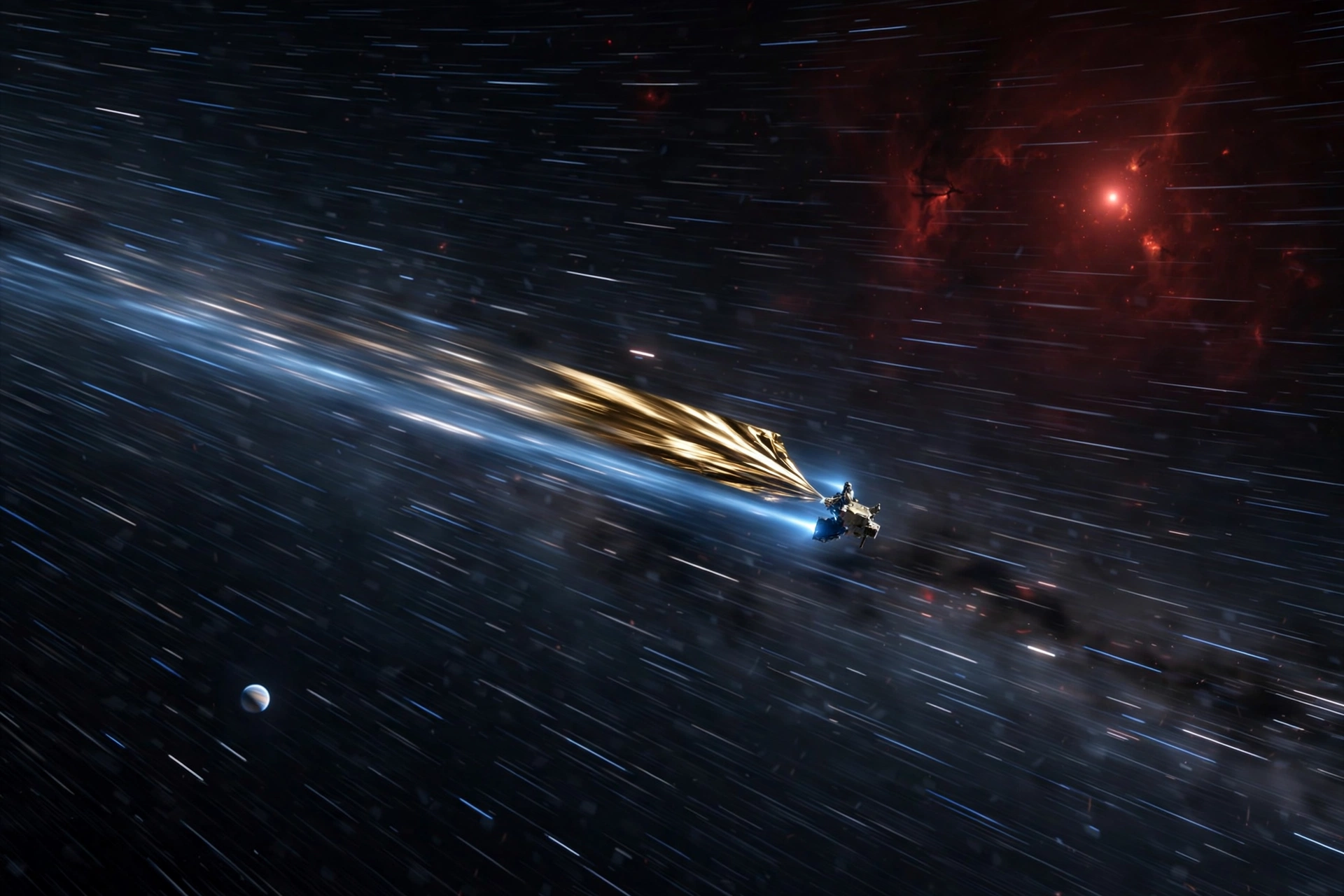
Starshot’s elegance is that it replaces one impossible problem — building a starship — with four merely ferocious ones. First, the laser: roughly 100 gigawatts of optical power, fired in perfect sync across an array kilometers wide, tracking a sail smaller than a dinner table as it recedes at a fifth of light speed. Second, the sail itself: a few grams of material that must survive megawatts per square meter without vaporizing, and stay balanced on the beam like a surfer — the "beam-riding" stability problem that has consumed years of simulation.
Third, the chip: a gram-scale spacecraft carrying a camera, a computer, and a power source, hardened against interstellar dust grains that strike like bullets at relativistic speed. Fourth, the phone call home: returning data across four light-years with a watt-scale laser, to be caught by the same giant array that launched it, now listening. Each problem is at the edge of known physics but not beyond it — which is precisely why the project survives scrutiny.
Why bother before it’s possible
Critics call Starshot a press release with a physics appendix. Its defenders reply that every interstellar concept before it required magic — warp drives, wormholes, infinite energy — while Starshot requires only money and engineering. The laser array alone would revolutionize deep-space communication; gram-scale probes are already useful for solar system science. And there is a deeper point: Starshot reframes the oldest dream in spaceflight. We spent a century trying to build bigger rockets to carry humans to the stars. The answer may be to build smaller ships and bigger flashlights — and let light do the carrying.
The target: Proxima Centauri b
Starshot is not aimed at empty space. Its destination is Proxima Centauri, 4.24 light-years away — and specifically Proxima b, a roughly Earth-mass world in its star’s habitable zone. A successful flyby at 20 percent of light speed would flash past the planet in hours, snapping what might be the first resolved images of another potentially habitable world: continents or oceans, clouds, perhaps the spectral signature of an atmosphere. Then the long wait: four years for the data to crawl home at light speed, carrying pictures across the void from humanity’s first interstellar emissary.
The competition
Starshot is not the only way to cross the gulf. Project Daedalus, the British Interplanetary Society’s 1970s design, proposed a fusion-pulse behemoth — 54,000 tonnes of ship, centuries of fuel mining. Solar sails like Japan’s IKAROS probe proved light pressure works, but sunlight thins with distance; a laser does not. Antimatter rockets win on paper and lose on production: we can currently make nanograms per year at billions of dollars per gram. Against this field, Starshot’s advantage is not elegance but honesty — every component is an engineering problem, not a physics miracle. It may still fail. But it fails forward, in the open, where the next idea can learn from it.