Terraforming & Sci-Tech
How to Turn Mars Into Earth: The Step-by-Step Blueprint
From super-greenhouse gases to an artificial magnetosphere, here is the actual engineering sequence scientists have proposed to make Mars habitable — and how long each step would take.
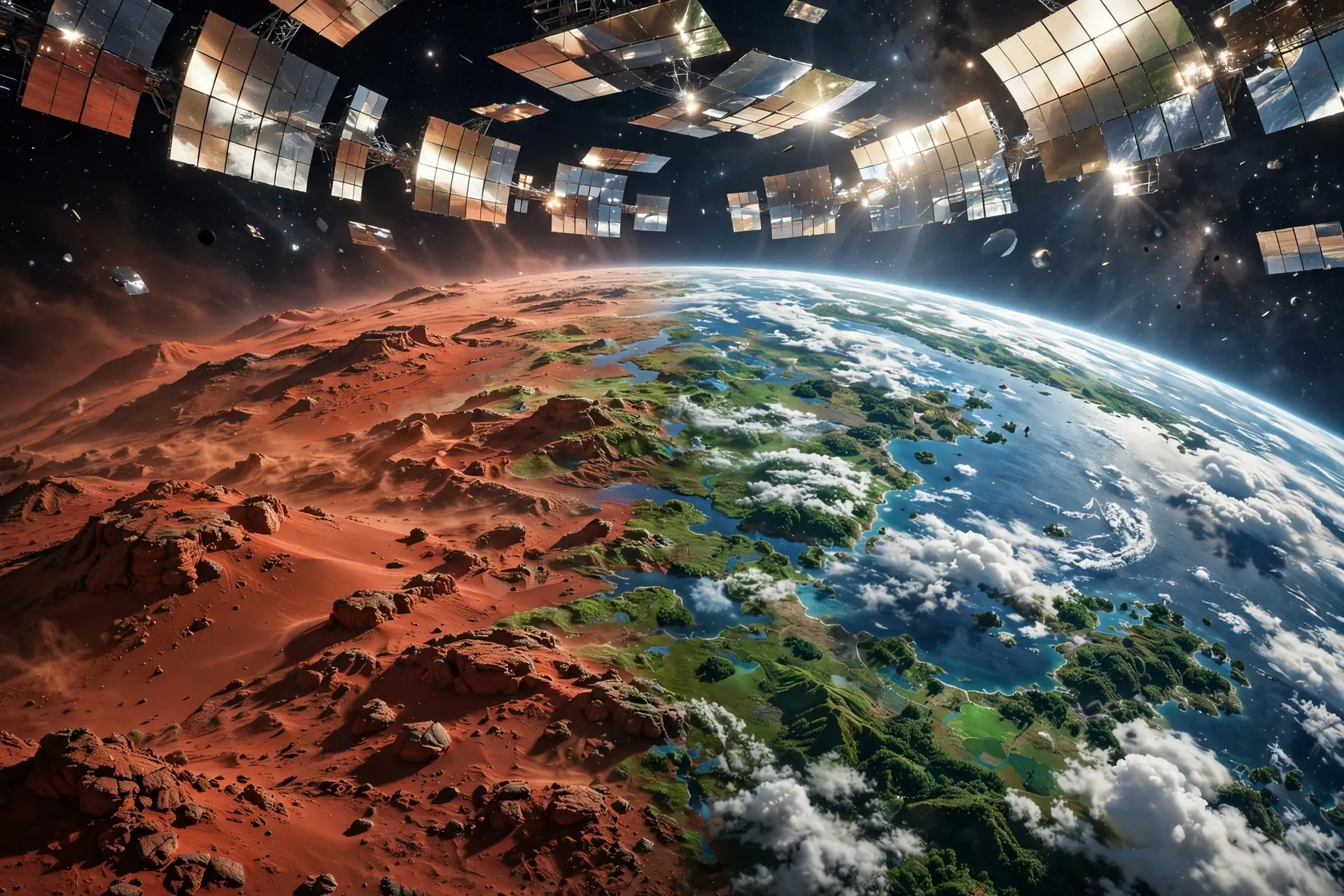
Terraforming Mars is the most audacious engineering project ever seriously proposed: converting a frozen, airless desert into a world where humans can walk outside and breathe. No single technology does it. Instead, researchers have sketched a sequence — each step unlocking the next — that could plausibly play out over centuries. Here is the blueprint, in order.
Step 1: Warm it up
Mars averages minus 63 degrees Celsius because its thin atmosphere cannot hold heat. The fastest lever is warming. In the 1990s, researchers proposed factories releasing super-greenhouse gases — fluorocarbons thousands of times more potent than CO2. A more elegant 2024 proposal suggested lofting engineered iron and aluminium nanorods into the Martian sky, particles tuned to trap escaping infrared radiation more than 5,000 times more efficiently than carbon dioxide. Models suggest a sustained release could raise global temperatures by tens of degrees within decades, not millennia.
Step 2: Give it a magnetic shield
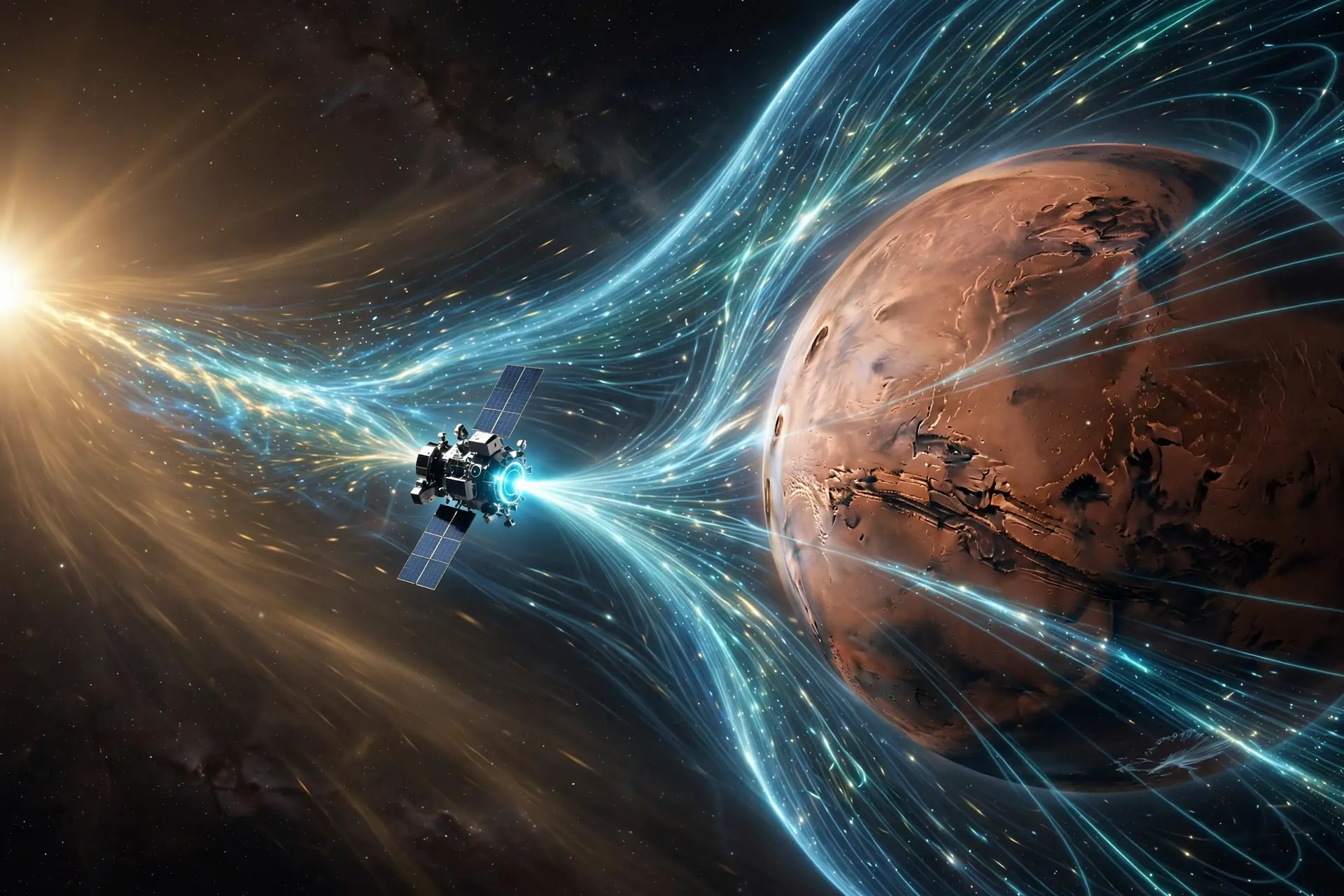
Mars lost its global magnetic field billions of years ago, and the solar wind has been stripping its atmosphere ever since. Warming the planet is pointless if the wind keeps stealing the air. In 2017, NASA scientist Jim Green proposed parking a powerful magnet (a magnetic dipole) at the Mars–Sun L1 Lagrange point, between Mars and the Sun, to deflect the solar wind around the planet like an umbrella. Simulations suggest the atmosphere would then thicken on its own as volcanic and subsurface gases accumulate instead of escaping.
Step 3: Thicken the air
With warmth rising and the wind blocked, frozen carbon dioxide at the poles begins to sublimate — turn straight from ice to gas — triggering a runaway feedback: more gas, more warming, more gas. If the polar reserves prove insufficient, the shortfall could be imported — nudging ammonia-rich asteroids or Kuiper belt objects into Mars impact trajectories to deliver volatiles — water, ammonia, and carbon dioxide ice. The target is an atmosphere thick enough that liquid water is stable on the surface and pressure suits become optional.
- Phase A (decades): nanorod warming + magnetic shield deployment
- Phase B (century): polar outgassing and volatile import, pressure climbs toward 100+ millibars
- Phase C (centuries): liquid water returns to Hellas Basin and the northern lowlands
- Phase D (millennia): oxygenation — the longest step by far
Step 4: Make it breathable
This is the hard part. A thick CO2 atmosphere is still poison. Converting it to oxygen means photosynthesis at planetary scale — engineered cyanobacteria and hardy plants seeded across the surface, working for centuries. Earth took roughly two billion years to oxygenate its air; with intent and engineering, Mars might do a crude version in a few hundred to a few thousand years. Nobody gets to breathe free Martian air in our lifetimes, but our descendants might.
“Terraforming is not one invention. It is a relay race where each generation hands the next a slightly warmer, thicker, wetter Mars.”
Why it might not work
Honest accounting demands the caveats. Martian soil is laced with toxic perchlorate salts. The planet is short on nitrogen, which Earth life needs. Its low gravity means any atmosphere slowly leaks away over geologic time, so maintenance would be eternal. And there is the ethical question: if Mars harbors native microbial life, do we have the right to overwrite its biosphere? The blueprint exists. Whether we should follow it is the harder problem.
The water question
Warming and thickening are only half the job — a living world needs oceans. Mars is not dry, merely frozen. Radar mapping has revealed vast mid-latitude glaciers buried under dust, and the south polar cap alone holds enough water ice to flood the entire planet about eleven meters deep. Melt it all and you get a global ocean tens of meters deep — shallow by Earth standards, but enough to fill the great basins.
The first sea would almost certainly form in Hellas Planitia, a 2,300-kilometer impact basin seven kilometers deep. Because it sits so far below the average surface, air pressure there is already the highest on Mars — the one place where liquid water is closest to stable today. Picture it: a shallow, briny sea glittering at the bottom of the largest visible crater in the solar system, the beachhead of a new hydrosphere.
The nitrogen gap
Here is the problem terraforming enthusiasts least like to discuss. Earth’s air is 78 percent nitrogen, and our bodies and crops depend on that inert buffer — pure oxygen at pressure is toxic and a fire hazard. Mars, however, is desperately short on nitrogen: its thin air is 95 percent CO2 with only a whisper of N2, and there is no known large reservoir on the planet.
Closing the nitrogen gap means importing it — from ammonia-rich asteroids, from comets, or in the grandest visions, from Titan, Saturn’s haze-shrouded moon, whose thick atmosphere is nearly all nitrogen. The energy economics are brutal: lifting megatons of volatiles across the solar system dwarfs every other step of the project. Some researchers suspect engineered biology could partially substitute, using argon (which Mars has in modest amounts) as the buffer gas instead. Nobody has a clean answer, which is precisely why it belongs in any honest blueprint.
Who builds a thousand-year project?
The deepest challenge is not physics but institutions. Terraforming pays off on timescales no corporation, and few nations, can plan for. The medieval cathedrals of Europe were built over centuries by institutions designed to outlive their builders — and a terraforming program needs the same durability: a covenant across generations to keep launching mirrors, seeding bacteria, and tending the sky.
What could start it? Not a single heroic mission, but an economy. Reusable heavy lift — the Starship-class vehicles now flying — makes the logistics conceivable: thousands of flights carrying factories, not flags. The first century would look industrial, not idyllic: mirror fleets and gas foundries tended by crews in pressure domes, while outside the air slowly, invisibly thickens. Their great-grandchildren might be the first to feel wind on bare skin — wind on a world their ancestors ordered from a catalog of physics.
“We will not terraform Mars in our lifetimes. But every mirror we launch is a vote cast for the people who will.”
The ethical question nobody can dodge
There is a moral landmine buried in this blueprint: Mars may already be inhabited. If microbial life persists in subsurface brines, planet-scale warming and atmospheric thickening would be an extinction event we caused on purpose — xenocide by climate engineering. Planetary protection advocates argue Mars should be preserved as a wilderness, studied but never transformed. Terraformers counter that a dead microbe cannot outweigh a living civilization’s second home, and that we cannot let the hypothetical veto the actual. Both sides agree on one thing: the decision cannot be unmade, so it deserves the seriousness of a constitutional convention, not an engineering review.
A realistic timeline
Honest terraforming is measured in centuries, not news cycles. Phase one — decades: robotic factories land, mirrors deploy, nanorods flow, and the first 30 degrees of warming unlock briny water. Phase two — a century or two: the magnetic shield goes up at L1, outgassing accelerates, and pressure climbs toward the Armstrong limit — the pressure below which water boils at body temperature — where humans need only oxygen masks, not full suits. Phase three — a millennium or more: engineered microbes and plants convert CO₂ to oxygen, and the air creeps toward breathable. Nobody alive today will take that first unmasked breath. But every phase begins with hardware we can already imagine building, which is what separates this blueprint from fantasy.