Cosmic Mysteries
Dyson Spheres: Have We Already Spotted an Alien Megastructure?
In 1960, Freeman Dyson described how to find giant alien civilizations: look for the waste heat of star-sized machines. Sixty-six years later, astronomers are still looking — and the hunt just got interesting.
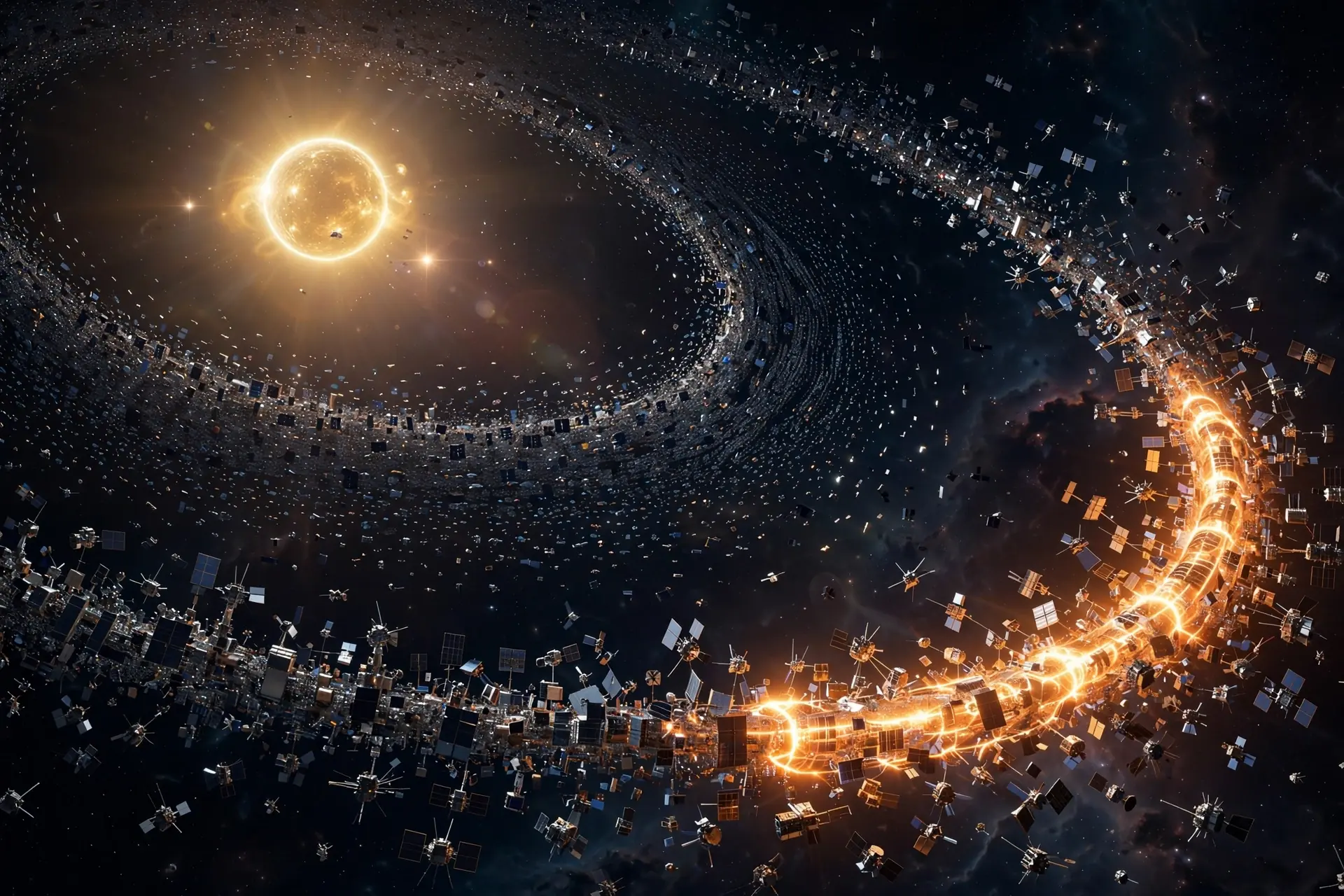
In 1960, physicist Freeman Dyson published a two-page paper with a radical idea: a civilization far older than ours might harvest the entire energy output of its star by surrounding it with orbiting collectors — a Dyson sphere, or more realistically, a vast Dyson swarm. Such a structure would betray itself not by light, but by heat: starlight captured and re-radiated as infrared glow. Dyson’s paper was, in effect, the first instruction manual for hunting alien megastructures.
- Dyson swarm: millions of independent collectors — the physically realistic version
- Dyson shell: a solid sphere — almost certainly impossible to build or stabilize
- Dyson bubble: lightweight statites held up by radiation pressure alone
- What to look for: stars dim in visible light but glow too bright in infrared
The star that dimmed
The hunt’s most famous moment came in 2015, when astronomers studying data from NASA’s Kepler space telescope noticed KIC 8462852 — Tabby’s Star — dimming erratically by up to 22 percent, in patterns no planet could produce. Megastructure speculation exploded. Follow-up observations told a more mundane story: later dimming events were stronger in blue light than red — the signature of dust, not solid objects. The leading explanation today is clumps of dust orbiting the star. But the episode proved something important: our telescopes are now good enough that a real Dyson swarm under construction would be hard to miss.
Seven new candidates
In 2024, Project Hephaistos combed millions of stars — cross-matching Gaia, 2MASS, and WISE data — for the infrared excess a partial Dyson sphere would produce, and surfaced seven small red dwarf stars (M-dwarfs) with unexplained extra heat. The authors were careful: natural explanations like warm debris disks or background galaxies contaminating the measurements remain likely, and each candidate needs follow-up. Still, it was the first systematic trawl of its kind, with explicit criteria and a follow-up list — the beginning of a catalog, not the end of a mystery.
“The universe is a pretty big place. If it’s just us, seems like an awful waste of space.”
Why we keep looking
No confirmed technosignature — no sign of alien technology — exists, not in infrared, not in the Breakthrough Listen radio search. But the search has barely begun: we have examined a tiny fraction of stars with the sensitivity a real megastructure hunt requires. Whether the answer is swarms around distant suns or silence, the hunt is forcing us to survey the sky more carefully than ever. If someone out there is building big, the waste heat will give them away eventually.
The Kardashev ladder
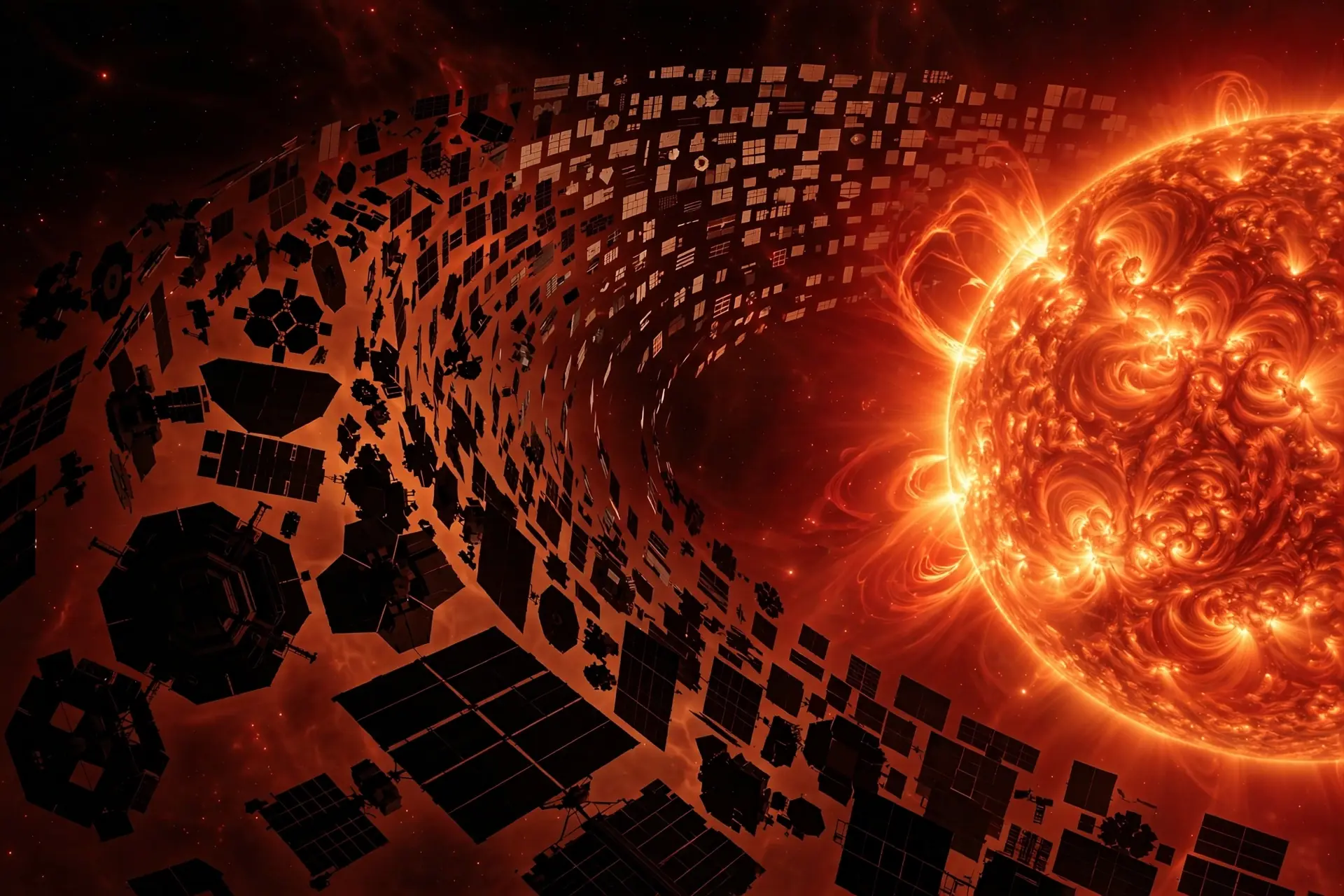
Dyson’s 1960 paper was not really about aliens — it was about thermodynamics. Any civilization with growing energy needs eventually outgrows its planet, and the star is the obvious next power source. Nikolai Kardashev formalized the ladder: a Type I civilization commands its planet’s energy, Type II its star’s, Type III its galaxy’s. Humanity is not yet Type I. A Dyson swarm is simply what Type II looks like from far away: not a monument, but infrastructure, glowing in the infrared with the unavoidable heat of industry.
How we’d actually confirm one
A candidate becomes a discovery only by surviving elimination. Spectra can rule out debris disks (which have telltale silicate features); high-resolution imaging can rule out background confusion; long-term monitoring can check whether the dimming looks engineered or dusty. And the bar is deliberately extreme, because the claim would be the biggest in history. Dyson himself would have approved of the skepticism — he proposed the search as physics, not faith. The waste heat of a true Type II civilization cannot hide forever. We just have to keep looking, carefully, and let the infrared speak.
What a swarm would actually look like
Forget the solid shell — no known material could withstand the stresses, and it would be gravitationally unstable anyway. The realistic version is a swarm: millions of independent collectors, each orbiting the star, built by self-replicating factories that first disassemble a Mercury-size planet for raw material. Construction would take centuries to millennia, but the logic is exponential: the first collectors power the factories that build the next ten thousand. From afar, the star would look normal in visible light but glow too brightly in the mid-infrared — a point source radiating the waste heat of industry at a few hundred kelvin — roughly room temperature to oven-hot.
The silence so far
Here is the sobering part. NASA’s WISE infrared space telescope gave us the data to check, and a survey of 100,000 galaxies (astronomers call it the Ĝ “G-HAT” survey) found no obvious Type II or Type III civilizations — no galaxy glowing with the waste heat of total stellar exploitation. Either megastructures are rarer than optimists hoped, or advanced civilizations do not expand the way we assume, or they hide their heat with frightening efficiency. The null result is itself a discovery: it bounds how common galaxy-spanning industry can be. The search continues because the alternative — that nobody ever builds big — would be almost as strange as finding one.