Cosmic Mysteries
Fast Radio Burst Repeats Every 16 Days, Stumping Astronomers
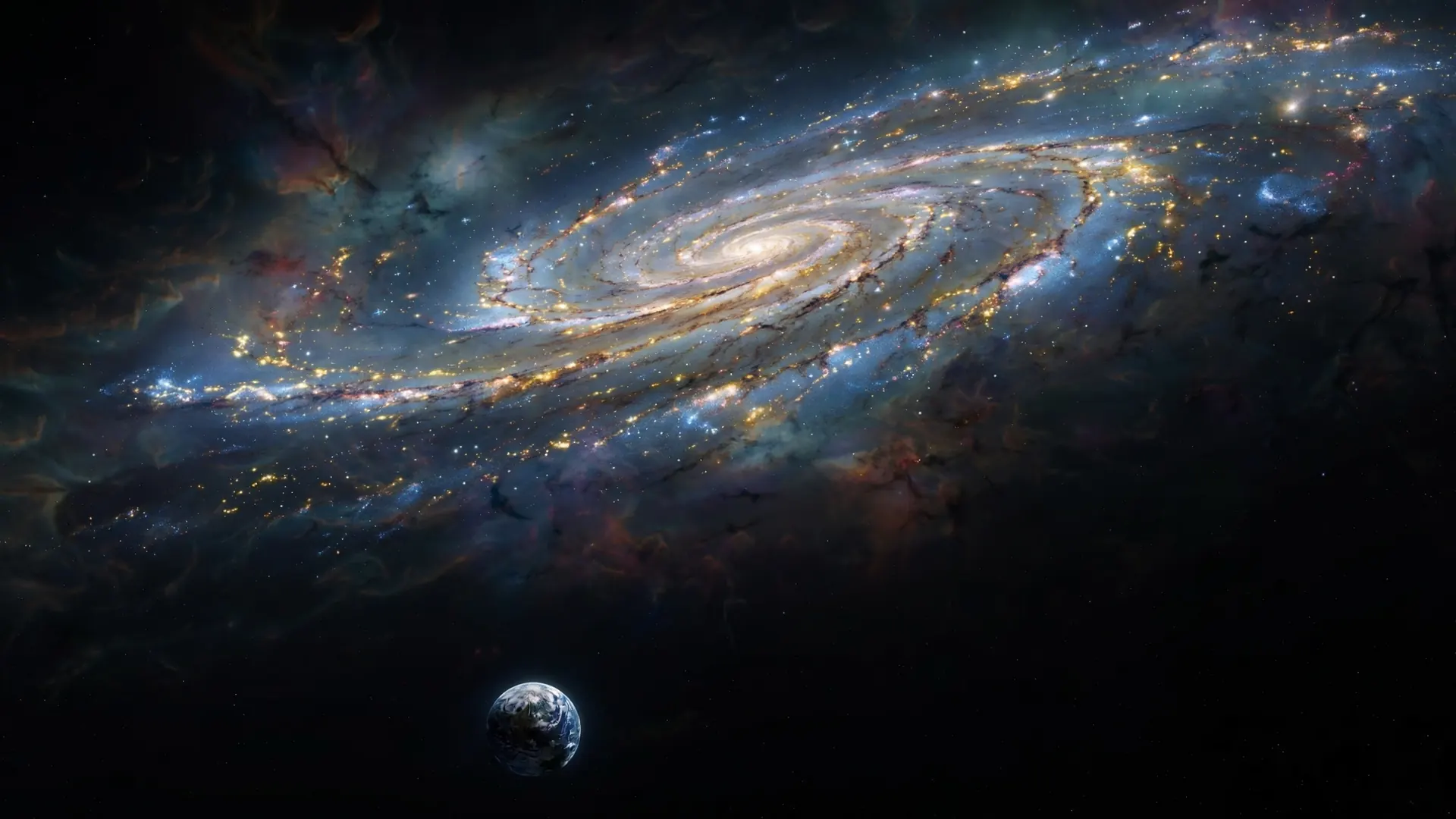
FRB 20180916B keeps firing on schedule from a spiral galaxy 500 million light-years away. New data rules out the simplest explanations.
Fast radio bursts are millisecond flashes that release as much energy as the Sun does in days. Most fire once and vanish. FRB 20180916B is different: it fires for four days, goes silent for twelve, and then starts again, with metronome-like regularity.
Leading suspects
- A magnetar — a neutron star with a magnetic field trillions of times stronger than Earth’s — orbiting a massive companion star
- A slowly precessing magnetar whose beam sweeps past Earth
- An ultra-slow rotating neutron star, unlike any seen before
Simultaneous observations at low and high frequencies show the bursts arrive at different phases of the cycle, a "chromatic" pattern that challenges every one of these models.
A cosmic metronome
The 16.35-day cycle was discovered in 2020 in archival data from CHIME, the Canadian radio telescope: roughly four days of activity followed by twelve days of silence, repeating like clockwork. Pinpointing the source placed it in a star-forming region of a nearby spiral galaxy — a very different neighborhood from the first known repeater, FRB 20121102A, which lives in a tiny dwarf galaxy. Whatever makes repeaters, it can happen in ordinary galactic environments.
The chromatic clue
Here is the detail that breaks models. When LOFAR, a European radio telescope array, caught bursts at very low frequencies, they arrived systematically later in the 16-day cycle than the higher-frequency CHIME bursts — as if the source’s beam sweeps across our line of sight at different times for different colors of radio light. A simple binary orbit does not predict this. A precessing magnetar, wobbling like a top so its beam sweeps past Earth, can produce periodicity but struggles with the chromatic offset. An ultra-slow rotating neutron star is exotic enough to be interesting and unconstrained enough to be suspicious.
The leading composite picture pairs a magnetar with a massive, rapidly spinning Be-type star (a hot star with a disk of gas around its equator): the companion’s wind creates a curved, frequency-dependent screen, so different radio colors escape at different orbital phases. It is clever, it nearly fits, and the leftover discrepancies still nag. That is the sign of a mystery worth keeping.
Why it matters
FRBs are more than curiosities. Each burst’s dispersion — the smearing of its frequencies by intervening electrons — counts the ordinary matter — baryons, the protons and neutrons — between us and the source, making FRBs unique probes of the universe’s missing ordinary matter. And the repeater versus one-off divide may be telling us there are two entirely different engines. Every new 16-day cycle is another experiment; with CHIME and LOFAR watching each one, the metronome will eventually give up its secret.