Cosmic Mysteries
Are Europa’s Water Plumes Real? Clipper Is Built to Find Out
Hubble glimpsed geysers on Jupiter’s icy moon, then lost them. Europa Clipper’s instruments are now calibrated to catch one in the act.
Beneath the ice of Europa, Jupiter’s moon, lies an ocean with twice the water of all Earth’s seas. If plumes really vent that ocean into space, a spacecraft could sample it without ever landing.
- Hubble plume detections in 2012 and 2016 never confirmed
- Galileo magnetometer data hints at a 2,000 km-tall eruption in 1997
- Europa Clipper’s MASPEX mass spectrometer can "taste" plume gas during close flybys
“Either Europa is spraying its ocean into space, or we’ve been fooled by noise. Both answers teach us something.”
An ocean with no sunlight
Beneath Europa’s fractured ice lies an ocean estimated at 100 kilometers deep — roughly twice the water of all Earth’s seas combined. It stays liquid not from sunlight but from tidal flexing: Jupiter’s gravity kneads the moon on every 3.5-day orbit, and the friction becomes heat. Where that warm water meets the rocky seafloor, chemistry happens — the same water-rock reactions that power Earth’s deep-sea vent ecosystems, which thrive with no sunlight at all.
The plume saga
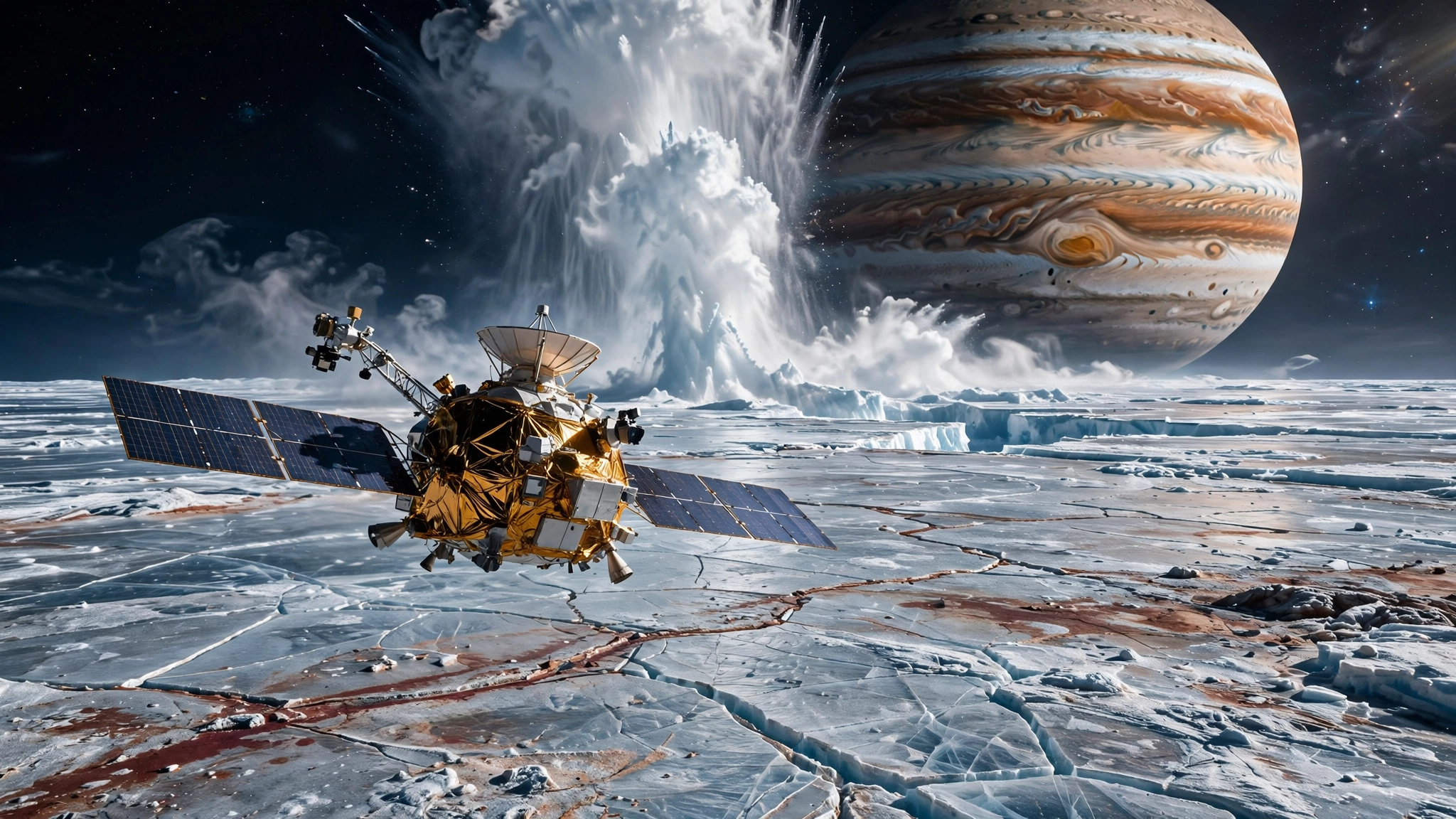
The plume story is a detective novel with conflicting witnesses. Hubble reported ultraviolet hints of 200-kilometer geysers in 2012 and again in 2016, but follow-up observations saw nothing. Then, in 2018, researchers re-examined magnetometer data from NASA’s Galileo spacecraft from a 1997 flyby and found a brief magnetic kink consistent with the spacecraft flying through a 2,000-kilometer plume. Skeptics counter that every detection sits barely above the background noise, and Europa has a talent for false alarms. The field is genuinely split.
Clipper’s plan
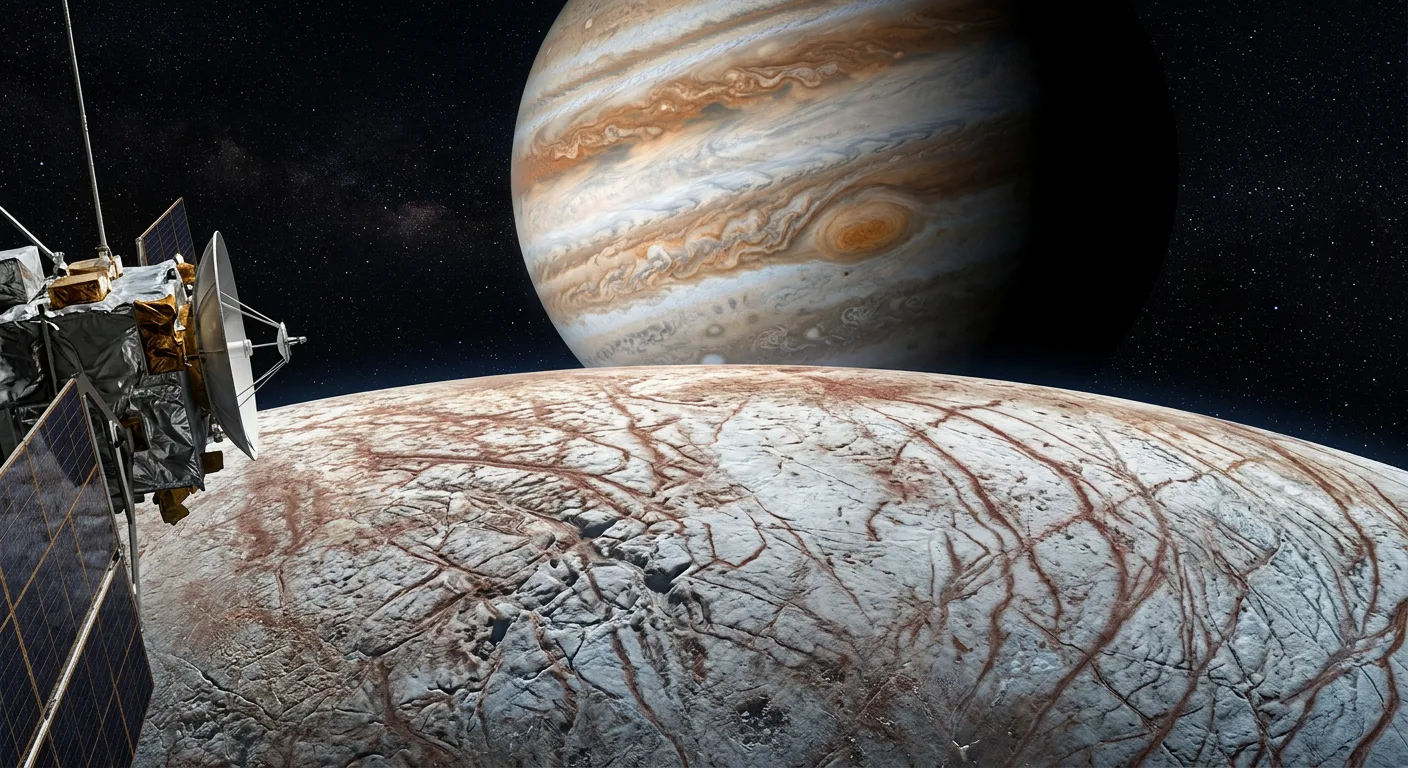
Europa Clipper, en route to arrive in 2030, was designed to settle this without needing luck. Across nearly 50 flybys it will map the ice shell with its REASON ice-penetrating radar, measure the ocean’s depth and salinity with its magnetometer, and — the elegant part — taste anything Europa exhales. MASPEX, a mass spectrometer a thousand times more sensitive than the one flown on the Cassini mission to Saturn, can analyze plume gas during a flythrough; SUDA, an instrument that catches frozen droplets, will read their chemistry grain by grain. If a plume fires during the mission, Clipper samples an alien ocean without ever touching down.
If the plumes aren’t real
A null result would still be science. Radar sounding of the ice shell, gravity mapping of the interior, and surface composition measurements will constrain the ocean’s chemistry regardless. Plumes would be easy mode — a free sample delivered to space. Without them, confirming habitability gets harder, but the ocean itself, kneaded by Jupiter for four billion years, is not going anywhere.