Interactive · Black holes
Could you survive falling into a black hole?
Pick a black hole, drag yourself closer, and find out. The answer depends on size in a way most articles never show you: small holes tear you apart, monsters let you in.
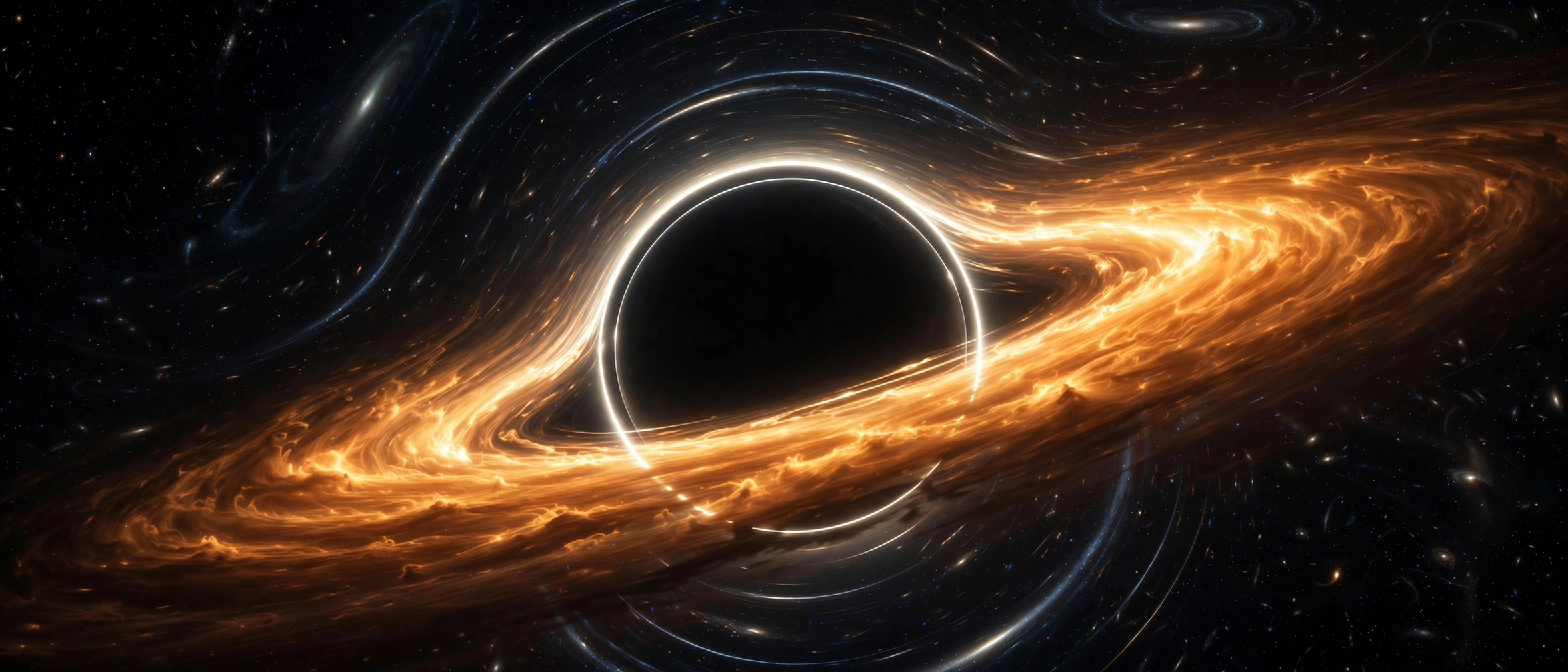
Want the full story behind the fall? What is inside a black hole and the black holes hub pick up where this tool stops.
The honest questions
Would I really survive crossing a supermassive black hole horizon?
In this idealized, non-rotating model, yes, you cross it alive: the tidal stretch at a supermassive horizon is far below anything you could feel. But crossing is still a one-way trip. No signal, ship, or light can ever get back out, and the center is still ahead of you in your future.
Why does a bigger black hole feel gentler at its horizon?
Tidal stretch at the horizon falls as the horizon radius grows: it scales as one over the radius squared. A stellar black hole packs its gravity into a city-sized horizon, so the pull changes violently across your body. A supermassive horizon is millions of kilometers across, so the pull barely changes across 1.8 meters.
Does time really stop at the horizon?
To a watcher far away, yes, in appearance: your light gets redshifted and your clock seems to crawl to a stop as you approach the horizon. On your own clock, nothing special happens at the crossing. You keep falling, and in this model you reach the center in finite time.
Are these numbers exact?
No, they are Schwarzschild estimates for a non-rotating black hole, with masses that are themselves estimates, especially for TON 618. Real black holes spin, which changes the horizon and the fall. Treat every number here as an honest order-of-magnitude, not a measurement of a real fall.