 Black Holes & Singularities
6 min read
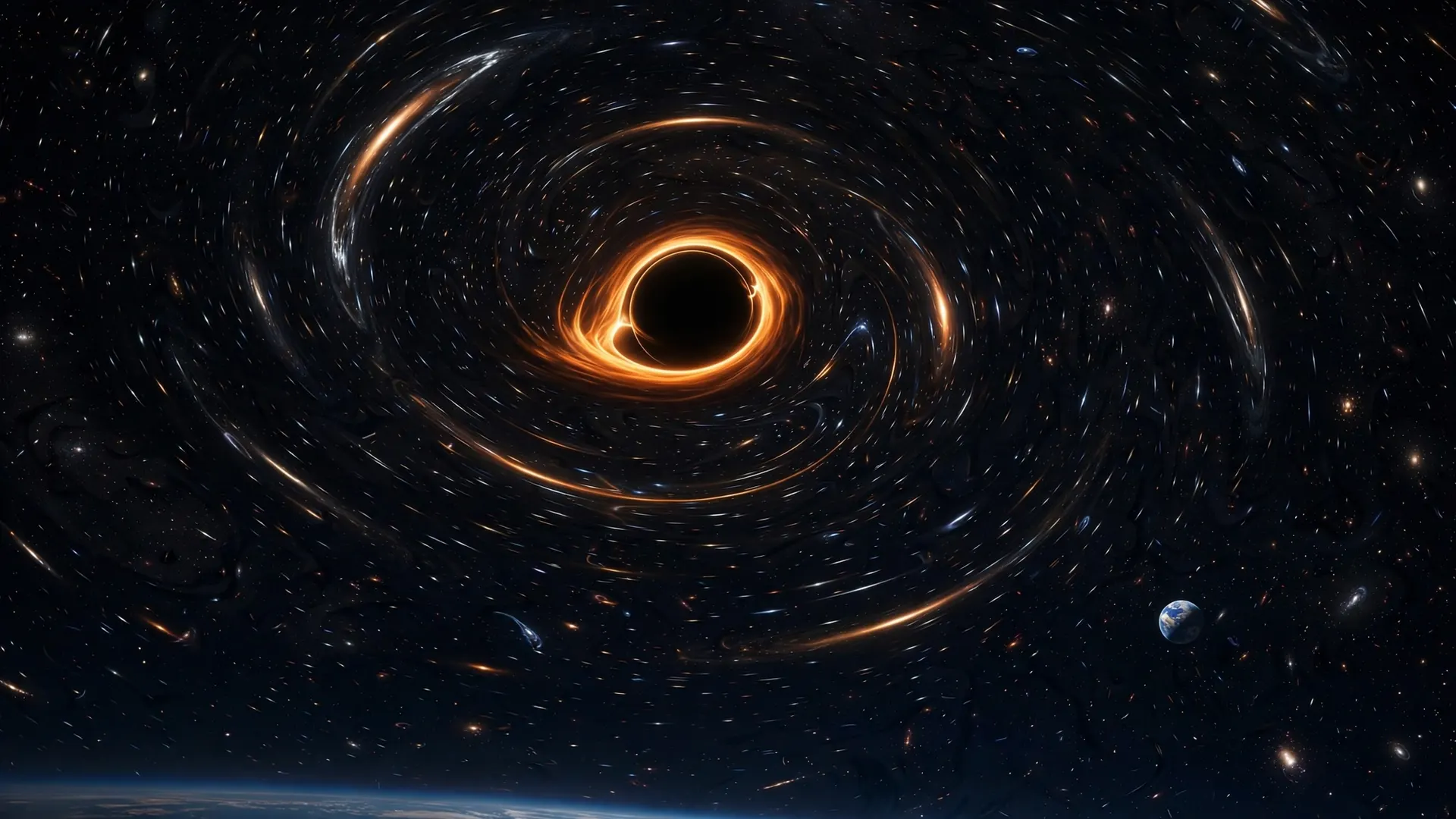
What If the Sun Became a Black Hole?
Swap the Sun for a black hole of the same mass and Earth’s orbit wouldn’t twitch — but with the light gone, our planet would freeze solid within months.
Cosmic Replay
Topic Hub
The most extreme objects in the universe — where gravity wins completely and our theories break. This hub gathers everything Cosmic Replay has published on black holes into one guided tour, from thought experiments to telescope images.
The guided journey
Each piece builds on the last — start with the thought experiment, end at the edge of current research.
Stop 1 of 5
Start here. The most fun thought experiment in astrophysics — and it quietly teaches you how orbits, mass, and the event horizon actually work.
Read “What If the Sun Became a Black Hole?”Black Holes & SingularitiesSwap the Sun for a black hole of the same mass and Earth’s orbit wouldn’t twitch — but with the light gone, our planet would freeze solid within months.
Stop 2 of 5
Now go deeper — literally. What general relativity says happens past the horizon, and where the theory breaks down into fuzzballs, firewalls, and paradoxes.
Read “What’s Inside a Black Hole? The Singularity Problem”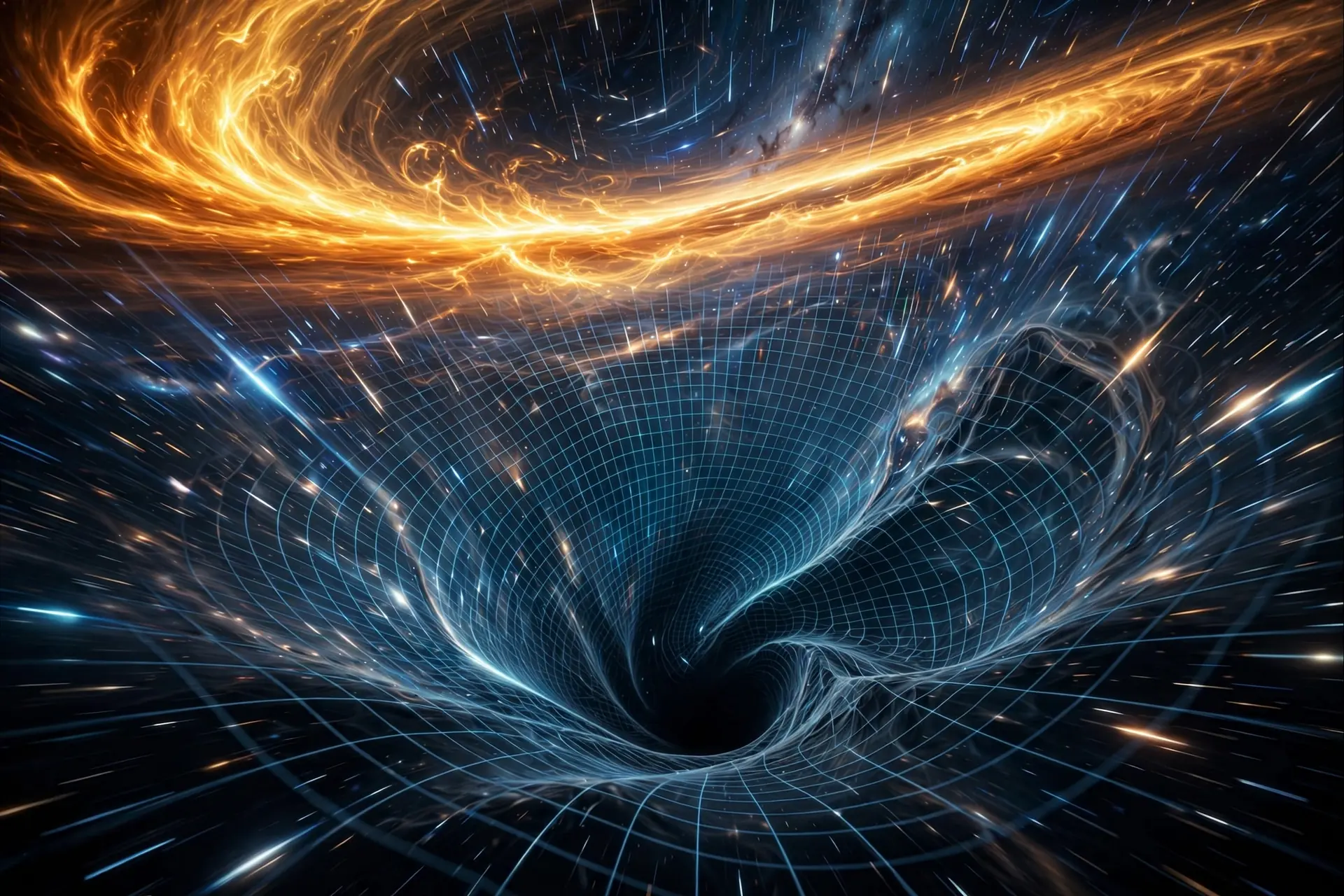 Black Holes & Singularities
Past the event horizon, our best theories collapse into contradiction. Firewalls, fuzzballs, and wormholes — a tour of physics’ most guarded secret.
Stop 3 of 5
Zoom out to the monsters: black holes billions of times the Sun's mass, ranked — including one so large astronomers argue about whether it should exist.
Read “The Biggest Black Holes in the Universe, Ranked”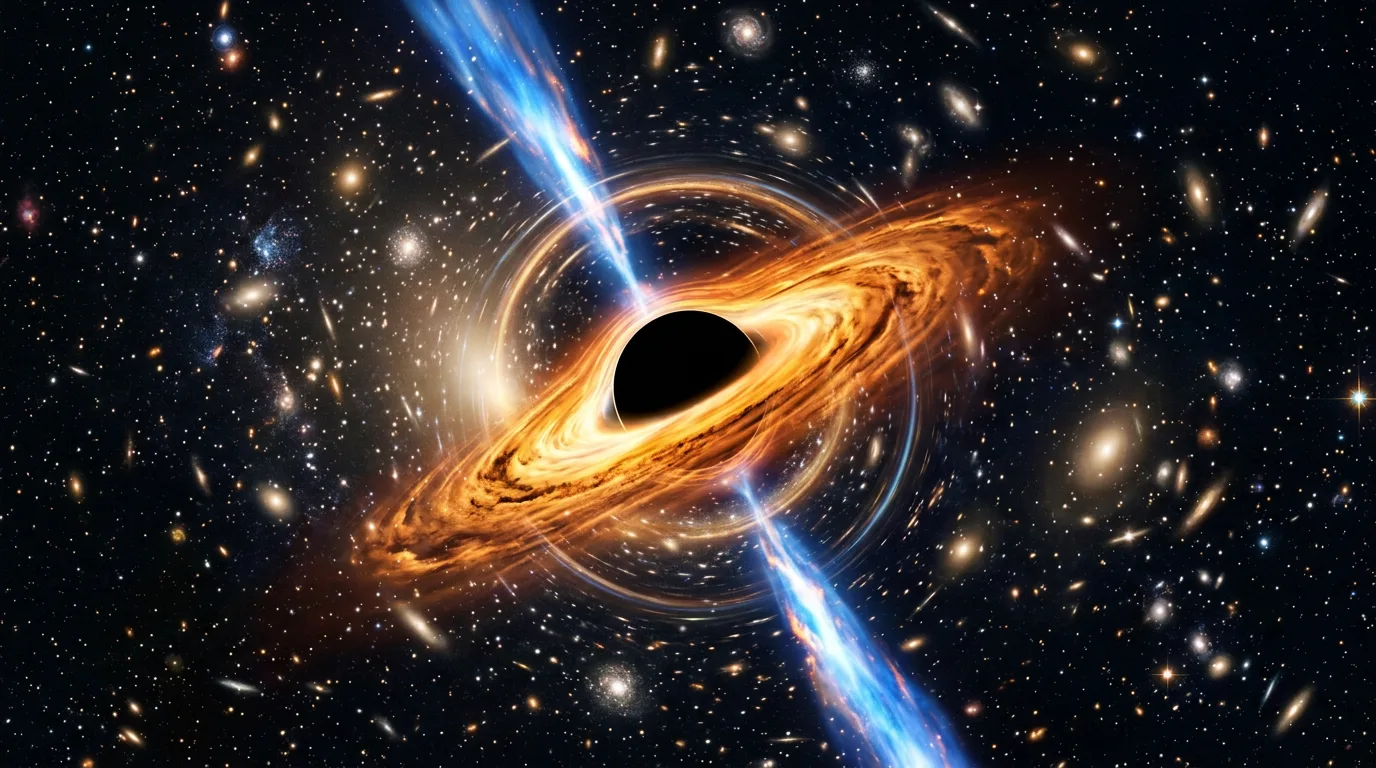 Black Holes & Singularities
From the 4-million-solar-mass heart of our galaxy to a 100-billion-solar-mass monster that strains physics itself — a tour of the heavyweight champions of the cosmos.
Stop 4 of 5
See one in action. The Event Horizon Telescope caught a blob of plasma circling our own galaxy's black hole every 70 minutes.
Read “EHT Films a Hot Spot Orbiting Sagittarius A*”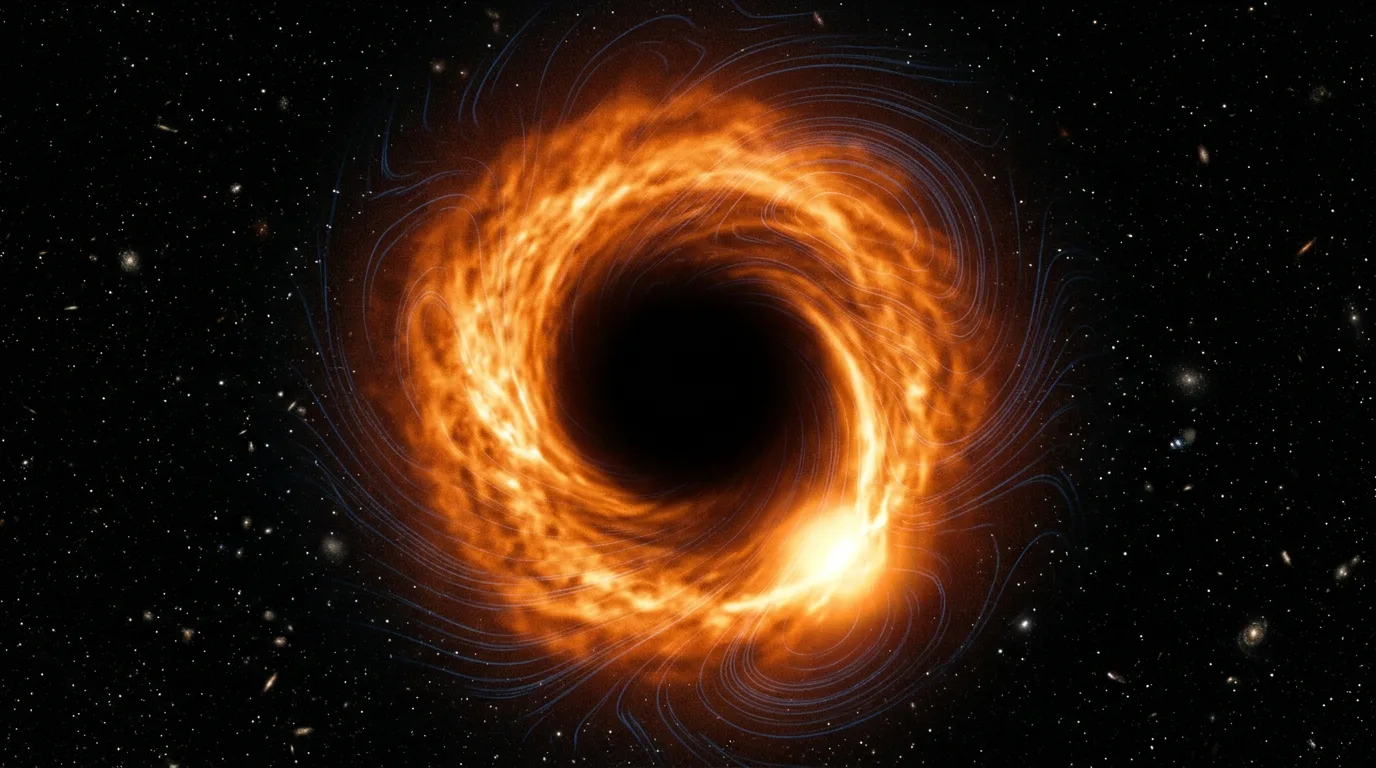 Black Holes & Singularities
A sequence of polarized images captures a blob of plasma circling our galaxy’s central black hole every 70 minutes, just outside the horizon.
Stop 5 of 5
End at the beginning: JWST found black holes that skipped stellar birth entirely — and they may rewrite how the first giants formed.
Read “JWST Spots "Naked" Black Hole Seeds That Skipped Stellar Birth”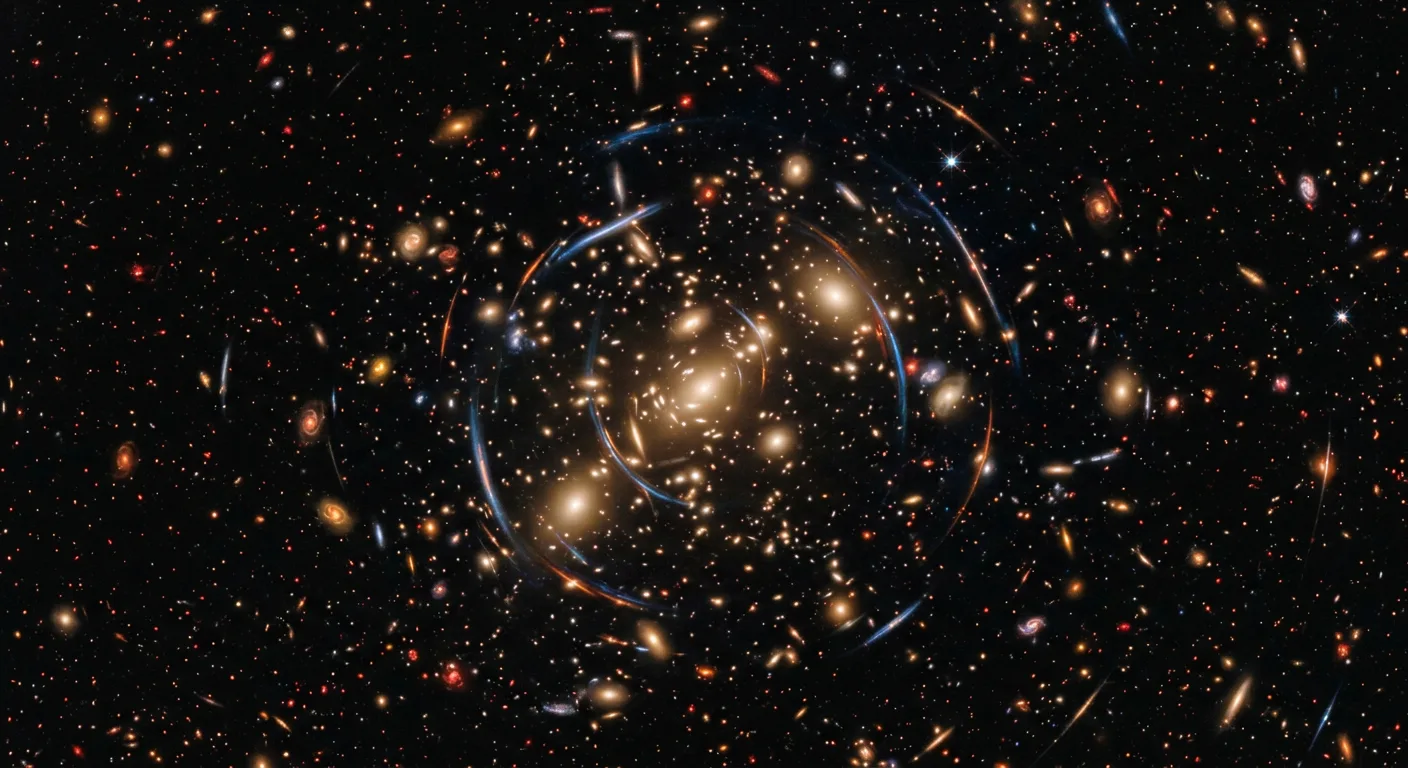 Black Holes & Singularities
Several galaxies at redshift 10+ host black holes far too heavy for their stars, supporting the theory that some formed directly from collapsing gas clouds.
The overview
A black hole is what remains when matter collapses past the point of no return. Squeeze enough mass into a small enough volume and the escape velocity — the speed you would need to climb out of its gravity — exceeds the speed of light. Since nothing in the universe outruns light, the boundary where this happens, called the event horizon, is a one-way door. Anything that crosses it can never come back, not even information about what it was.
Black holes come in (at least) three sizes. Stellar-mass black holes, a few to a few dozen times the Sun's mass, form when massive stars die. Supermassive black holes, millions to billions of solar masses, sit at the centers of galaxies — including our own Sagittarius A*, 4.3 million solar masses. In between, intermediate-mass black holes are the missing link astronomers are still hunting. How the supermassive ones grew so large so early remains one of the biggest open questions in astrophysics — and new JWST observations of "naked" black hole seeds are rewriting the theories.
We cannot see black holes directly — no light escapes — but we see their fingerprints everywhere: stars whipping around invisible masses, accretion disks glowing white-hot in X-rays as matter spirals inward, gravitational waves rippling outward when two of them merge, and now, direct images. The Event Horizon Telescope's portraits of M87* and Sagittarius A* show the shadow of the event horizon ringed by lensed light, and follow-up movies are beginning to capture plasma orbiting just outside the edge.
Why do they matter so much? Because a black hole is where our two great theories of physics — general relativity and quantum mechanics — collide head-on. The information paradox asks whether information destroyed in a black hole is truly lost, which would break quantum mechanics. Proposed resolutions range from fuzzballs (no interior at all, just a tangled surface of strings) to firewalls of high-energy particles at the horizon. Whoever resolves it will likely hand us the first real theory of quantum gravity.
The features below take you from the gentlest possible introduction to the research frontier. Start at stop one — no physics background required.
Quick answers
A region of space where matter has collapsed so densely that the escape velocity — the speed needed to leave — exceeds the speed of light. Since nothing outruns light, nothing that crosses the boundary, called the event horizon, can ever come back out. It is not a cosmic vacuum cleaner, though: far away, a black hole's gravity behaves exactly like any other mass.
Tidal forces stretch you lengthwise and squeeze you sideways — physicists call it spaghettification. For a stellar-mass black hole this happens before you even reach the horizon. For a supermassive one, you could cross the horizon intact, but the singularity at the center, where our equations break down, is unavoidable from there.
The closest known is Gaia BH1, about 1,560 light-years away — a dormant stellar-mass black hole found by the wobble it induces in its companion star. Our galaxy's central supermassive black hole, Sagittarius A*, is about 26,000 light-years away and poses no danger to us.
Stephen Hawking showed they slowly evaporate by emitting Hawking radiation — but for any real black hole this takes vastly longer than the current age of the universe. The smallest ones evaporate fastest; a solar-mass black hole would need around 10^67 years.
Phoenix A, at the heart of a galaxy cluster about 5.8 billion light-years away, weighs an estimated 100 billion Suns. Our ranked feature walks through the full leaderboard — and the measurement controversies behind it.
Speak the language
Want everything, unfiltered? Browse all black hole stories