Black Holes & Singularities
What If the Sun Became a Black Hole?
Swap the Sun for a black hole of the same mass and Earth’s orbit wouldn’t twitch — but with the light gone, our planet would freeze solid within months.
Imagine waking up tomorrow and the Sun is gone. Not exploded, not dimmed — replaced overnight by a black hole with exactly the same mass. Your first instinct is probably terror: Earth gets ripped from its orbit and swallowed screaming into the dark. Here is the twist physicists love to spring on people: almost nothing about Earth’s motion would change. Our orbit would carry on as if nothing had happened. The catastrophe wouldn’t come from gravity at all. It would come from the dark.
The surprise: your orbit wouldn’t twitch
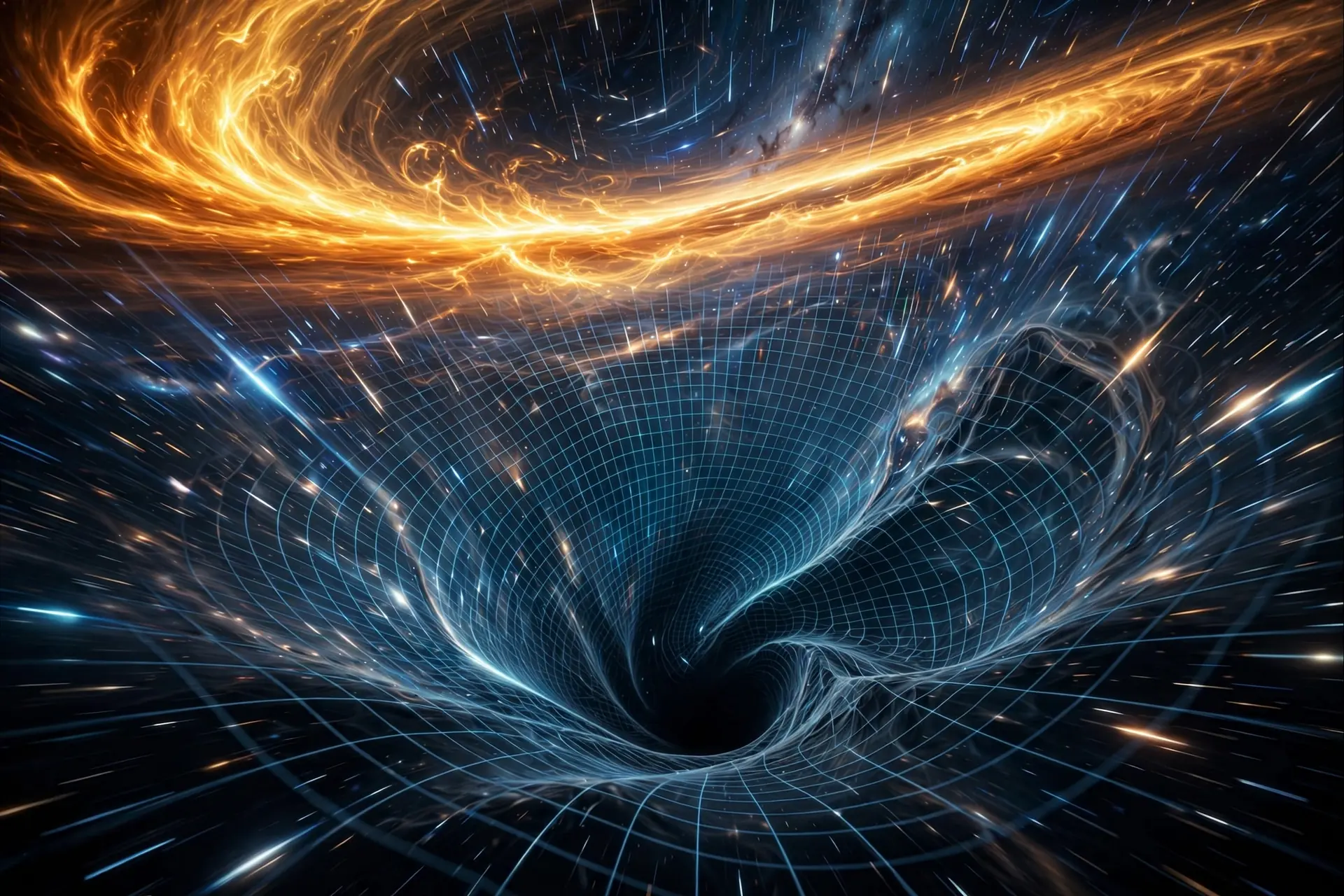
Gravity doesn’t care what an object looks like — only how much mass it has and how far away you are. Outside a spherical mass, the gravitational field is identical whether that mass is a star, a planet, or a black hole; Einstein’s general relativity guarantees it, and Newton’s law agrees. Swap the Sun — 1.989 × 10³⁰ kilograms — for a black hole of the same mass, and at Earth’s distance of 150 million kilometers, the pull is exactly what it was yesterday.
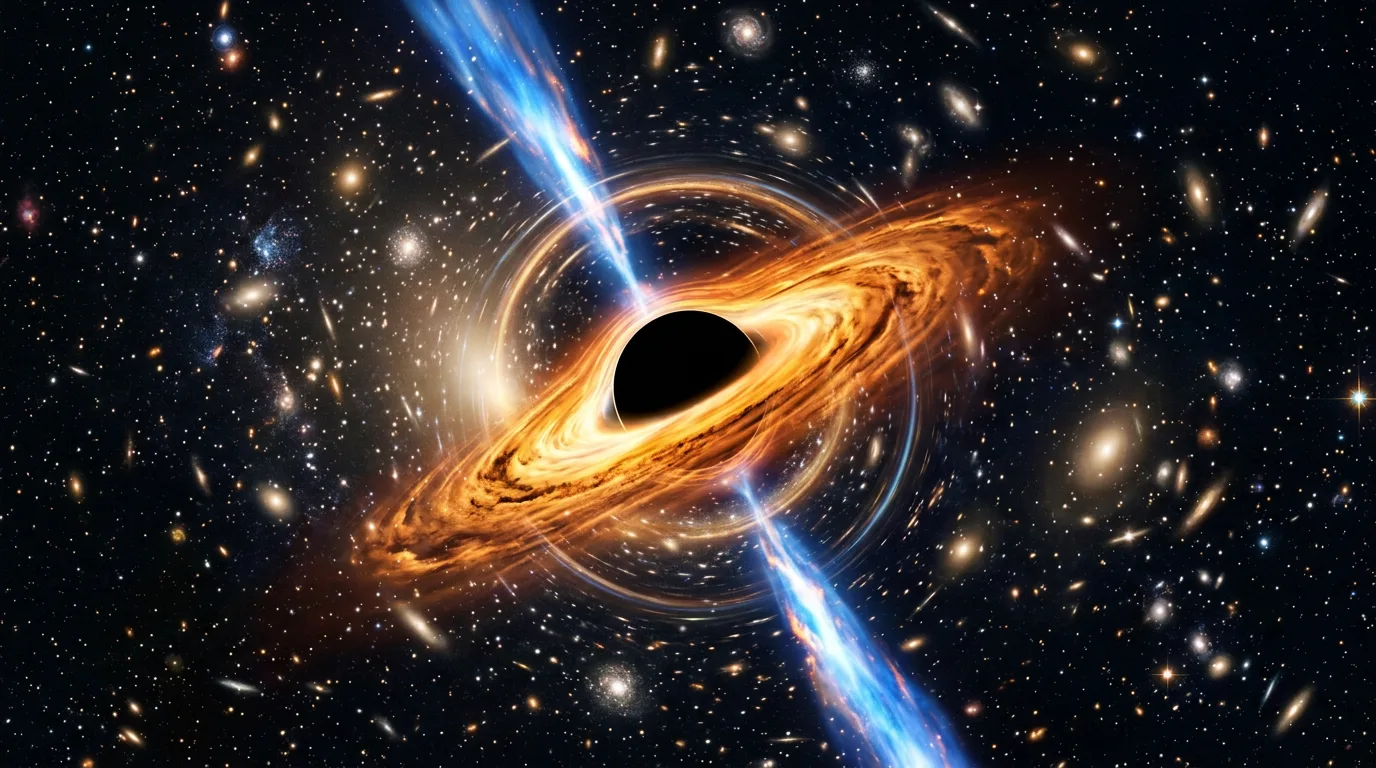
The black hole itself would be absurdly small. A one-solar-mass black hole has an event horizon — the Schwarzschild radius — of just 2.95 kilometers, about the length of a morning jog. The Sun, by contrast, is 1.4 million kilometers across. All that mass squeezed into something smaller than a city neighborhood. From Earth, the most massive object in our daily lives would become utterly invisible: a six-kilometer-wide patch of nothing, 150 million kilometers away, betrayed only by the way its gravity bends the light of distant stars behind it.
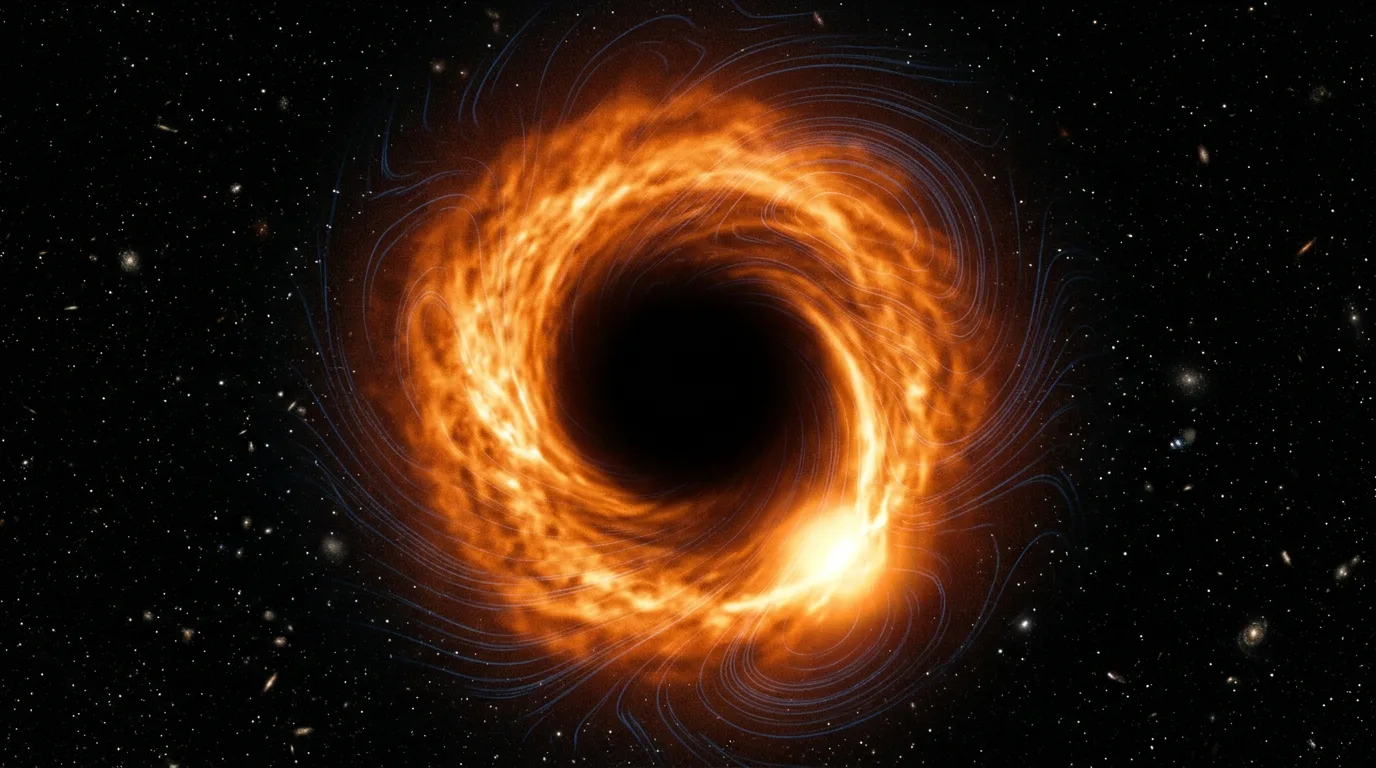
So no — Earth would not be “sucked in.” That’s the myth this whole scenario exists to demolish: black holes don’t suck. Objects orbit black holes the same way they orbit anything else. For Earth to fall in, it would have to shed nearly all of its orbital velocity — some 30 kilometers per second — and nothing in this scenario slows it down. The planets would keep circling the dark on the same stately schedule, year after year. Astronomers have watched matter orbit a real black hole the same obedient way.
“Black holes don’t suck. Objects orbit black holes the same way they orbit anything else.”
The real killer: eight more minutes of light
What would actually end the world is the light switch. Sunlight takes about 8 minutes and 20 seconds to reach Earth, so for eight minutes after the swap nothing would seem wrong — the sky still blue, your coffee still warm in the morning sun. Then the last photons would arrive, and noon would turn to midnight. Permanently.
A black hole emits no light of its own. (Strictly speaking it glows with Hawking radiation — but for a solar-mass black hole that glow is a feeble 60 nano-kelvin, colder than deep space, and the hole would need some 10⁶⁷ years to evaporate. Utterly irrelevant on any timescale that matters.)
Robbed of sunlight, Earth’s surface would start hemorrhaging heat into space. Within days to a couple of weeks, average temperatures would fall below freezing everywhere on the planet. Photosynthesis — the foundation of nearly every food chain — would halt within days of permanent night. There would be no next harvest, because there would be no next day.
A timeline of the freeze
The first hour: confusion. Power grids hold, the internet buzzes with footage of the last sunset. Somewhere, someone points a telescope at the Sun’s coordinates and finds only stars — plus one star too many, bent out of shape where the Sun used to be.
The first week: the cold arrives. Frost in the tropics. Heating systems strain and fail in regions never built for winter. Crops die in the fields.
The first month: the oceans begin to skin over. Sea ice spreads from the poles toward the equator, and the great thermal battery of the planet starts running down. Global shipping, already battered, grinds to a halt in frozen harbors.
The first year: the surface is an iceball. And then the atmosphere itself starts to die — with temperatures plunging toward roughly −240°C, all that Earth’s own internal heat can sustain, nitrogen and oxygen begin to snow out of the sky. The air thins until the stars shine undimmed at noon. Earth becomes a frozen rock wrapped in darkness.
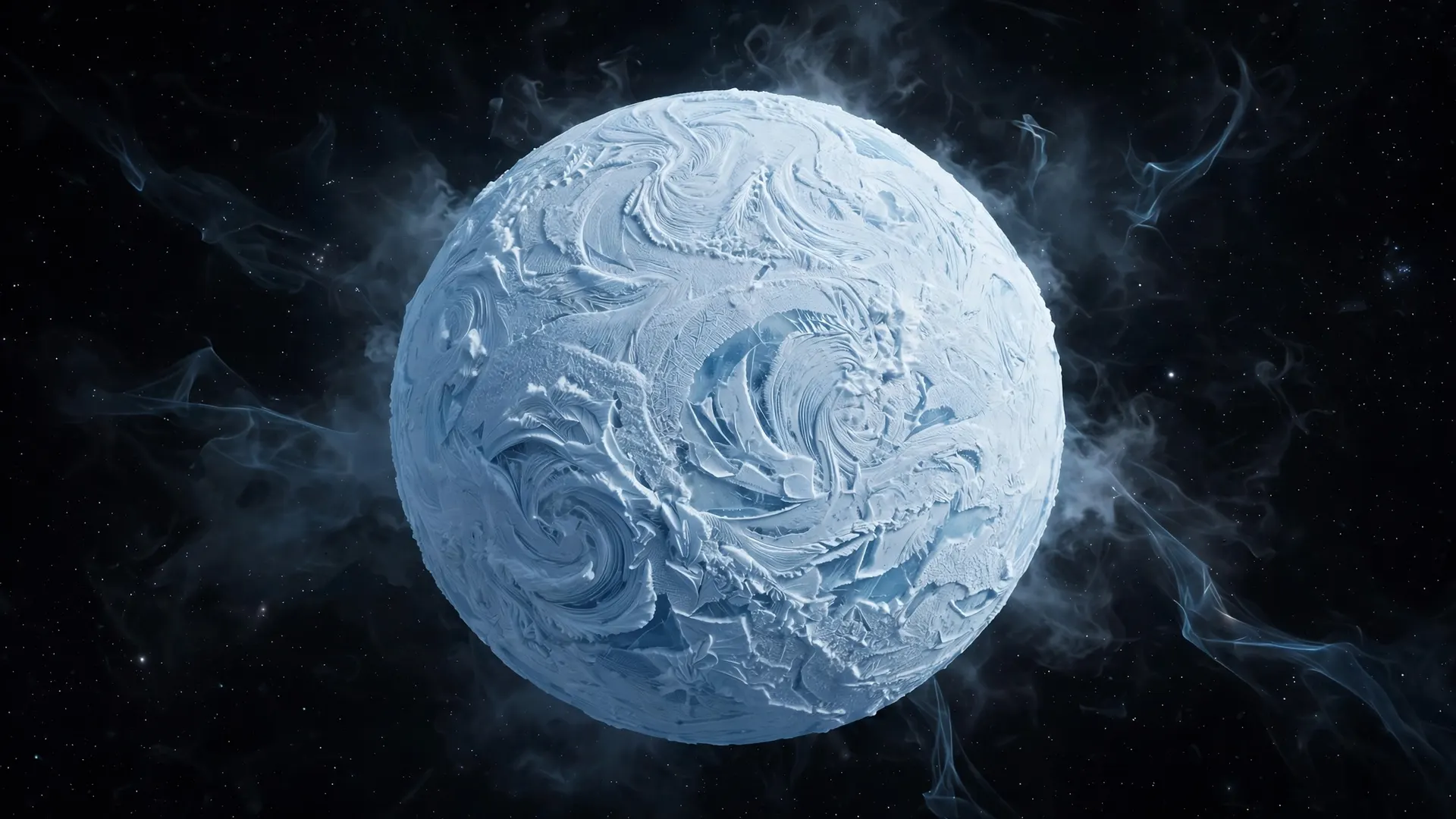
The view from the dark
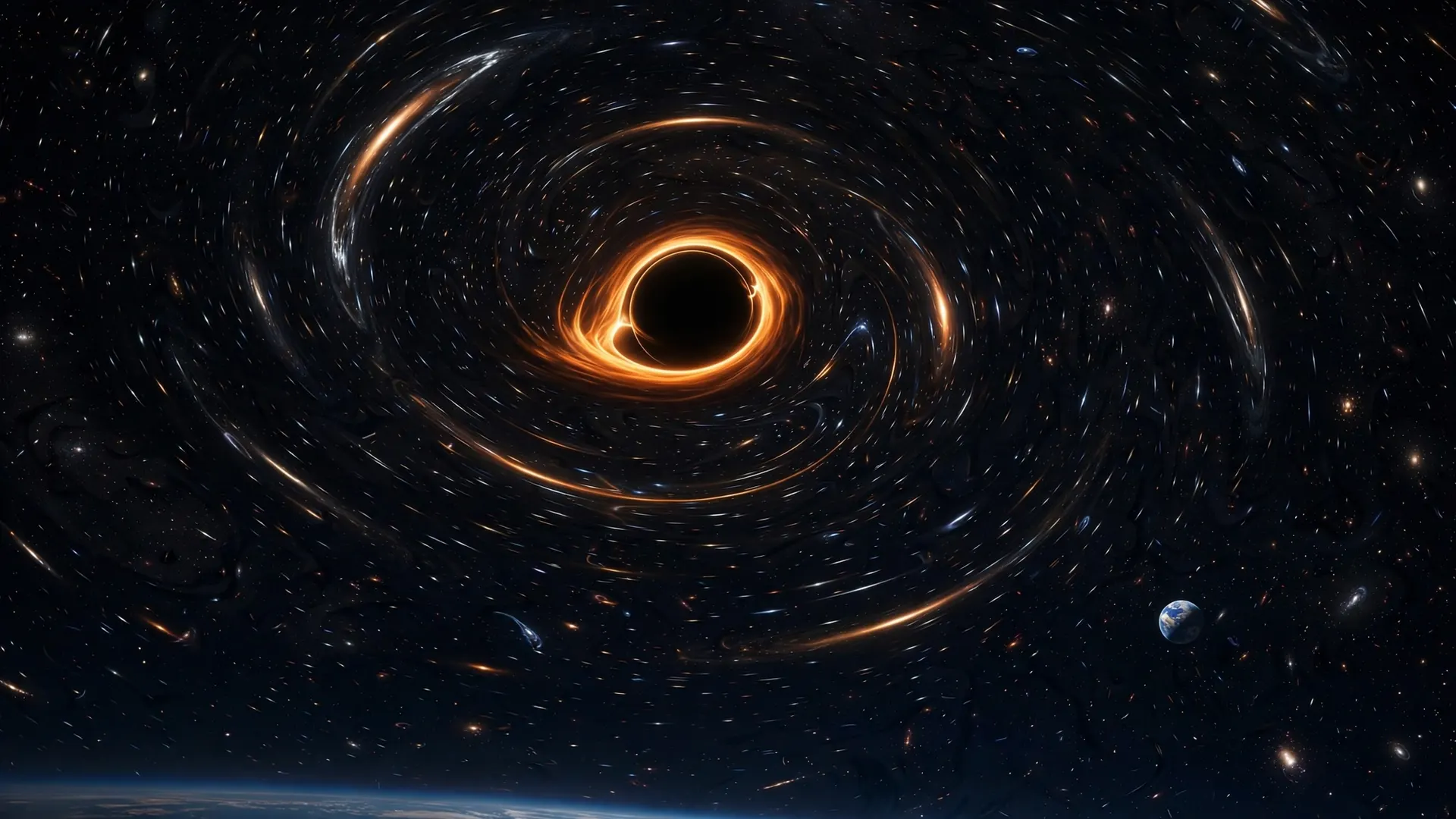
There is a strange beauty in it. With no sun and no moonlit sky — the Moon would be dark too, lit by nothing — the night would be absolute, and the stars would blaze at midday with a clarity no human has ever seen. The Milky Way would arch overhead at noon. And where the Sun used to be, there would be nothing at all: no glow, no corona, just a tiny knot of bent starlight marking a six-kilometer absence.
The Moon, incidentally, would keep circling exactly as before — same mass, same gravity, same tides, now invisible. The solar wind would vanish, the heliosphere would collapse, and interstellar cosmic rays would wash through the solar system unimpeded. Comets would lose their tails. The whole system would keep running perfectly, in the dark.
Could anything survive?
Probably — just nothing like us. Earth’s interior stays hot from radioactive decay, and that warmth will last for billions of years. Entire ecosystems around deep-sea hydrothermal vents have never seen sunlight and would barely notice the apocalypse. Microbes kilometers underground would carry on as if nothing had happened. Life, it turns out, is harder to kill than civilization.
And here’s a lovely irony: Europa wouldn’t even notice. The hidden ocean beneath its ice is kept liquid by the kneading tides of Jupiter’s gravity, not by sunlight — so while Earth froze, that alien sea would keep sloshing in the dark, as it always has. We’ve been wondering what’s down there for years.
Humans would face a starker equation: sealed habitats, artificial light for crops, power from nuclear fission or geothermal wells — the ultimate bunker civilization. Technically conceivable; civilizationally shattering. Everything we are is a solar-powered phenomenon, and we would learn that the hard way.
The honest footnote: this can’t actually happen
The scenario needs one piece of fine print: the Sun cannot become a black hole. It simply isn’t massive enough. Only stars born with around twenty times the Sun’s mass can collapse into black holes; our star will end its life far more quietly, swelling into a red giant before settling down as a white dwarf — a cooling ember about the size of Earth. Our thought experiment requires a wizard with a cosmic trash compactor.
The lesson: black holes don’t suck
Which is exactly why physicists love this question. It demolishes the most stubborn myth in astronomy — the black hole as a ravenous monster dragging in everything around it. It isn’t. It’s just mass, doing what mass does. From far away, a black hole is indistinguishable from anything else that weighs the same. The largest ones we’ve found are terrifying not because they’re hungry, but because they’re heavy.
And if you ever did fall toward one, the story would be very different — crossing the event horizon is a one-way trip into physics we don’t yet understand. But Earth isn’t taking that trip. We’re staying right here, 150 million kilometers out, circling a darkness where the Sun used to be.
The Sun gives us two things: gravity and light. We always feared losing the first. It’s the second we can’t live without.