Interactive
Where are the planets right now?
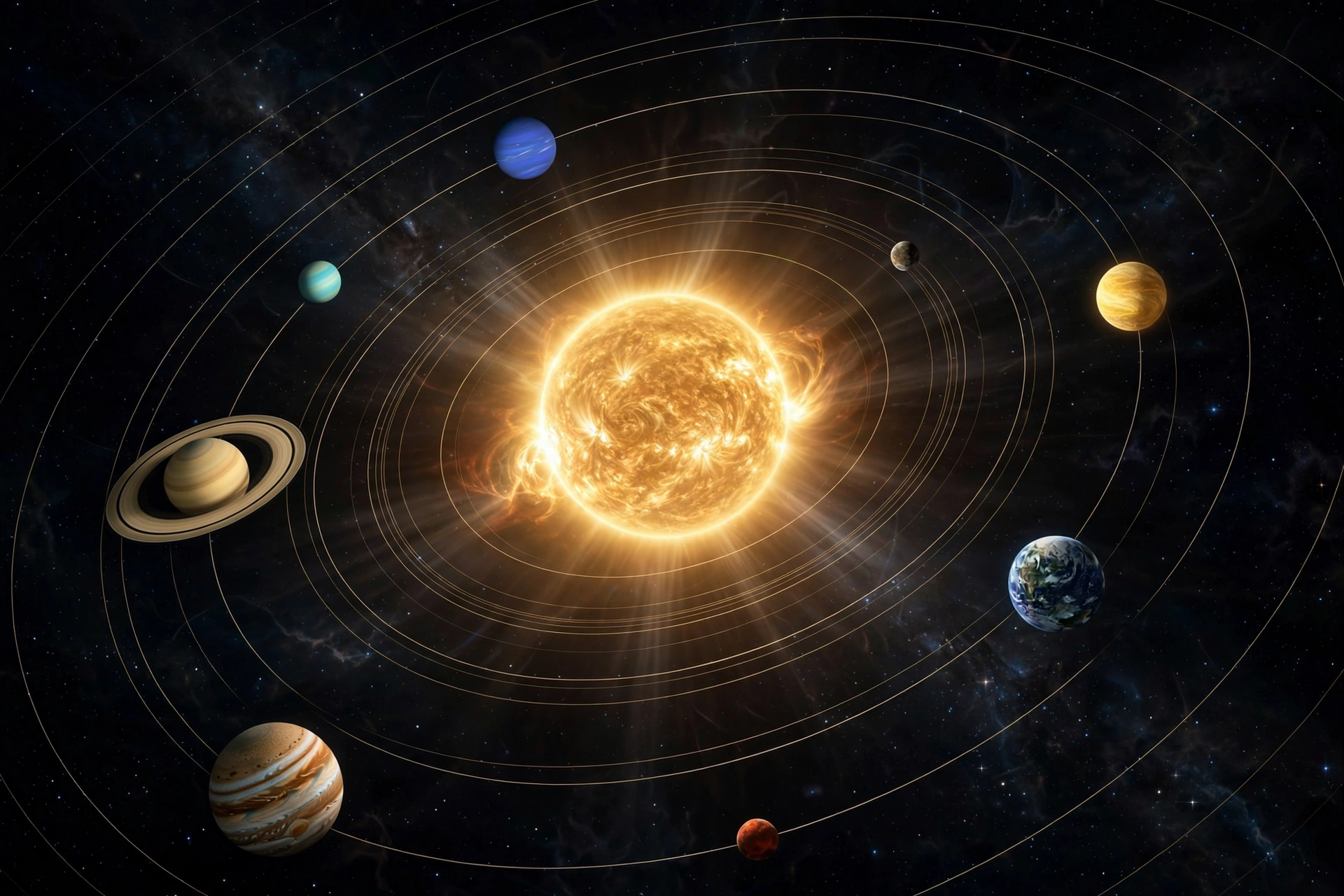
Not in a neat line, and not where any textbook diagram left them. The view below draws the real solar system from real positions at this very moment, and lets you run time forward to watch it turn. Flip to true scale to see how much emptiness the diagrams hide, or switch to your solar system and rebuild the whole thing with your own suns and planets, then watch gravity decide whether it survives.
Computing the solar system…
Want the travel version of these distances? The Space Travel Calculator turns them into trip times for real and imagined engines, and Signal Time shows how long a radio hello takes to cross them.
Under the hood
Two views, one system, and an honest toy
Our solar system never guesses. Every frame is recomputed from the site’s astronomy engine, JPL Keplerian orbital elements evaluated for the simulated date on screen, so running time forward a year shows you the real configuration a year from now, not a physics approximation of it. The standard view squeezes Neptune’s orbit onto one screen with a gentle distance compression so the inner planets stay readable; the true-scale view removes the squeeze and shows the proportions as they are.
Your solar system is a toy gravity model, and we say so plainly: a simplified two-dimensional simulation that pulls every body toward every other with Newton’s gravity, stepped in half-day increments. It starts from today’s real positions and is faithful enough that the untouched system holds together for centuries of simulated time. Move a planet, add a sun, delete Jupiter, and it will show you stability and chaos the way the real universe deals them out, just faster and with the rough edges of a toy. For exact positions, trust the first view; for intuition, play with the second.
Nothing about your visit is collected: shared systems travel inside their links, and everything else runs entirely in your browser.
Sources
- Standish, E. M., JPL: “Keplerian Elements for Approximate Positions of the Major Planets”: the orbital elements the live view runs on.
- NASA planetary fact sheets: the masses, radii, and orbit sizes used for every body in both views.
- Lagrange, J.-L. (1772), and the modern literature on hierarchical triple systems: the nested arrangement the Three Suns preset is built on, the shape real three-star systems like Alpha Centauri survive in.
Common questions
Where are the planets right now?
Right where the view above shows them. Every position is computed live from JPL Keplerian orbital elements, the same engine behind our Sky Tonight page, for the exact moment you load the page. Press play and the planets keep moving at the speed you choose: one day per second, ten, or thirty. Mercury will lap the Sun in about three minutes at the fastest setting, while Neptune barely creeps. There is no single fixed map of the solar system, because the map changes every hour.
Why does the solar system look so empty at true scale?
Because it is. Space is mostly nothing, and everyday diagrams lie about that to fit everything on a page. In the true-scale view here, the Sun is drawn 110 pixels wide and everything else uses the same scale: Earth becomes a dot about one pixel wide, thousands of pixels away. Shrink the Sun to a beach ball and Earth would be a peppercorn some 60 metres away, Jupiter a small marble at about 300 metres, and Neptune nearly 2 kilometres off. The emptiness is not a flaw in the drawing. It is the truest thing about the solar system.
What would happen if Earth had three suns?
Days would have no fixed rhythm: sometimes one sun would be up, sometimes two, sometimes all three, and seasons would follow the suns’ slow dance rather than a tidy yearly cycle. Real three-sun systems survive by nesting: two suns orbit each other closely while the third circles the pair from far away, the arrangement the Three Suns preset in the sandbox uses, with Earth and Mars placed far out where the trio’s combined gravity is steady enough. Try dragging a planet closer in and watch how quickly that steadiness falls apart.
How accurate is the live view?
The "Our solar system" view is the site’s real astronomy engine: JPL Keplerian elements, good to a few arcminutes for the outer planets and about a tenth of a degree for Mercury, far tighter than anything a page like this needs. Distances from Earth are computed from those same positions, so the kilometres and light times in the panel are today’s true figures. The sandbox below it is a different beast: a simplified gravity toy, honest about being one.
What happens if you remove Jupiter?
In the real solar system, Jupiter’s gravity shepherds comets and asteroids, flinging some out of the system entirely; whether that makes it Earth’s shield or, as some studies argue, also a source of incoming rocks is a live debate. Either way, the real effects unfold over millions of years. In the sandbox, use the No Jupiter preset and run a few centuries: the inner planets keep their orbits at first, which is the honest answer for human timescales, but the system’s long-term balance has changed, and patient watching at high speed starts to show it.
Can I share a solar system I built?
Yes. Press "Share this system" in the sandbox and the whole setup, every body’s mass, position, and speed, is packed into the link itself. Anyone who opens it gets your exact system, ready to play with. Nothing is uploaded or stored: the link is the save file, the same privacy rule as every interactive on this site.