Cosmic Mysteries
Are We Living Inside a 2-Billion-Light-Year Void?
The KBC Void is a proposed 2-billion-light-year underdensity around our galaxy, 20% thinner than average. Fresh data says it could solve the Hubble tension.
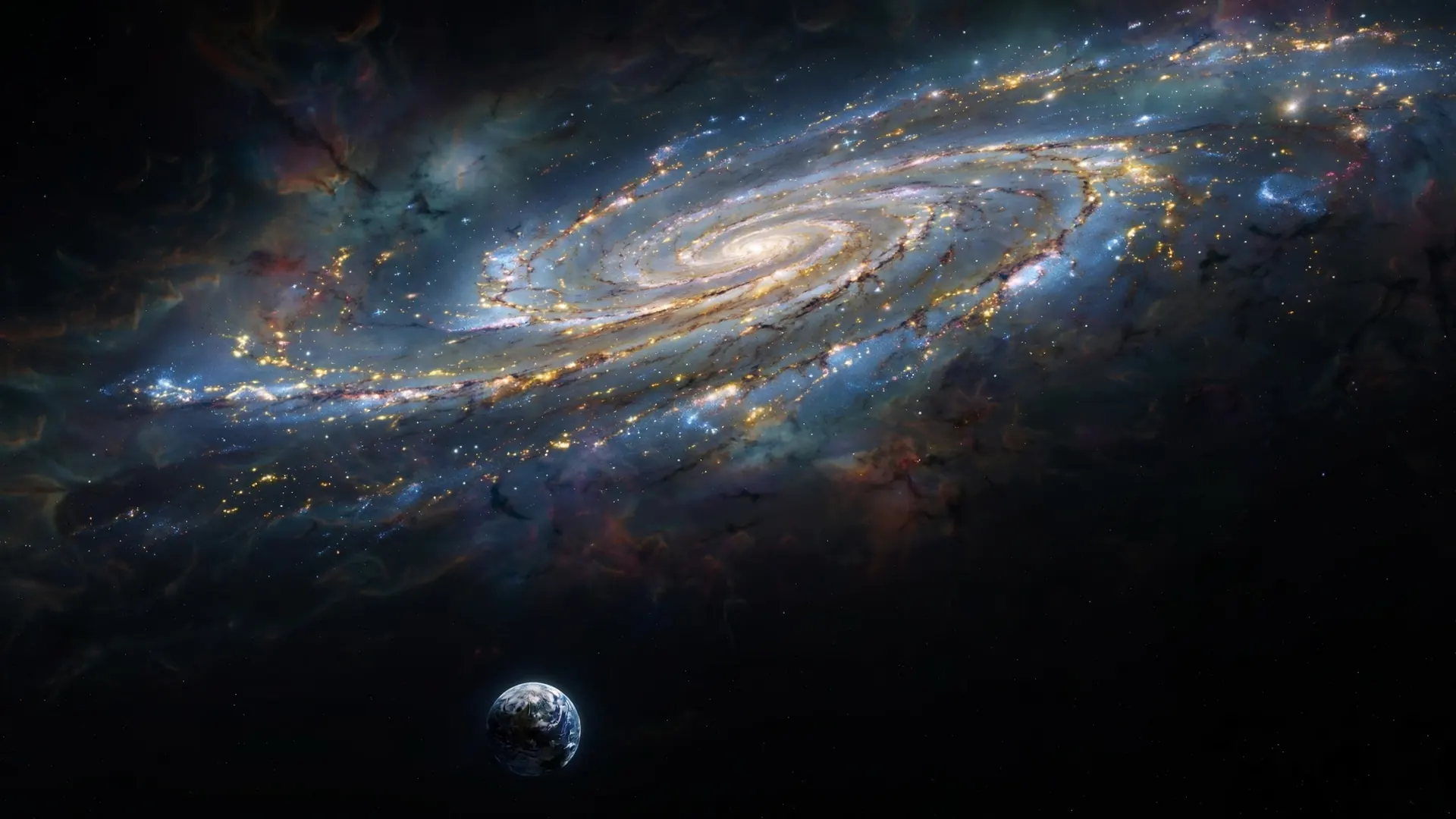
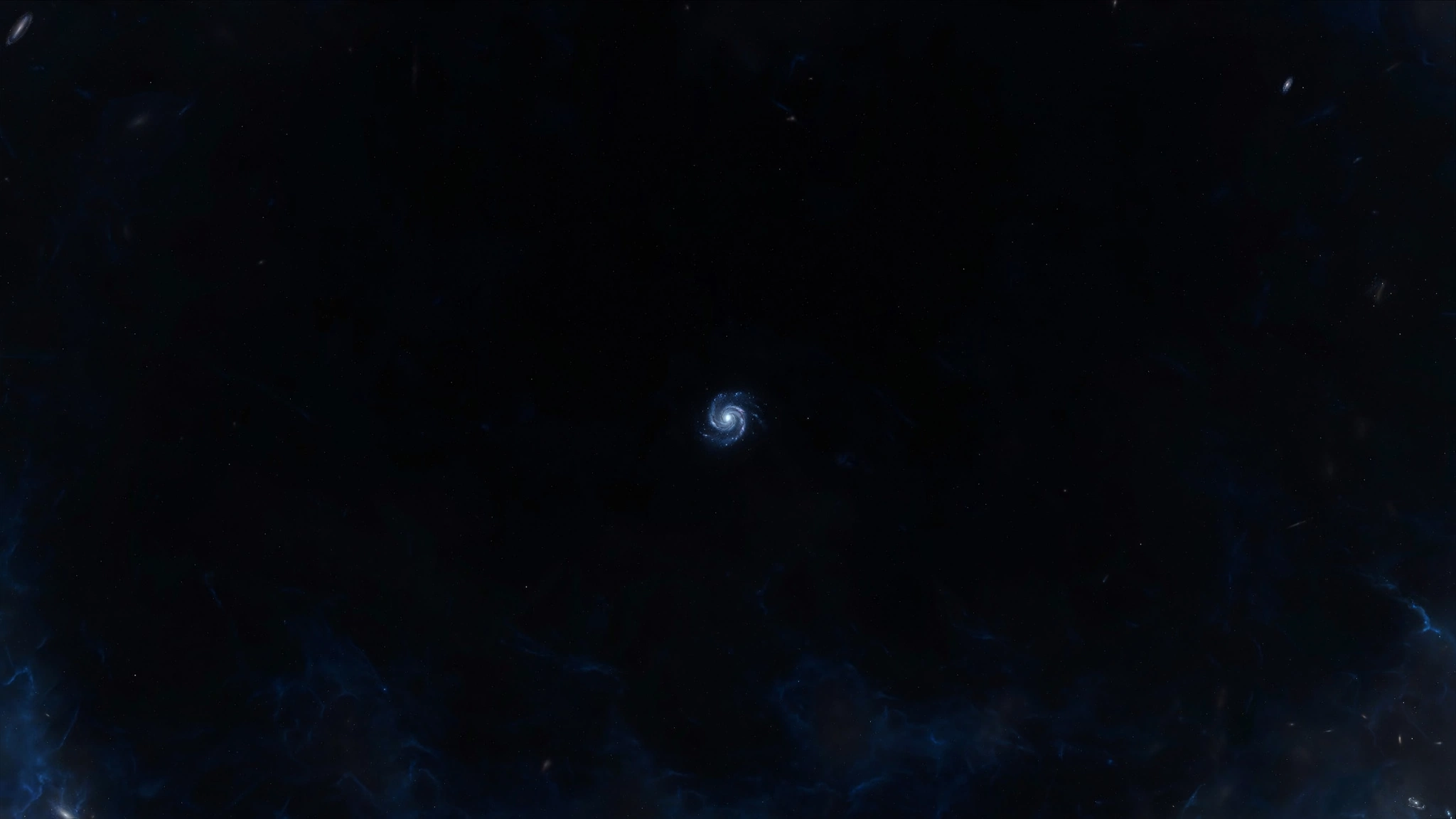
Imagine drifting far above the cosmic web, high enough that galaxies shrink to grains of sand. Below you, glowing filaments thread the darkness like dew on a spider’s web. Look closer at your own neighborhood, though. There is a thinning here: a region roughly 2 billion light-years across where galaxies are scarcer than they should be. And near its center, small and oblivious, sits the Milky Way.
Here is the short version: the KBC Void is a proposed 2-billion-light-year-wide underdensity surrounding our galaxy, about 20 percent less dense than the cosmic average. A 2025 study of the universe’s frozen sound waves found a void model 100 million times more likely than no void, and it could explain why the nearby universe appears to expand faster than the distant one. It is still disputed.
That is the claim behind the KBC Void, also called the Local Hole, and it may be the most consequential map of our neighborhood ever drawn. If it is real, it could dissolve one of cosmology’s deepest mysteries: the Hubble tension, the stubborn disagreement over how fast the universe is expanding. If it is not, it is still a lesson in how hard it is to see the forest when you live inside one particular tree.
A thinning, not a hole
The story begins in 2013, when Ryan Keenan, Amy Barger, and Lennox Cowie counted galaxies in near-infrared light across 90 percent of the sky. They found the nearby universe, out to roughly a billion light-years, holds fewer galaxies than regions farther out, with the density rising only beyond about 300 megaparsecs. The underdensity is roughly spherical and about 600 megaparsecs across: 2 billion light-years of thinner-than-average cosmos, with our galaxy sitting within a few hundred million light-years of its center.
First, forget the word void. The KBC region is not empty. It still holds the Milky Way, the Local Group, the Virgo Cluster, and most of the Laniakea Supercluster, plus all the gas, dust, and dark matter those contain. It is simply about 20 percent underweight compared with the cosmic average, by the leading measurement. “If the Milky Way had been in the center of the Boötes void, we wouldn’t have known there were other galaxies until the 1960s,” astronomer Greg Aldering has said. Even the Boötes void, the classic empty patch, contains galaxies. The KBC Void is not the emptiest place in the universe. It is the emptiest place that happens to contain us, which makes it far more interesting.
Why a thinner universe looks faster
Here is why a mild thinning of galaxies matters: it breaks the measurement cosmologists thought was clean. The Hubble tension is simple to state and brutal to resolve. Measure the expansion rate nearby, using Cepheid stars and Type Ia supernovae as mile markers, and you get about 73 kilometers per second per megaparsec. Measure it from the afterglow of the Big Bang, and you get 67.4. Both numbers have survived a decade of rechecks. They refuse to agree.
What if nothing is wrong with the universe, and the weirdness is in our address? Picture yourself standing in a shallow crater on a vast plain. Gravity tugs you gently toward the rim, away from the center. Galaxies inside a cosmic void feel the same pull from the denser matter around them, a slow outward drift that piles onto the universe’s own expansion. There is a second effect too: an underdense region sits atop a gentle hill of gravitational potential, so light arriving from the denser universe beyond must climb uphill to reach us, stretching its wavelength a touch further. Both effects nudge every redshift measurement in our neighborhood slightly upward. You would read a faster expansion rate than the universe truly has. The Hubble tension, in this telling, is not a crack in cosmology. It is an optical illusion, and we are standing inside the lens.
“A potential solution to this inconsistency is that our galaxy is close to the centre of a large, local void… As the void is emptying out, the velocity of objects away from us would be larger than if the void were not there. This therefore gives the appearance of a faster local expansion rate.”
The Big Bang’s frozen echo votes for the void
Hold on. If you grew up hearing the universe is the same in every direction, this should bother you. For years the void idea had a credibility problem: a 2-billion-light-year dip should not exist in standard cosmology. Haslbauer, Banik, and Kroupa calculated in 2020 that such a void defies the standard model at 7.09 sigma. Other cosmologists countered that supervoids can appear in the standard picture after all. The debate sat in stalemate. Then came the sound of the Big Bang.
In July 2025, at the Royal Astronomical Society’s National Astronomy Meeting in Durham, Banik presented a new line of evidence, published the same year in Monthly Notices of the Royal Astronomical Society, and it is the strongest the void has ever had. It comes from baryon acoustic oscillations: pressure waves that rippled through the hot plasma of the early universe for its first 380,000 years before freezing into the arrangement of galaxies. Cosmologists call them the “sound of the Big Bang.” They act as a standard ruler imprinted across the sky: galaxies prefer to sit a known distance apart, and that preferred separation lets you chart the expansion rate at different eras.
“These sound waves travelled for only a short while before becoming frozen in place once the universe cooled enough for neutral atoms to form. They act as a standard ruler, whose angular size we can use to chart the cosmic expansion history.”
Here is the trick. A local void slightly distorts the relationship between that ruler’s apparent size and its redshift, because the void’s outward velocities and gravitational pull add a little extra redshift on top of cosmic expansion. Banik and his colleagues folded 20 years of baryon acoustic oscillation measurements into the analysis. The result: a void model is about 100 million times more likely than a void-free model tuned to fit the Planck satellite’s cosmology.
“By considering all available BAO measurements over the last 20 years, we showed that a void model is about one hundred million times more likely than a void-free model with parameters designed to fit the CMB observations taken by the Planck satellite, the so-called homogeneous Planck cosmology.”
The skeptics’ counterattack
So is the case closed? Not so fast. In 2026, Filip Stiskalek, Harry Desmond, and Banik himself tested the void against a completely different kind of data: direct distance measurements from the CosmicFlows-4 catalog, using the Tully-Fisher relation to pin down how far away nearby galaxies really are. Their result shrinks the picture. The velocity fields prefer a void no larger than about 70 megaparsecs, roughly a tenth of the size the galaxy counts imply, and the predicted local expansion rate lands between 70.2 and 72.1 kilometers per second per megaparsec. That narrows the Hubble tension but does not erase it. The void may be real but smaller, or the galaxy counts may be telling a story the distances do not fully confirm.
What would it mean if the hole is real?
The deeper question is what a 2-billion-light-year underdensity would even mean. If it exists at full size, standard cosmology has a problem bigger than the Hubble tension: such a structure should be vanishingly rare. Some researchers take that as evidence that gravity behaves differently on the largest scales, in the spirit of modified-gravity theories. Others argue the apparent void is a patchwork of smaller structures and selection effects that will dissolve under better surveys. Both camps agree on the next test: cosmic chronometers, which date ancient “dead” galaxies from their starlight and chart the expansion history without touching the distance ladder. A confirmed KBC Void would be one of the largest structures ever mapped, though unlike the alien megastructures we scan the skies for, this one is made mostly of absence.
Where does that leave you, standing on a small planet near the middle of a suspiciously empty region? The Fermi paradox asks why the universe seems so quiet; the KBC Void asks something stranger: whether our whole neighborhood is the quiet part. We may live in a cosmic valley so wide that its far edge is farther from us than some galaxies are from each other, and the most ordinary thing about it is that we only just noticed. Every measurement in cosmology is taken from somewhere, and somewhere is not nowhere.
The echo of the Big Bang is still ringing. It may be telling us we live inside a hole in the universe, or it may be telling us something else entirely. The next few years of data will decide, and the answer will change what the word “average” means.
Frequently asked questions
- What is the KBC Void?
- A proposed 2-billion-light-year-wide underdensity surrounding the Milky Way, named for Keenan, Barger, and Cowie, who found it in 2013 near-infrared galaxy counts. It is roughly 20 percent less dense than the cosmic average, not empty space.
- Is the KBC Void completely empty?
- No. It contains the Milky Way, the Local Group, the Virgo Cluster, and most of the Laniakea Supercluster, along with gas, dust, and dark matter. “Void” means lower density than the cosmic average, not nothingness.
- How could a void make the universe look like it is expanding faster?
- Gravity pulls matter inside the void toward the denser surroundings, adding an outward drift on top of cosmic expansion, and the void’s gravity adds extra redshift to incoming light. Both effects make the nearby expansion rate read higher than the true value.
- Is the KBC Void proven to exist?
- No. A 2025 baryon acoustic oscillation analysis found a void model about 100 million times more likely than a void-free one, but 2026 direct-distance measurements suggest the void may be much smaller. The debate is active and unresolved.