Missions
The Flying Roadster: Real Rocket Science, Not a Car Story
Tesla’s new Roadster flew over its own lineup on cold-gas thrusters borrowed from orbital flight. Here’s what the hover demo proved — and what it didn’t.
On the night of October 15, 2026, at SpaceX’s rocket test site in McGregor, Texas, a car flew. Not metaphorically. A white Tesla Roadster — with no one inside — drove up a towering curved ramp, clung to it upside down, peeled off into the night sky, rolled itself upright with jets of compressed air, and set down on its wheels like a lander touching the Moon. Then it did it again over a line of parked Teslas, adding a flip. “Well, it worked,” Elon Musk said. “Flying cars are real.”
Every car site covered this as auto news. But the Roadster isn’t really a car story — it’s a spacecraft propulsion story. The thing that flew that night was cold-gas thruster hardware straight out of orbital flight, bolted to a chassis. To understand what happened in Texas, forget everything you know about cars and think about rockets.
What the demo actually showed
The event streamed on X for about 23 minutes starting at 7:55 p.m. Central — 19:55 on a 24-hour clock, a wink at 1955, the year Marty McFly travels to in Back to the Future (Musk has been flirting with the flying-DeLorean comparison since 2019). The venue said it all: McGregor is where SpaceX tests its engines, and the centerpiece, dubbed “The Ramp,” played like a SpaceX test with a car standing in for the rocket.
The Roadster accelerated up a huge curved ramp until it was completely upside down, held there by a fan-based suction system Musk says generates more than 2 G of grip — enough to drive on a ceiling. It then fired cold-gas thrusters developed with SpaceX engineers, peeled off the ramp, rotated in midair, and eased itself to a landing on the pavement. The tricks kept coming: the car hovered itself over a Cybercab, Cybertruck, Tesla Semi, Model Y and Model 3 while in motion, and closed with a straight-up launch into a corkscrew from a standstill. Tesla also clocked the car from 0 to 60 mph in 0.81 seconds in a live test, and showed a clip of it hitting 60 in exactly one second. “It literally is just going to puff itself up,” Musk said, “and be able to do these maneuvers whenever you’d like.”
Two things the livestream made clear that the headlines sometimes skip: every stunt ran without a human inside — an Optimus robot sat in the seat as set dressing — and the thrusters are, per witnesses, deafeningly loud. Musk fired them near the audience for only a few seconds. It sounded like a rocket launch, because it is one.
Three trims, one of which leaves the ground
Tesla announced three configurations. Performance is “road ready”: two seats, active aerodynamics and the multi-mode suction system, claimed 0–60 mph in under 1.6 seconds. Thrust is “race ready”: two seats plus rear-mounted cold-gas thrusters for sub-0.9-second acceleration. Rocket is “air ready”: a single seat and ten perimeter-mounted thrusters for forward and upward acceleration plus lateral rotational movement — the barrel rolls — with a claimed 0–60 in under 0.59 seconds.
All three claim more than 300 miles of range and top speeds beyond 230 mph. Musk said Tesla will finally build the car — first promised back in 2017, when it was quoted at 1.9 seconds to 60 and 620 miles of range — in 2028. Reservations opened at $50,000 for Performance and $250,000 for Thrust; the Rocket trim is invite-only, and no final prices were announced.
Cold-gas thrusters, explained like a spacecraft engineer
Here’s where the space story starts. A cold-gas thruster is the simplest rocket engine in existence: a tank of highly pressurized gas, a fast valve, and a nozzle. Open the valve, the gas expands through the nozzle at near-supersonic or supersonic speed, and the recoil pushes the vehicle the other way. No combustion, no fire, no separate fuel — just pressure. The “gas” is compressed air, and the car carries an onboard compressor that refills its own tanks.
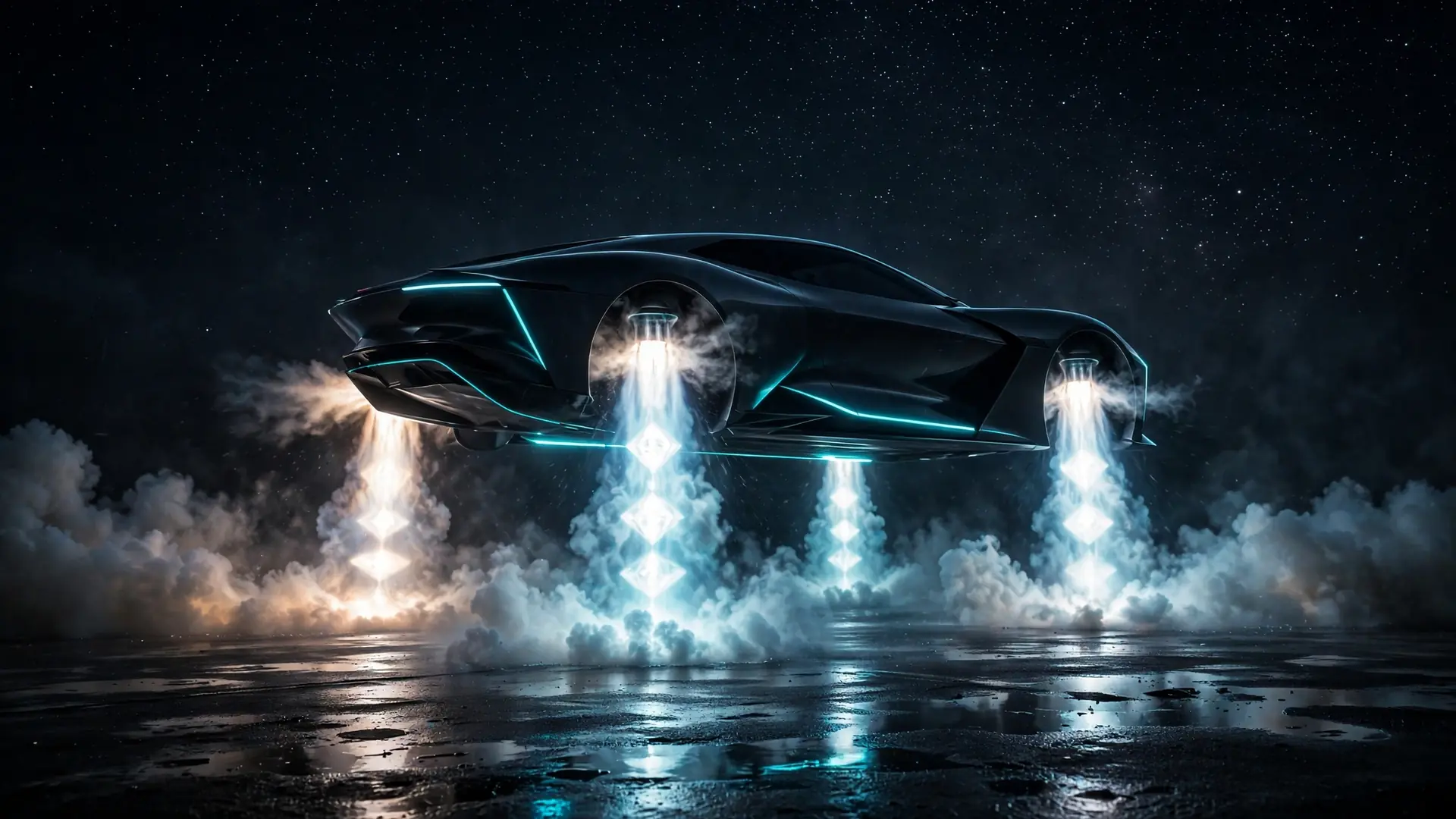
Tesla put numbers on the system: two carbon-fiber-wrapped tanks holding a combined 250 kilograms of air, ten nozzles around the car, and — per Musk onstage — 80 kilonewtons of peak thrust, which he described as four to five times the force available through conventional tire grip. Teaser footage even showed Mach diamonds, the repeating bright rings that mark supersonic nozzle flow, in the plumes.
Spaceflight readers will recognize every component. The tanks are composite-overwrapped pressure vessels — COPVs — the same class of high-pressure tank SpaceX flies on Falcon 9 and Dragon, in the same engineering lineage as Starship’s orbital hardware. Falcon 9’s second stage carries a cold nitrogen gas attitude control system that SpaceX’s own user’s guide describes as “more reliable and produces less contamination than a propellant-based reaction control system,” and nitrogen cold-gas jets once steadied a returning Falcon 9 booster by nulling its roll rate. Cold-gas attitude thrusters have been steering spacecraft since the 1960s.
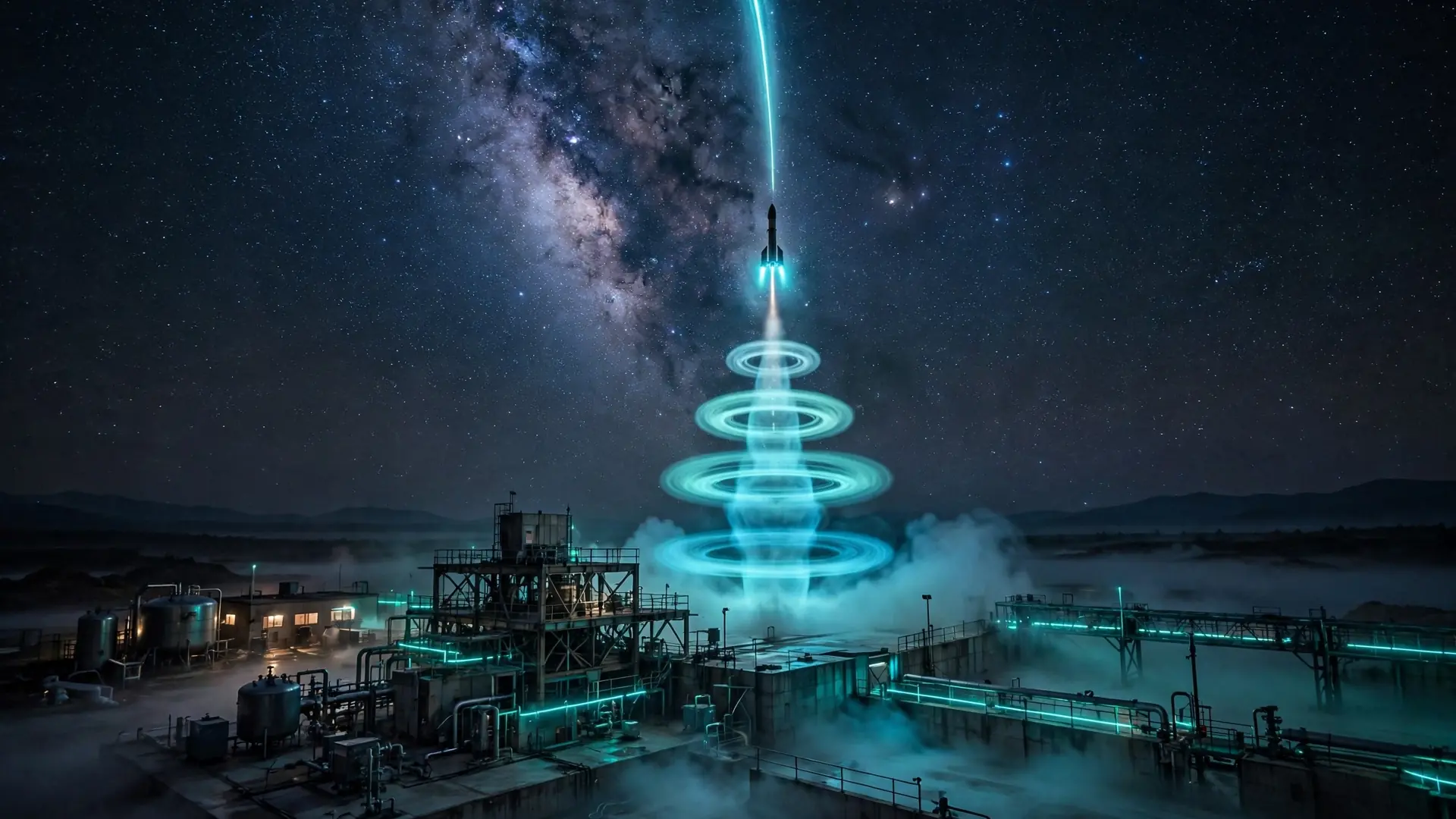
The scale is what’s new. Each of the Roadster’s ten thrusters works out to roughly 8 kilonewtons — about twenty times the thrust of one of Dragon’s Draco maneuvering thrusters. This is the first consumer vehicle ever fitted with spacecraft-class propulsion. Nothing in the automotive world has a comparable system, because cars were never allowed to act like spacecraft.
Why tires can’t do what the Roadster did
Every wheeled vehicle hits the same ceiling: the traction circle. A tire can only transmit force to the road up to the friction of rubber on asphalt; past about 1 g of acceleration, even the stickiest street tires slip. The Rimac Nevera — holder of 23 performance records, with a 1.74-second 0–60 — is arguably at that ceiling right now. Tesla’s claimed 0.59-second sprint would need over 4.6 g.
Thrusters bypass the ceiling entirely because they don’t act through the wheels at all. They push on the chassis directly. Newton’s third law still applies, but the tire-road interface is irrelevant to a thruster pulse. That’s the real reason the Roadster can do things no drivetrain, however powerful, ever could: the force path is air, not rubber. It’s a propulsion philosophy closer to a light-sail probe than to any engine — the push comes from outside the wheels entirely.
What the hover actually proved — and what it didn’t
Here’s the part car coverage missed. To hover, thrust must exceed weight — a thrust-to-weight ratio above one. Eighty kilonewtons against a car weighing on the order of 1,700 kg (about 16.7 kN of weight) gives a thrust-to-weight ratio near five. The hover is exactly what the physics predicts. What the demo really proved was the control loop: firing ten nozzles with millisecond timing to stabilize a car in midair, rotate it, and set it down on its wheels without a driver. That’s a guidance problem SpaceX knows intimately — the same class of problem as those nitrogen thrusters steadying a returning booster.
But cold-gas physics also sets a hard ceiling the demos didn’t advertise. Compressed gas is the least efficient propellant there is: a cold-gas thruster’s specific impulse — roughly, how much thrust you get per kilogram of propellant — is only about 60–70 seconds. At 80 kN of thrust, the system burns through roughly 115–135 kilograms of air per second. With 250 kg on board, that’s about two seconds of full thrust. The hover was always going to last seconds — which is exactly how long it lasted. Sustained flight was never on the table; this is a party trick with a physics receipt.
Then the honest caveats: nothing was independently tested — everything happened on Tesla’s own stream, staged and timed by Tesla. The car recharges its tanks itself, but Tesla hasn’t said how long a recharge takes or how many bursts a full charge allows. And a system that deafens a crowd from hundreds of yards away raises questions no spec sheet answers — about noise, safety, and what any regulator will say about rocket plumes on a public road. Musk himself joked that the upper limit of the acceleration is probably where g-forces detach a retina, which is funny until you sit in the single seat of the Rocket trim.
The bigger signal
Musk called the Roadster “the best of the last of the human-driven cars,” and Tesla wrote that the night marked “a new moment in history.” The nine-year delay from the 2017 promise earns the skepticism. But strip away the car-industry theater and something genuine remains: spacecraft propulsion techniques — COPV tanks, cold-gas attitude thrusters, thrust-vector stabilization — just crossed over into a consumer product. The suction fan is the sideshow; the rocket hardware is the story.
The Roadster won’t take you to orbit. But it’s the first car ever built with a piece of one bolted on — and on a night in Texas, it flew.