Terraforming & Sci-Tech
How to Terraform Venus: The Harder, Hotter Twin
Venus is Earth’s twin in size and gravity, but its surface is a 465°C pressure cooker. Terraforming it means shading the planet, burying its CO2, and importing water.
The lander touches down in a landscape the color of rust, under a sky the color of mustard. Within minutes, its cameras film a world no human eye has ever seen directly: flat volcanic rock, yellow haze, dim light like a cloudy afternoon on Earth. Then the heat closes in, circuits soften, seals fail, and after about two hours the bravest machine ever sent to another planet’s surface goes quiet. Venus does not kill landers with drama. It kills them with a slow oven.
Here is the short version. Terraforming Venus means fixing four problems in order: live in the clouds first, shade the planet to cool it, move or bury 92 atmospheres of carbon dioxide, and import the water Venus lost. Skip a step and the plan falls apart. A 2022 paper argues the honest shortcut is to stop trying to fix the surface at all, and build a new one that floats.
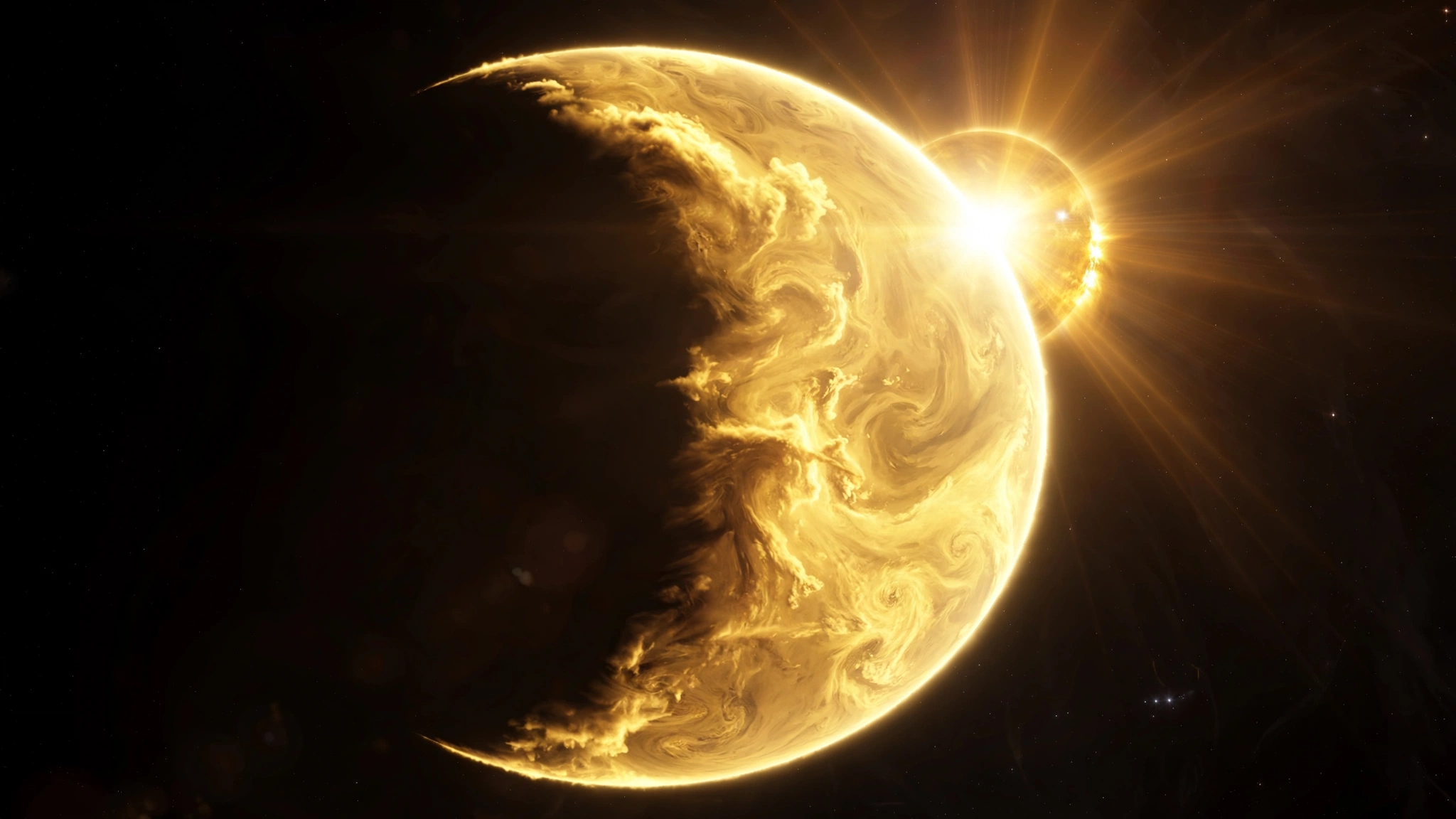
Start with why Venus deserves the effort. It is the closest planet to Earth, nearly Earth’s size, with surface gravity about 90 percent of ours. But the similarities end at the cloud tops. Below them sits an atmosphere 96.5 percent carbon dioxide, pressing down at about 92 times Earth’s sea-level pressure and holding the surface at about 465 degrees Celsius, hot enough to melt lead, under clouds of sulfuric acid droplets. There is no magnetic field, no rain that reaches the ground, no oceans.
The twin that went wrong
Earth and Venus were born with similar ingredients, and early Venus may have held shallow oceans. The difference is what each did with its carbon. On Earth, rain washed carbon dioxide out of the air and locked it into rock and shells. On Venus, the carbon stayed in the sky, the greenhouse effect fed on itself until the oceans boiled, sunlight split the water molecules apart, and the light hydrogen escaped to space. The planet dried out for good. Recent modeling even found a chemical shortcut for that escape, a charged molecule called HCO+ that may have doubled the hydrogen loss rate. Venus is not just hot. It is a planet that lost its water and never got it back.
The first serious plan to fix it came in 1961, when Carl Sagan proposed seeding Venus’s clouds with algae to eat carbon dioxide and breathe out oxygen. It was elegant, and wrong in a way Sagan later admitted with unusual grace: he had written the paper believing Venus’s surface pressure was a few times Earth’s. Spacecraft soon showed it was about 90 times Earth’s, which meant his algae would have produced nearly pure oxygen over a surface buried in graphite. In his 1994 book Pale Blue Dot, he called it plainly:
“Here’s the fatal flaw: In 1961 I thought the atmospheric pressure at the surface of Venus was a few 'bars,' a few times the surface pressure on Earth. We now know it to be 90 bars, so that if the scheme worked, the result would be a surface buried in hundreds of meters of fine graphite, and an atmosphere made of 65 bars of almost pure molecular oxygen.”
Sagan’s retraction is the honest starting point, because it sets the scale. Every Venus plan has to reckon with numbers that dwarf anything humans have ever attempted, so the order you attack them in is the trick. Most explainers list terraforming ideas like items on a menu. They are a sequence, and the first step is the one most people get backwards.
Step one: stop trying to land
Go up, not down. In the layer between about 50 and 55 kilometers up, the air thins from about one Earth atmosphere of pressure to about half that, and temperatures fall through the range of 0 to 50 degrees Celsius. NASA scientist Geoffrey Landis worked out the numbers in a 2003 paper, and put it best:
“However, viewed in a different way, the problem with Venus is merely that the ground level is too far below the one atmosphere level. At cloud-top level, Venus is the paradise planet.”
Ordinary breathable air is a lifting gas in Venus’s dense carbon dioxide, with more than 60 percent of helium’s lifting power on Earth. A balloon full of the air you breathe would float, carrying a habitat with it, and with inside and outside pressures nearly matched, a tear would leak slowly instead of exploding. You would still need a mask and acid protection outside, but not a pressure suit. NASA’s Langley Research Center took the idea seriously in its High Altitude Venus Operational Concept, or HAVOC, a phased plan running from robotic airships to a 30-day crewed airship stay and a round trip of about 440 days. As study lead Dale Arney put it, Venus “is no worse than the second planet we would go to after leaving Earth.”
The clouds solve one more problem for free. A solar day on Venus lasts about 117 Earth days, nearly two months of daylight and two months of night for anyone on the ground. But the upper atmosphere super-rotates, whipping around the planet roughly every four Earth days, so a floating city rides that wind like a slow carousel, trading the 117-day solar day for a roughly four-day cycle, about two days of light and two of dark at the equator, without ever touching the ground. The acid is the catch, though proof-of-concept work found an FEP-Teflon film that maintained 90% transmittance to relevant spectra even after 30 days’ immersion in concentrated sulfuric acid. Compare that with a day in a Martian colony, where every breath depends on machines in a near-vacuum.
Step two: pull down the shade
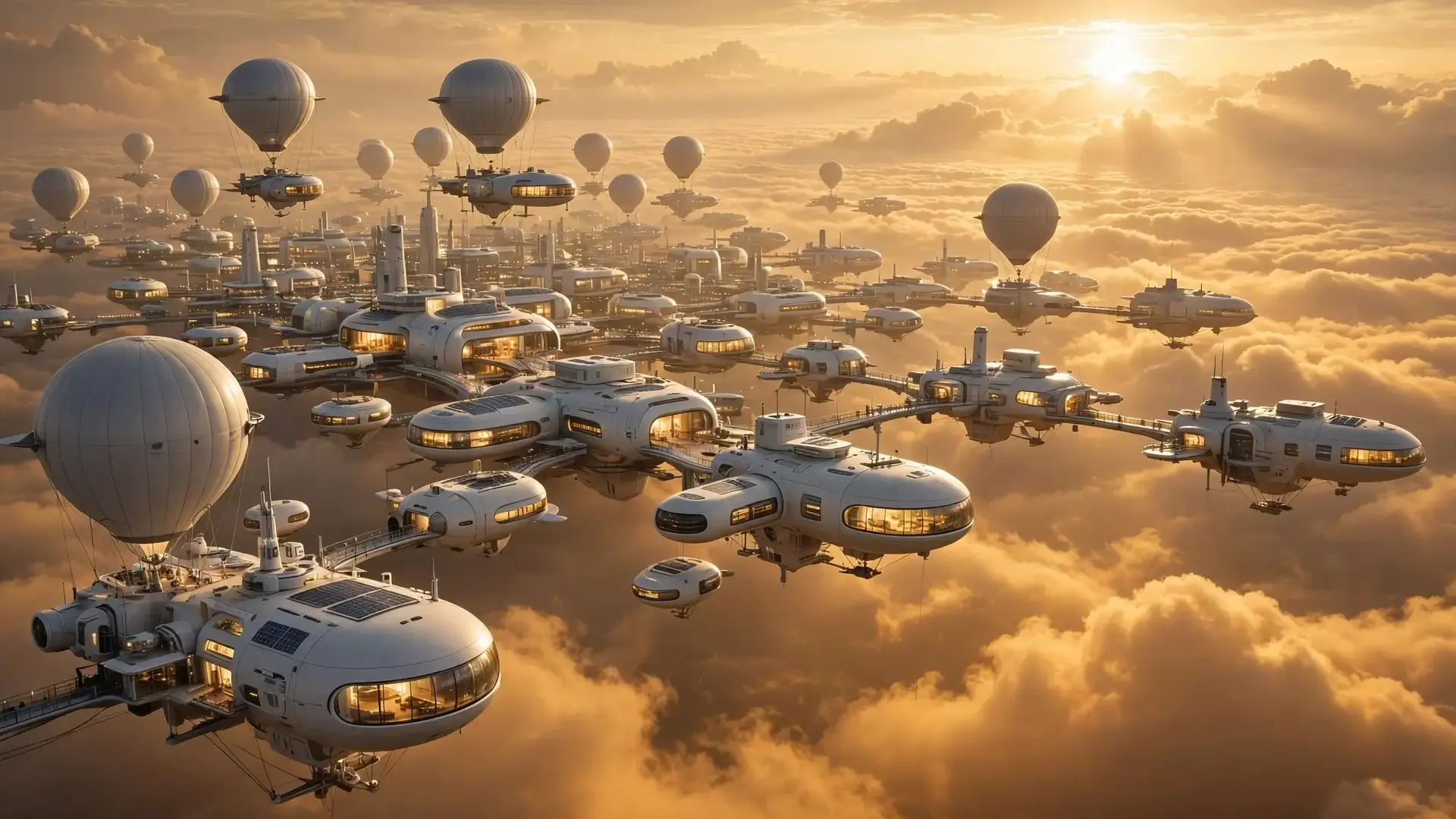
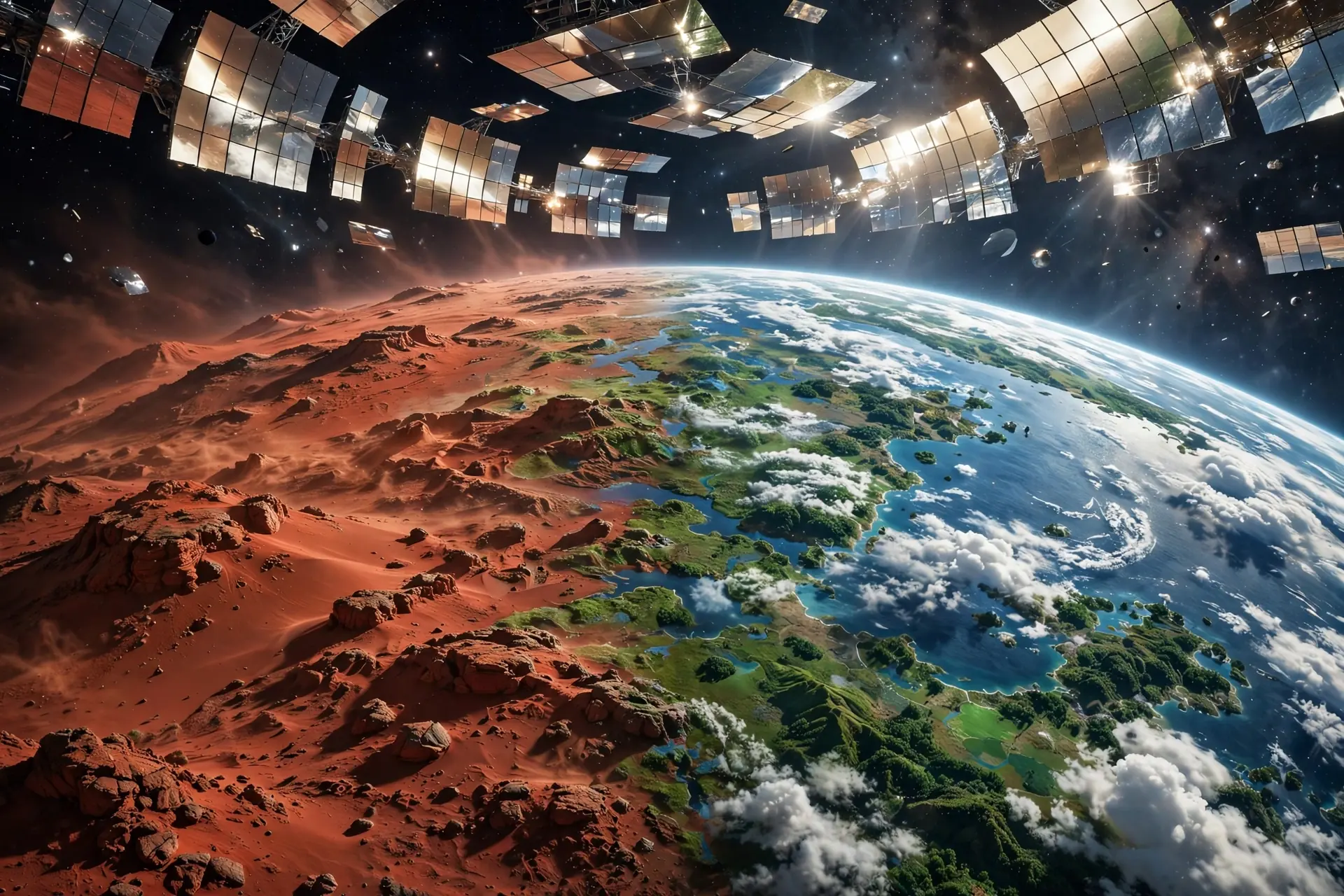
Cloud cities are a place to live, not a terraformed planet. For that, the surface has to cool, and cooling means blocking sunlight. The classic design, worked out by Paul Birch in 1991, parks a giant shade of angled mirror slats near the Sun-Venus L1 point, tens of thousands of kilometers across, held stable against the push of sunlight itself. Cut the sunlight and wait. Over roughly two centuries the atmosphere radiates its heat away, carbon dioxide condenses out of the sky as liquid and dry ice, and the pressure collapses. Then you meter sunlight back in carefully, just enough to rewarm the surface in a controlled way while you decide what to do with the frozen air. It is the only step that is mostly a waiting game, and still a construction project larger than anything humanity has ever built.
Step three: where do you put 92 atmospheres?
Here is the number that breaks most plans: Venus’s sky holds about 92 Earth atmospheres of gas, nearly all carbon dioxide, and you have three options for moving it, each with a catch big enough to sink it. Freeze it out under the shade and bury it under an insulating blanket, and you must keep it cold forever. Lock it into carbonate rock with calcium and magnesium, and one synthesis calculated you would need calcium equal to about 85% of the mass of Ceres, mined from Mercury and hauled up the Sun’s gravity well. Blow it off the planet with mass drivers, and you need energy no civilization has ever commanded. Even if you succeed, you are left with the nitrogen: 3.5 percent of 92 atmospheres is about four times all the nitrogen in Earth’s sky, so a terraformed Venus starts with a thick nitrogen blanket whether you want one or not.
Step four: the problem nobody solves
Now the step most explainers skip. Venus is bone dry: its air holds only a trace of water vapor, and the hydrogen its oceans once held is gone to space for good. An Earth-like Venus needs an ocean, and an ocean needs hydrogen, and Venus has no local source worth the name. Birch’s answer was characteristically bold: break up an icy moon such as Enceladus and rain it down in pieces. Others would import hydrogen and pair it with oxygen cracked from local carbon dioxide. Either way, the water has to be shipped in from elsewhere in the solar system, in staggering quantities. Any Venus plan that does not name its water source is not a plan. It is a wish.
Step five: fix the day
Last, the clock. Venus turns backwards, once every 243 Earth days, slower than its own 224.7-day year, so the Sun rises in the west and sunrise to sunrise lasts about 117 Earth days. Surface settlers would face roughly 58 days of daylight and 58 days of night. Orbital mirrors could fake a day-night cycle, and floaters dodge the whole problem by riding the super-rotating winds. Either way, the calendar is an engineering problem, not a given. On Earth we take the 24-hour day for granted. On Venus you have to build it.
The shortcut: build a new surface and leave the old one alone
This is where a 2022 paper by Alex Howe changes the conversation. Instead of removing 92 atmospheres, Howe proposes building an artificial surface in the temperate cloud layer, assembled from locally produced materials and floating on nitrogen as a lifting gas, with the crushing lower atmosphere sealed beneath it. Above the platform you build a breathable sky. Below it, the old Venus stays exactly as it is. As Howe writes:
“Such a surface could be built with locally produced materials and would float above the bulk of the atmosphere using nitrogen as a lifting gas.”
The resource bill collapses. No Ceres-mass of calcium, no centuries of freezing the sky, no ocean to import: Howe’s analysis says the project still needs water from elsewhere, but only comparatively modest quantities, and could be completed in a minimum of 200 years in a best-case scenario. That is still longer than any human institution has ever planned for, and the engineering is unproven at every scale. But it is the only Venus plan whose shopping list fits on one page. The price is philosophical: you never walk on real Venusian ground. Your world is a floor bolted to the sky, with an ocean of air above it and an ocean of poison sealed beneath. If you want a feel for planetary engineering on the easier planet first, our Terraform Mars simulator hands you the sliders for turning Mars into a second Earth. Venus is the advanced course.
So which Venus do we get? Mars will probably get the first footprints, because its surface is reachable today, even if living there means fighting cold, thin air, and one-third gravity. Venus gets the longer game: first the airships, then the shade, then, maybe, a floor above the clouds with a breathable sky on top and the old hell sealed underneath. The twin that went wrong may yet become the twin we learned to live with, not by conquering its surface, but by refusing to fight it. The most Earth-like place in the solar system, it turns out, was never the ground. It was the sky, fifty kilometers up. The problem was never Venus. It was where we insisted on standing.
Frequently asked questions
Can we terraform Venus?
Not with today’s technology. The honest sequence is: live in the clouds first, shade the planet to cool it, deal with 92 atmospheres of carbon dioxide, import water, and fix the 117-day solar day. Even the fastest credible plan, a floating artificial surface, needs a minimum of 200 years in a best-case scenario.
Why is Venus hotter than Mercury if Mercury is closer to the Sun?
Because of its atmosphere. Venus’s sky is 96.5 percent carbon dioxide, which traps heat in a runaway greenhouse effect that holds the surface at about 465 degrees Celsius. Mercury has almost no atmosphere, so its heat escapes to space.
Could humans live on Venus right now?
Not on the surface, where the pressure is about 92 times Earth’s and the temperature melts lead. But in the layer 50 to 55 kilometers up, the pressure falls from about one Earth atmosphere to about half that, and temperatures sit between 0 and 50 degrees Celsius, which is why floating cities and NASA’s HAVOC airship concept are the serious proposals.
How long would terraforming Venus take?
Centuries at minimum. A 2022 paper on a floating artificial surface estimates 200 years in a best-case scenario, and that plan skips the hardest steps. Fully terraforming the surface, removing the carbon dioxide and importing an ocean, would take far longer.
Sources & Research
The primary studies and reporting behind this story, linked for readers who want to check our work.
- NASA, "Venus: Facts" (orbit, rotation, atmosphere, and surface conditions) · NASA Science
- Howe, Alex R. (2022), "Cloud Continents: Terraforming Venus Efficiently by Means of a Floating Artificial Surface" · Journal of the British Interplanetary Society (arXiv:2203.06722)
- Landis, Geoffrey A. (2003), "Colonization of Venus" · AIP Conference Proceedings, 654, 1193-1198
- Sagan, Carl (1961), "The Planet Venus" · Science, 133(3456), 849-858
- Arney, Dale C. & Jones, Christopher A., "NASA’s Wild Airship Idea for Cloud Cities on Venus" (HAVOC concept) · Space.com
- Birch, Paul (1991), "Terraforming Venus Quickly" · Journal of the British Interplanetary Society, 44, 157-167
- Chaffin, Cangi, Gregory et al. (2024), "Venus water loss is dominated by HCO+ dissociative recombination" · Nature, 629, 307-310
- Jones, Arney et al. (2015), "High Altitude Venus Operational Concept (HAVOC): Proofs of Concept" · NASA Technical Reports Server