Terraforming & Sci-Tech
A Sol on Mars: One Day in a Human Martian Colony
One Martian sol, 24 hours and 39 minutes, through butterscotch dawns, greenhouse breakfasts, dusty EVA walks, and blue sunsets: daily life on Mars, hour by hour.
Every rendering of a Mars colony shows the same thing: gleaming domes under a dusty red sky. But none of them tell you what the day actually feels like. What do you eat for breakfast when the nearest supermarket is 225 million kilometers away? What does "morning" even mean on a world where the sun sets blue? Forget the artist’s impressions. Walk with me through one full sol, one Martian day, lived hour by hour, the way the science says it would really happen.
This is not the first landing. The first landing is a camping trip: footprints, flags, and a ride home. This is a few dozen years later, a permanent outpost in the early days of a colony, where the novelty has worn off and the maintenance has begun. The planet is still trying to kill you, but now you have a routine.
Wake-up: the day is 39 minutes too long
Your alarm goes off, and today is not 24 hours long. A Martian sol lasts 24 hours, 39 minutes, and 35 seconds. Shift your schedule by that much every day and your body clock detaches within a week; NASA’s Mars rover teams lived on "Mars time" for 90-day stretches and described it as permanent jet lag. On a colony, everyone lives on Mars time permanently. Your watch counts past 24:00 and keeps going to 24:39. Birthdays drift. The extra 39 minutes becomes "the 25th hour," the colony’s unofficial currency of free time.
You wake to the hum of the life-support fans, the background music of every Mars habitat. Outside your window the sky is butterscotch, pale orange-pink from fine dust suspended in air so thin it would be called a vacuum on Earth. It is 95% carbon dioxide at less than 1% of Earth’s pressure, and last night it dropped below −100°C. You roll out of bed and discover the first surprise of Martian mornings: at 0.38 g, everything feels spring-loaded. Stairs are a game. Dropping your toothbrush means it falls in slow motion. Walking will never quite feel normal, your body keeps expecting the ground to meet your feet sooner.
Breakfast: from the greenhouse, with reservations
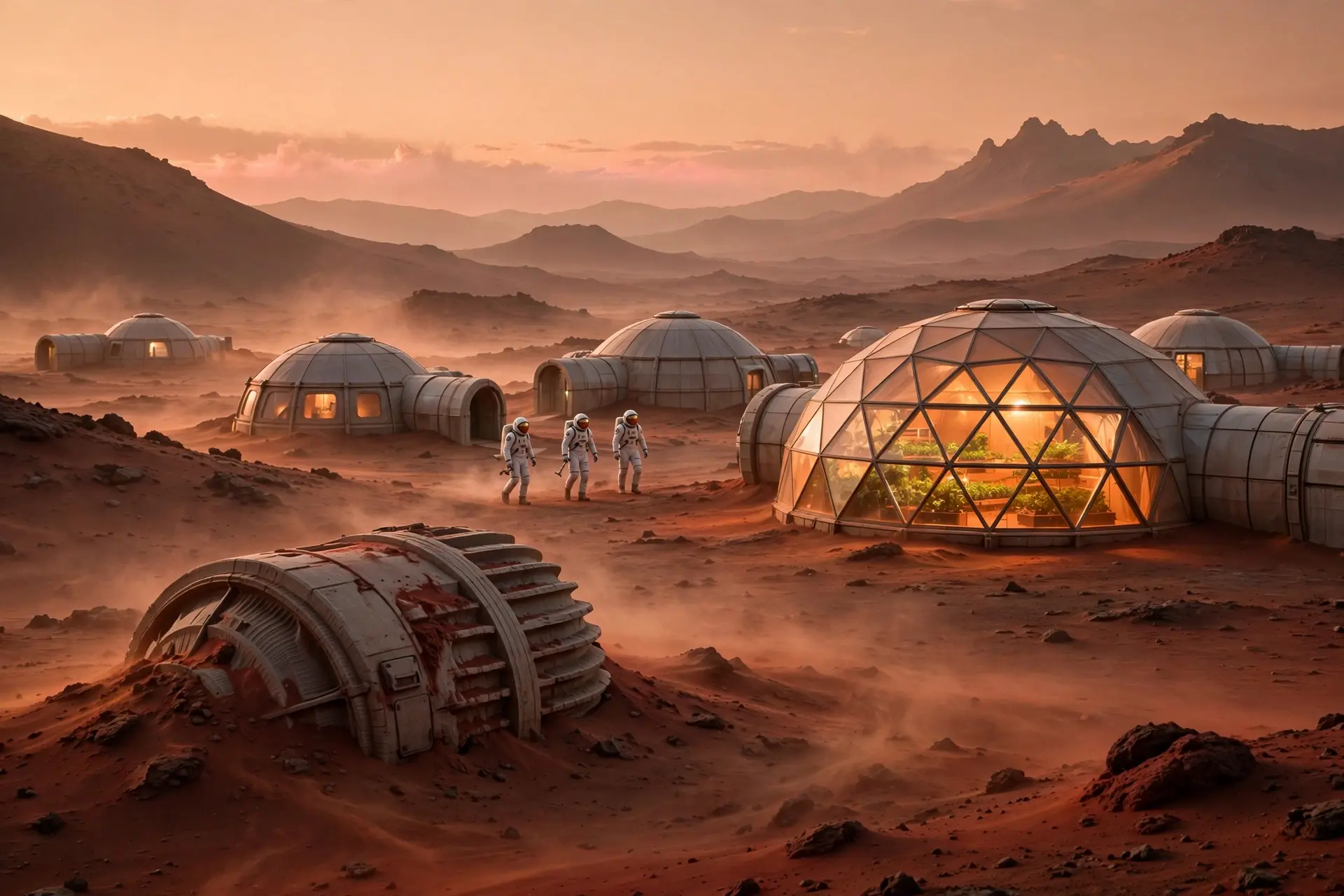
Breakfast is a small miracle of engineering. The greens on your plate grew in stacked racks under pink LED light tuned to the red and deep-blue wavelengths plants actually use, because Mars sunlight is weak, and because the farm lives inside a radiation-shielded module, buried under meters of regolith or sunk into a lava tube, where no natural sunlight reaches at all. Power for the lights comes from solar arrays and, more reliably, from compact fission reactors along the lines of NASA’s demonstrated Kilopower design, which keep running when dust storms blot the sun for weeks.
Martian dirt, by the way, wants your lunch dead. The soil at NASA’s Phoenix landing site carries 0.4 to 0.6% perchlorate salts, chemicals that disrupt the human thyroid and poison seedlings. So the farm crew washes the regolith, breaks the perchlorates down with bacteria, and seeds the soil with fungi that scavenge minerals for the roots; 2026 research has explored hydrogel substrates that cut water use, and even recycled crew waste as fertilizer, the real-life version of growing potatoes in The Martian. Nothing about a Mars harvest is easy. Everything about it is necessary: every resupply from Earth costs a fortune and a two-year wait, so the colony eats what it grows. The coffee, if you’re lucky, is freeze-dried luxury from the last cargo flight, tasted once a week, on Sundays.
Midday: the dust rules everything
Suiting up for the midday EVA is the most ritualized part of the sol. The suits of the future probably won’t be the bulky balloons of the Apollo era: MIT’s experimental BioSuit concept is a skintight mechanical counter-pressure garment, a second skin that squeezes you instead of inflating around you. But whatever the suit, the drill is the same: check seals, check reserves, budget your radiation. Mars has no magnetic field and almost no atmosphere, so the surface dose runs about 0.64 millisieverts per day, dozens of times the background you’d get on Earth. Outside hours are budgeted like money, because against an astronaut’s career radiation limits, they are money.
Then there’s the dust. Martian dust is electrostatic, clingy, razor-fine, and laced with perchlorate. It sticks to everything and tracks inside no matter what you do. In July 2026, a NASA working group proposed the first formal dust standard for habitats: keep fine particles below 0.1 milligrams per cubic meter of air. The airlock ritual — scrubbing down, swapping outer garments, vacuuming seals — is not ceremony; it’s medicine. On Mars, dust is weather, geography, and adversary all at once.
Getting around at one-third gravity
Outside, your body reminds you where you are with every step. At 38% of Earth’s gravity you don’t walk so much as bounce, a loping gait the Apollo crews would recognize, only springier. It’s fun for about an hour. Long-term, the fun ends: low gravity leaches bone and wastes muscle, which is why every colonist’s schedule includes up to two hours of resistance exercise a day, just like crews on the ISS. For longer trips there are pressurized rovers, shirtsleeve cabins on wheels, because no one walks 20 kilometers in a suit if they can help it.
And the weather forecast is always the same, with one exception: dust storms. Local storms are routine; every few years they merge into planet-encircling monsters that dim the sun for weeks, the 2018 storm ended the Opportunity rover, whose solar panels simply starved. A colony plans for this the way a northern town plans for winter: stocked food, stocked power, and indoor work on the schedule.
Afternoon: mail from Earth arrives late
Somewhere around mid-afternoon, your inbox fills. Not in real time: nothing from Earth arrives in real time. Radio signals take 3 to 22 minutes each way depending on where the planets are in their orbits, so a "conversation" with home is really an exchange of voice and video messages, hours apart. The news bundle downloads in the afternoon: headlines from a planet you can’t call. NASA rehearsed exactly this in its CHAPEA experiment, where four volunteers spent 378 days sealed inside a 1,700-square-foot 3D-printed habitat in Houston, June 2023 to July 2024, growing vegetables, doing simulated Mars walks, and working through those same delays.
The delay does something to you. Emergencies are yours to solve; help is, at best, a message arriving 20 minutes after you asked for it. The crew of the real first colony will be selected for that independence the way submariners are selected for confinement. CHAPEA’s commander, Kelly Haston, emerged after 378 days and simply said hello: "It’s actually just so wonderful to be able to say hello to you all." On Mars, the same goodbye to Earth would be permanent.
Evening: the blue sunset
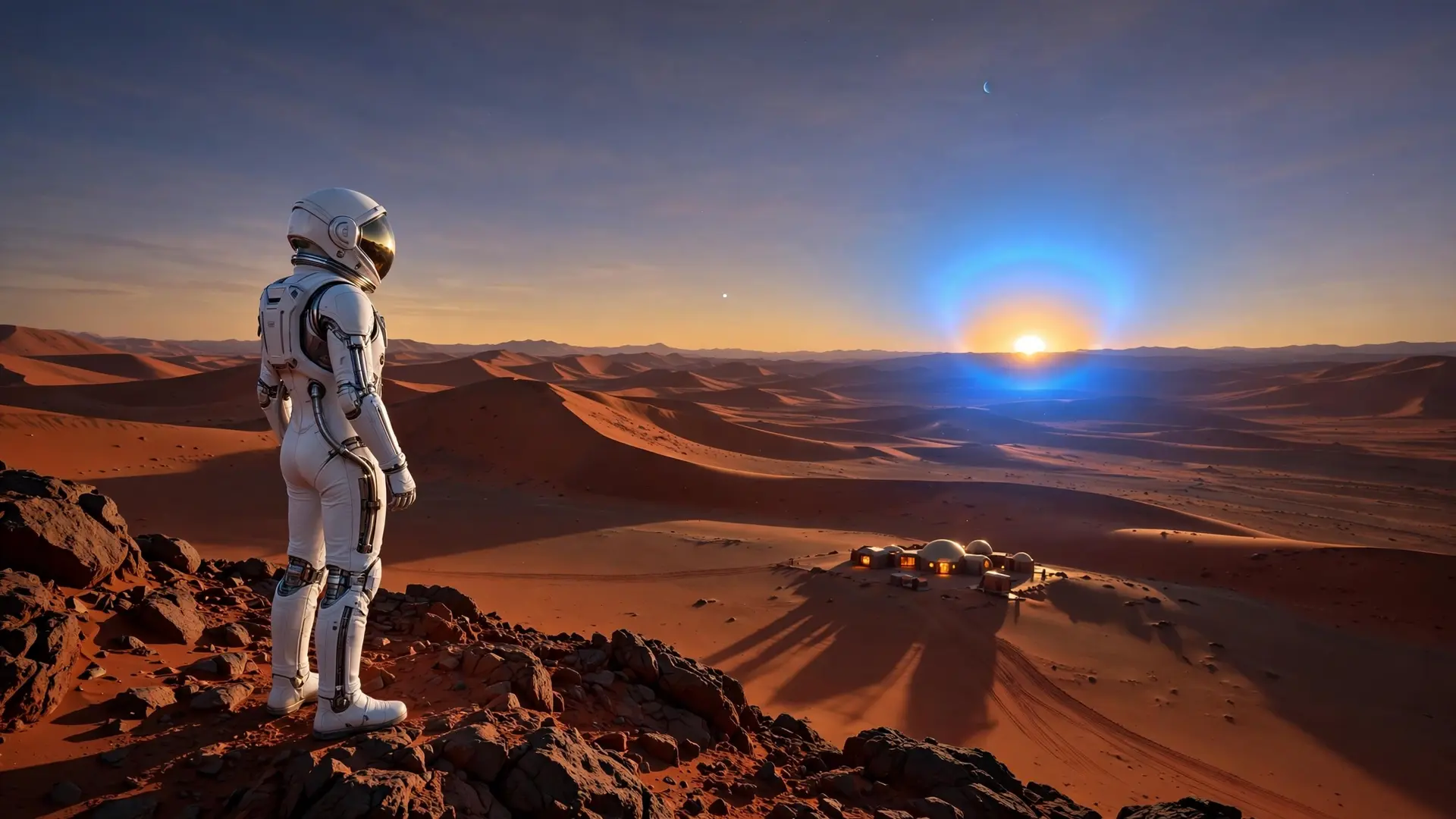
Then comes the moment no rendering prepares you for. The sun sinks toward the horizon and the sky around it turns blue. NASA’s Curiosity rover photographed it: on Mars, fine dust scatters blue light around the sun at dusk, so sunsets glow an eerie azure while the rest of the sky stays butterscotch. It is the single most alien thing you will ever see, and you will see it every clear evening.
Look up and the sky keeps performing. Phobos, the larger of Mars’ two moons, is so close and fast that it rises twice every sol, a dark potato tumbling overhead in hours. And if you know exactly where to look, there’s a pale-blue evening star that never climbs high: Earth. Curiosity once photographed it from the surface: our whole world, a dot. Dinner is greenhouse vegetables and shelf-stable staples, eaten in the commons dome under real plants, because a year of NASA’s isolation research keeps confirming the same thing: green things matter to morale. You walk the rows after your shift the way Earth people walk a park.
The honest part
Here is what the brochures leave out. The radiation problem is genuinely unsolved for long stays: a few years on the surface, unshielded, would spend an astronaut’s entire career radiation budget, which is why the sleeping quarters sit under the thickest shielding the colony has. The health effects of 0.38 g over decades are simply unknown; nothing that large has ever lived that long in partial gravity. There is no quick ride home: launch windows back to Earth open every 26 months, and the refueling that makes the trip possible is itself a frontier technology. And most days are not adventure. Most days are maintenance: fixing seals, washing dust, coaxing crops, filing reports.
But that is also what makes it real. A colony is not a resort and not a stunt — it is the most remote research station ever built, the one that never gets resupplied. Every system that keeps you alive was built by people who will never breathe the air it makes, a toaster-sized machine called MOXIE already proved the principle, squeezing 122 grams of oxygen out of thin Martian air between 2021 and 2023. Turning the whole planet breathable is a project for millennia. Living on it as it is, that starts with a single sol.
And still: when the blue glow spreads around a smaller sun, and Phobos crosses the sky for the second time that sol, someone will step outside in the dust and look up at Earth, a pale-blue star, and think — we’re doing it. That’s what a day on Mars feels like.