Cosmic Mysteries
The CMB Cold Spot: A Cold Case 20 Years On
A ten-degree patch of the Big Bang’s afterglow sits 70 microkelvin colder than it should. Twenty years on, no suspect fully explains it.
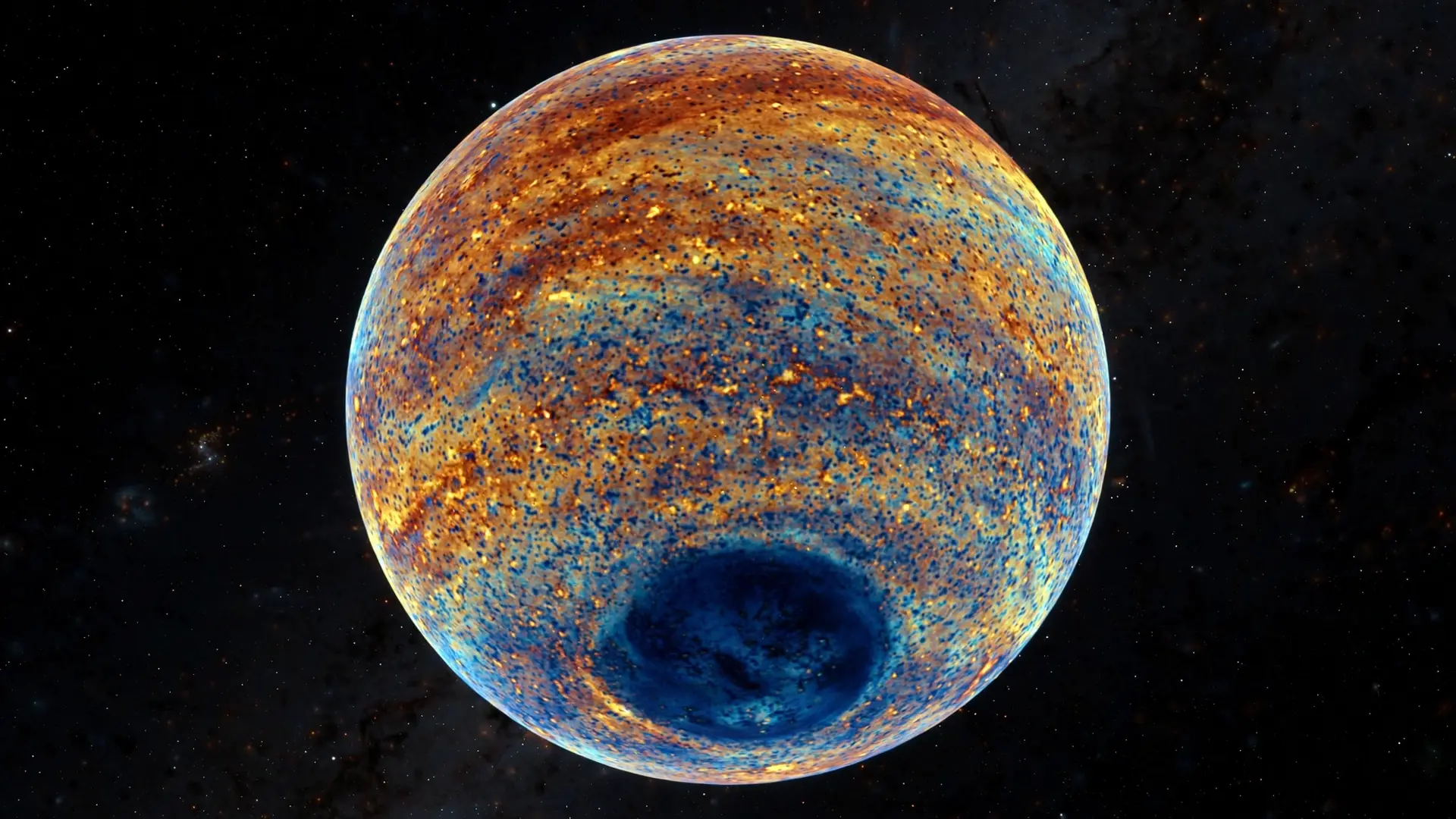
Spread the oldest light in the universe across a wall and it looks almost perfectly smooth. The afterglow of the Big Bang glows at 2.73 degrees above absolute zero in every direction, mottled by ripples just eighteen millionths of a degree tall. Then your eye catches it, low in the southern sky: a bruise. A patch ten degrees wide, about twenty full Moons across, sitting far colder than anything around it. It has been there in every map we have made since 2004, and nobody can say why.
The CMB Cold Spot is a ten-degree-wide patch of the Big Bang’s afterglow, about 70 microkelvin colder than average, in the constellation Eridanus. A giant supervoid, a cosmic texture, or a statistical fluke could explain it, but after twenty years of tests, no explanation fits all the evidence.
A bruise ten full Moons wide
The spot was found in 2004, when astronomers at the Instituto de Fisica de Cantabria in Spain ran a mathematical filter called a wavelet analysis over the first year of data from NASA’s Wilkinson Microwave Anisotropy Probe, or WMAP, building on a blind detection by Vielva and colleagues that same year. The filter was designed to hunt for places where the afterglow refused to behave like random noise. It found one, centered in the constellation Eridanus at galactic coordinates 207.8 degrees longitude and minus 56.3 degrees latitude. The team, led by Marcos Cruz, published the detection in 2005.
Here is what makes it strange. The cosmic microwave background, the CMB, is the light released when the universe was about 380,000 years old and finally cool enough for atoms to form. That light has been stretched by cosmic expansion into microwaves, and its temperature varies from place to place by only about 18 microkelvin, millionths of a degree, as a record of slightly denser and thinner patches in the infant universe. The Cold Spot averages about 70 microkelvin colder than the mean, roughly four times the typical wiggle, and at its deepest points it plunges about 140 microkelvin below average. Typical primordial ripples span about one degree of sky. The Cold Spot spans about ten.
So why, you might wonder, is a cold patch a problem at all? Because the standard model of cosmology says the early universe’s fluctuations were random, like static, with a specific statistical recipe. Run that recipe in a computer and a patch this large and this cold shows up, in one conservative estimate, only about 1.85 percent of the time, roughly a 1-in-50 chance. That is unlikely, but it is not impossible, and that gap between unlikely and impossible is where the whole mystery lives. When the European Space Agency’s Planck satellite mapped the same sky in sharper detail, the spot was still there, at similar significance, which ruled out the comforting idea that WMAP had simply glitched.
Suspect one: the giant hole
Initially, the most popular suspect was not in the infant universe at all, but in the space between us and it. In 2007, Lawrence Rudnick and colleagues at the University of Minnesota noticed a matching dip in a radio survey of galaxies in exactly the Cold Spot’s direction: fewer radio sources, as if a vast region of the universe were missing there. The dip’s significance was later disputed by other teams, but the idea it planted stuck. If a huge void sat between us and the CMB, light crossing it would lose energy and arrive colder, an effect called the integrated Sachs-Wolfe effect.
The logic is simple enough to picture. A void is a gravitational hill, not a well: with less mass there, spacetime is raised, not dented. Light climbing that hill loses energy, and because dark energy is stretching the void while the light crosses it, the hill flattens as the light travels, so the light regains less energy on the way down than it spent on the way up. It emerges tired, redder, colder.
Then came the void itself. In 2015, a team led by Istvan Szapudi of the University of Hawaii combined galaxy counts from the Pan-STARRS1 telescope and NASA’s WISE satellite and mapped a supervoid aligned with the Cold Spot: a region 1.8 billion light-years across, its center roughly 3 billion light-years away, holding far fewer galaxies than average. It belongs to the same family as the giant void we may live inside, an underdensity so large it strains the standard model. Szapudi called it what may be, in his words, ‘the largest individual structure ever identified by humanity.’ Case closed? Not quite. The same team admitted the void’s expected cooling effect did not fully explain the spot, and that admission turned out to be prophetic.
Later, the alibi fell apart. In 2017, Ruari Mackenzie and colleagues at Durham University did the expensive, unglamorous version of the test: they measured precise distances to 7,000 galaxies in the Cold Spot’s direction with the Anglo-Australian Telescope, instead of estimating distances from galaxy colors as earlier surveys had. Their map showed no monster void. The Cold Spot’s line of sight was split into ordinary smaller voids separated by clusters, a soap-bubble pattern that looked much like a control patch of sky elsewhere.
“The voids we have detected cannot explain the Cold Spot under standard cosmology.”
The plot twist from the Dark Energy Survey
Just when the supervoid seemed dead, it came back with better evidence and a stranger problem. In 2022, Andras Kovacs and the Dark Energy Survey collaboration mapped the region’s dark matter directly, by measuring how its gravity bends the light of galaxies behind it. Their mass map confirmed the Eridanus supervoid as the most prominent large-scale underdensity in the survey’s dark matter maps, a detection stronger than five standard deviations, and confirmed it sits at low redshift, below 0.2.
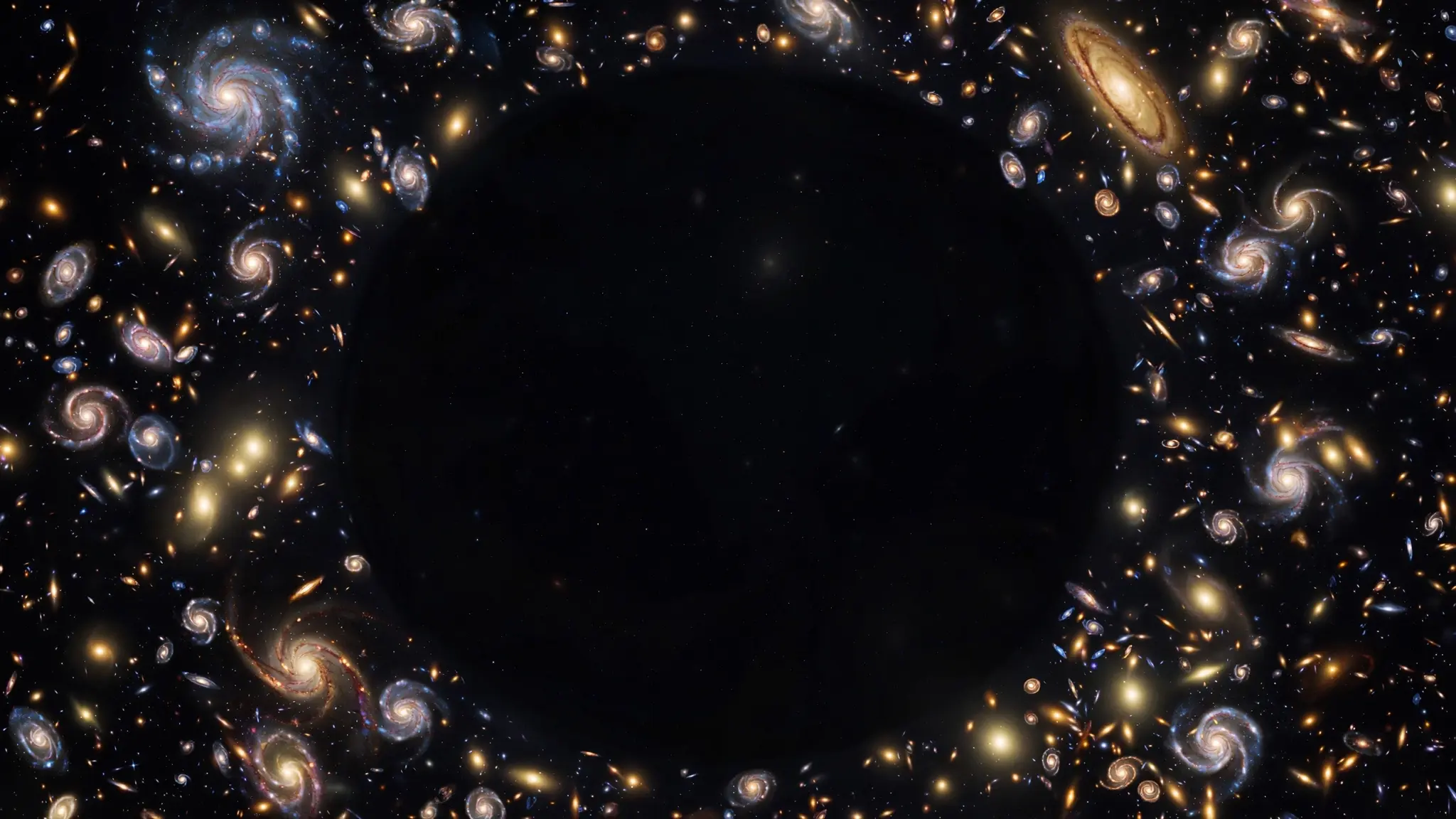
But the numbers still refused to add up. Under the standard model, the supervoid’s integrated Sachs-Wolfe cooling accounts for only about 10 to 20 percent of the observed temperature drop. The rest is unaccounted for. There is, however, a crack in that accounting. Supervoids elsewhere in the sky have shown cooling imprints about 5.2 times stronger than the standard model predicts, an excess that, if it applied to Eridanus too, would be roughly enough to explain the whole spot. The catch is that the survey’s own lensing measurement of the Eridanus void came out about 30 percent weaker than simulations of the standard model expected, a roughly two-standard-deviation effect at the void’s center, so a hint rather than a verdict. It suggests the void may have grown shallower over time in a way that would boost its cooling. So the supervoid is real, its cooling is too small on paper, and reality keeps suggesting the paper is missing something. That is not a solution. It is a better mystery.
Suspect two: a knot in the fabric of the universe
If the void cannot carry the case, the next suspect was born before the universe had atoms at all. In 2007, Cruz and colleagues, now working with Neil Turok, proposed that the Cold Spot could be a cosmic texture: a twisted knot of energy fields left over from a phase transition in the first fractions of a second after the Big Bang, like a defect frozen into a crystal as it cools. A collapsing texture would warp spacetime as it unwound, and light passing through would emerge redshifted, colder, in exactly the kind of smooth, round patch WMAP saw. Their statistical analysis found the spot’s size and depth consistent with a texture formed at an energy scale around 8.7 million billion gigaelectronvolts, far beyond any particle accelerator on Earth.
Turok himself kept the claim modest.
“We’re not certain this is a texture by any means. The probability that it’s just a random fluctuation is about 1 percent.”
The texture idea has a real virtue: it makes testable predictions about the spot’s shape and about polarization, the direction in which the ancient light vibrates. But nearly twenty years on, no confirming texture signature has appeared, and the idea remains what it was in 2007, a beautiful fit to one patch of sky, waiting for a second witness.
Suspect three: the fluke
Which leaves the least exciting suspect, and possibly the right one. A 1-in-50 event is rare, but the sky is big, and astronomers went looking for the weirdest thing in it. Once you account for the fact that the search itself picked the most extreme patch out of the whole map, the odds soften considerably. This is the look-elsewhere effect: if you scan a thousand lottery tickets for the biggest winner, the winner looks less miraculous than it did in isolation. Planck’s 2018 analysis sharpened this caution. Its polarization data, a second, independent view of the same ancient light, showed no significant corresponding anomaly at the Cold Spot, neither confirming new physics nor ruling it out.
“This means we can’t entirely rule out that the Spot is caused by an unlikely fluctuation explained by the standard model. But if that isn’t the answer, then there are more exotic explanations.”
There are wilder suspects in the file, including a bruise left by a collision with another universe. That idea has produced no supporting evidence, and it stays in the file because the case is unsolved, not because the evidence points there. Other unexplained silences, like the Fermi paradox, share the same shape: a universe that mostly behaves, interrupted by one thing that does not.
The verdict, for now
So where does the cold case stand? The spot is real, confirmed by two satellites. The supervoid in front of it is real, confirmed by galaxy counts and by dark matter maps. But the supervoid’s standard-model cooling explains only a fraction of the chill, the texture idea is unconfirmed, and the fluke explanation is unsatisfying precisely because it cannot be disproved. The next witnesses are already being called. Deeper surveys like Euclid and the Vera C. Rubin Observatory will map the galaxies along the Cold Spot’s line of sight in far greater detail, testing whether the void’s true shape hides extra cooling power, and next-generation CMB experiments will probe the spot’s polarization for the fingerprint a primordial origin would leave.
For now, the Cold Spot keeps its title. It is the largest unexplained bruise on the oldest picture we own, a place where the universe’s baby photo refuses to match the theory written to describe it. And like every good cold case, it stays open not for lack of suspects, but because every suspect has an alibi that is almost, but not quite, airtight.
Frequently asked questions
What is the CMB Cold Spot?
A region of sky in the constellation Eridanus, about ten degrees across, where the cosmic microwave background, the afterglow of the Big Bang, measures roughly 70 microkelvin colder than the 2.73 kelvin average. It was found in WMAP data in 2004 and confirmed by the Planck satellite.
How cold is the Cold Spot, really?
On average about 70 microkelvin below the CMB mean, with the deepest points around 140 microkelvin below. That sounds tiny, but typical CMB fluctuations are only about 18 microkelvin, so the spot is roughly four times colder than a normal ripple, and far wider than one.
What is the Eridanus supervoid?
A vast, underdense region of the universe, about 1.8 billion light-years across, found in the same direction as the Cold Spot. Light crossing it loses energy through the integrated Sachs-Wolfe effect and arrives colder. Under the standard model it explains only 10 to 20 percent of the spot’s chill, so it is a partial answer at best.
Could the Cold Spot be a collision with another universe?
That idea has been proposed, but it has no supporting evidence. The serious candidates remain a supervoid, a cosmic texture from the early universe, or a rare statistical fluke in an otherwise standard cosmos.
Has the Planck satellite solved the Cold Spot?
No. Planck confirmed the spot in temperature data, ruling out a WMAP instrument error, but its 2018 polarization analysis found no significant matching anomaly. That neither confirms new physics nor rules it out, so the mystery stands.
Sources & Research
The primary studies and reporting behind this story, linked for readers who want to check our work.
- Cruz, M. et al. (2005), "Detection of a non-Gaussian Spot in WMAP" · Monthly Notices of the Royal Astronomical Society, 356, 29-40
- Cruz, M. et al. (2007), "A Cosmic Microwave Background Feature Consistent with a Cosmic Texture" · Science, 318, 1612-1614
- Szapudi, I. et al. (2015), "Detection of a Supervoid Aligned with the Cold Spot of the Cosmic Microwave Background" · Monthly Notices of the Royal Astronomical Society
- Mackenzie, R. et al. (2017), "Evidence against a supervoid causing the CMB Cold Spot" · Monthly Notices of the Royal Astronomical Society, 470, 2328-2338
- Kovács, A. et al. (2022), "The DES view of the Eridanus supervoid and the CMB cold spot" · Monthly Notices of the Royal Astronomical Society, 510, 216-229
- Planck Collaboration (2020), "Planck 2018 results. VII. Isotropy and Statistics of the CMB" · Astronomy & Astrophysics, 641, A7