Cosmic Mysteries
The Wow! Signal at 50: Stronger, Sharper, Still Unexplained
The Wow! Signal was a 72-second burst in 1977 that never repeated. A 2025 re-analysis made it stronger and sharper, and telescopes will listen again in August 2027.
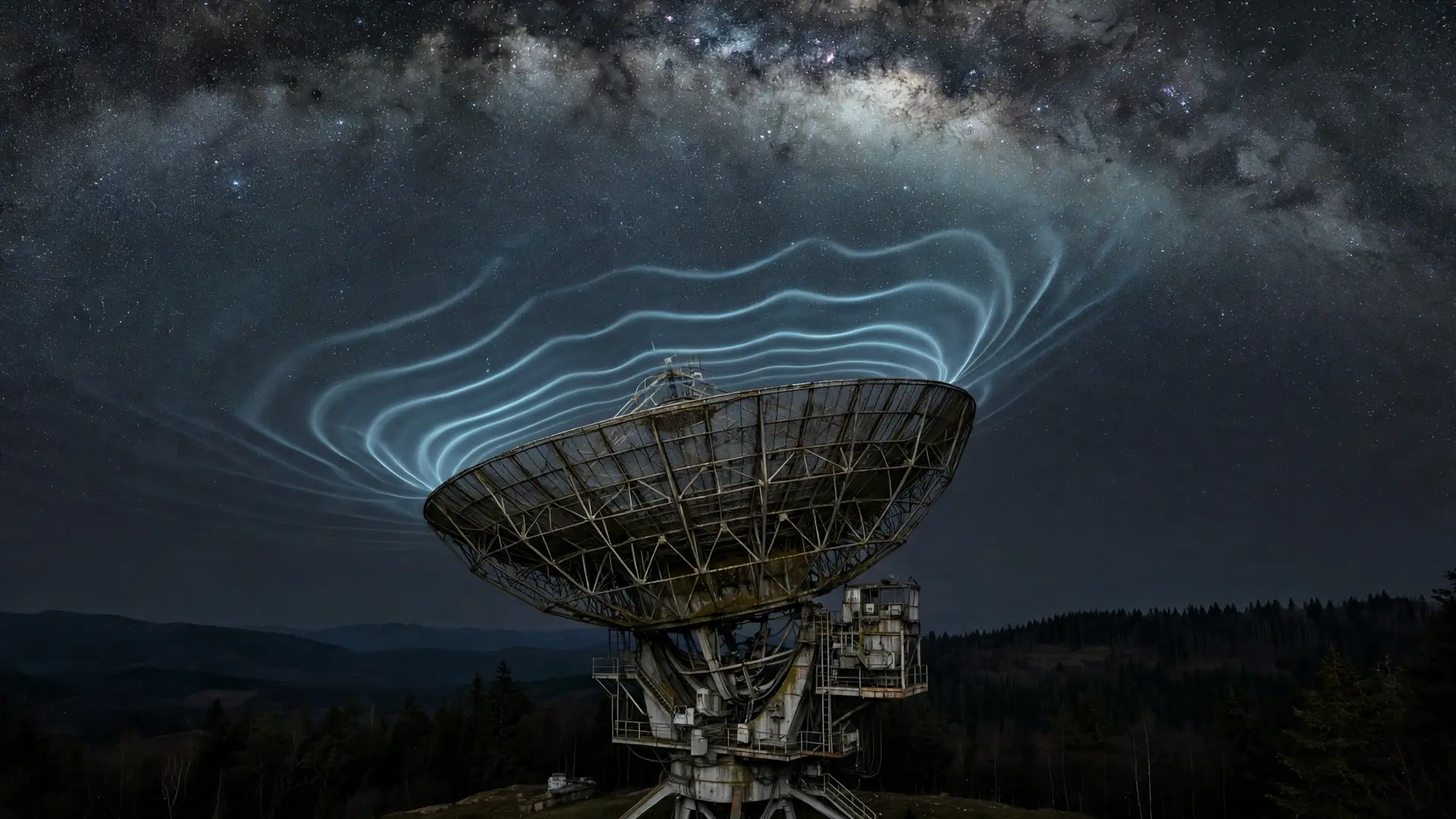
The telescope was listening alone. Late on August 15, 1977, Ohio State University’s Big Ear radio telescope swept the sky over Delaware, Ohio, the way it did every night, recording numbers onto a computer printout nobody was watching. Days later, astronomer Jerry Ehman picked up the stack, scanned the columns, and stopped at six characters climbing out of the noise: 6EQUJ5. He circled them in red pen and wrote one word beside them: Wow!
Here is the short version. The Wow! Signal was a 72-second narrowband burst near the hydrogen line that never repeated. A 2025 re-analysis made it four times stronger, pinned it to a sharper patch of sky, and offered a natural explanation, a flare in a cold hydrogen cloud. In August 2027, telescopes will listen to that sky again.
Seventy-two seconds, then silence
Big Ear was a drift telescope. It did not steer. Earth’s rotation carried a fixed patch of sky through its beam, so a real source far away should rise, peak, and fall over about 72 seconds as it crossed, and that is exactly what the printout showed. The code was the telescope’s shorthand for intensity: numbers and letters marked how far each 12-second sample rose above the background noise, and the letter U meant about 30 times background. A second feed horn swept the same patch about three minutes later and saw nothing, which is what you expect when a signal lasts exactly one beam crossing and then stops.
Two things made the burst electrifying. It was narrowband, squeezed into a thin slice of radio spectrum the way a transmitter’s signal is, not smeared across frequencies the way most natural radio noise is. And it sat near 1420 megahertz, the frequency at which cold hydrogen atoms broadcast, the most common element in the universe sending on its own channel. If you stood in that Ohio field that night, you would have heard nothing. All the drama was in the numbers. And then came the silence that has lasted 49 years: despite decades of follow-up searches with telescopes including the Very Large Array, the Allen Telescope Array, and Green Bank, the signal has never been seen again.
Every easy answer broke
Initially, the most popular explanations were the most ordinary ones, and each one fell apart on inspection. In 2017, astronomer Antonio Paris proposed that hydrogen gas around two passing comets, 266P/Christensen and P/2008 Y2 (Gibbs), had produced the burst. Staff at the Ohio State Radio Observatory answered with a rebuttal: the comet’s calculated position that night sat roughly an hour of right ascension away from where the signal came from, and no comet has ever been shown to glow at the hydrogen line anywhere near the Wow! Signal’s intensity. The comet idea did not survive its own coordinates.
Later, a different kind of answer appeared: a suspect star. In 2020, amateur astronomer Alberto Caballero identified a sunlike star, 2MASS 19281982-2640123, about 1,800 light-years away in the signal’s direction. It was a candidate address, not a detection. No signal has ever been recorded from that star, and an address without a second signal is just a dot on a map. Meanwhile, the interference theory, the idea that the burst was a satellite, a ground transmitter, or a reflection off the Moon, kept getting weaker as re-analyses tested it. The 2025 paper’s verdict is blunt: the evidence points away from interference and toward something astrophysical. The same silence sits at the heart of the Fermi paradox: a universe that looks empty, interrupted once by a shout nobody can explain.
Space archaeology
The case broke open not with a new telescope, but with old paper. The Arecibo Wow! project, led by astrobiologist Abel Méndez at the University of Puerto Rico at Arecibo, went back to decades of previously unpublished Ohio SETI observations and reworked them with modern methods. As researcher Héctor Socas-Navarro put it:
“We look at old archives with modern science methodologies. It’s a bit like space archaeology.”
The digging paid off before the Wow! Signal itself was even re-measured. In drift scans made at Arecibo between February and May 2020, using methods similar to Big Ear’s but more sensitive, with better time resolution and polarization measurements, Méndez and colleagues caught narrowband signals near the hydrogen line that looked like faint cousins of the Wow! Signal. They were about a hundred times weaker, they appeared in several directions, and unlike the Wow! Signal, they could be identified: small, cold clouds of neutral hydrogen drifting through the Milky Way. That discovery quietly broke a rule SETI hunters had leaned on for decades. Narrow does not automatically mean artificial. Nature can hum a single note too, a lesson that matters for every search for alien megastructures.
A flare in a cold cloud
From those faint clouds came the boldest idea of the whole case. Picture a cold hydrogen cloud as a hall full of atoms all holding the same note, quiet, until a flash of energy from a magnetar flare or a soft gamma repeater sweeps through and makes them sing that note together, far louder than any one atom could alone. The physics has names, maser flare or superradiance, but the picture is simple: a sudden brightening of the hydrogen line, triggered from outside, that flares and dies in about a minute. Méndez and colleagues argue the Wow! Signal could be the first recorded event of its kind, a hydrogen-line maser flare caught by accident in 1977.
The signal just got bigger and moved
Then came the re-measurement. The team’s second paper, released in August 2025, rebuilt Big Ear’s calibration and pointing from the archival records and revised nearly every number in the story. The signal’s possible origin narrowed to two adjacent fields, at right ascensions 19h 25m 02s or 19h 27m 55s, each uncertain by about three seconds, with declination near minus 26 degrees 57 minutes, uncertain by about 20 arcminutes. Its peak strength rose to more than 250 janskys, about four times the 54-jansky value most retellings quoted. Its frequency was corrected to 1420.726 megahertz, different from the long-quoted 1420.4556 megahertz figure, which implies a source moving toward the Sun at about 84 kilometres per second, a blueshift, instead of receding from us. As Méndez said:
“Our results don’t solve the mystery of the Wow! Signal, but they give us the clearest picture yet of what it was and where it came from. This new precision allows us to target future observations more effectively than ever before.”
Those three changes, stronger, sharper, and shifted, are why this story is back. A stronger signal raises the bar for every explanation: whatever made it had to deliver far more energy than the old numbers demanded. A sharper location turns a vague patch of Sagittarius into two fields a telescope can actually aim at. And a corrected frequency tells every future listener exactly which dial setting to use. The paper is candid about its own status: it was released as a preprint in August 2025, to be submitted to The Astrophysical Journal after incorporating feedback, so the new numbers are the team’s best reconstruction, not yet a refereed result.
The honest objections
So why, you might wonder, should you trust a flare nobody has ever seen? That is the right question, and the honest answer is that the idea has a hole in it. The hydrogen clouds Méndez’s team actually caught glowing in 2020 measured only a few janskys, roughly a hundredth of the Wow! Signal’s revised strength. For the maser idea to work, some flash must have amplified a cloud like those by a factor nobody has observed in the hydrogen line, and then never done it again in 49 years of watching, even though magnetars themselves flare repeatedly. Other one-off radio mysteries, like the fast radio burst that repeats every 16 days, at least gave astronomers a second act to study. The Wow! Signal has refused even that.
The paper does not hide this. It also does not close the alien door. An artificial beacon remains formally possible, just unsupported: no message was ever decoded from 72 seconds of numbers, no repetition has confirmed a transmitter, and a natural mechanism now exists that fits the shape of the signal even if its power stretches belief. That is the state of play, stated plainly. Natural explanation in the lead, alien explanation unruled out, mechanism unobserved. Anyone selling more certainty than that is selling something else.
August 2027: the second listen
Here is where the story stops being history and becomes a calendar event. The Japanese Society for SETI has called for worldwide joint observations of the Wow! Signal’s source region in August 2027, particularly around August 15, the 50th anniversary, at the revised frequency of 1420.726 megahertz and the revised coordinates. Facilities that have expressed interest or are under consideration include LOFAR, Breakthrough Listen, MeerKAT, Taiwan’s Bustling Universe Radio Survey Telescope, the University of Manchester, and Misato Observatory, and optical SETI observations are explicitly welcome. If any candidate of extraterrestrial origin turns up, the call recommends following the International Academy of Astronautics declaration on SETI detections, and the organizers plan an official announcement of the campaign’s outcome.
Méndez’s team has its own anniversary aim: to archive and share all of Big Ear’s data by 2027, so anyone can rework the case. And the hunt is widening beyond big dishes. The Wow@Home citizen-science project argues that the signal was strong enough for small telescopes to catch similar events, with a complete setup costing around 500 dollars, turning a once-in-50-years accident into something a network of backyard dishes could watch for around the clock. As Méndez put it:
“This study doesn’t close the case. It reopens it, but now with a much sharper map in hand.”
For 49 years the Wow! Signal has been a story about a single night in Ohio. The 2025 re-analysis turned it into something better: a sharper question with a date attached. Next August, dishes on several continents will point at two small patches of Sagittarius and listen on one precise frequency. If the sky stays silent, the flare idea gains ground and the mystery narrows further. If it speaks again, everything changes. Either way, the most famous unanswered signal in astronomy finally has a second appointment, and for the first time, we know exactly where to listen.
Frequently asked questions
What exactly was the Wow! Signal?
A 72-second narrowband radio burst detected on August 15, 1977 by Ohio State University’s Big Ear telescope, near the 1420 megahertz hydrogen line. On the printout it appeared as the sequence 6EQUJ5, peaking about 30 times above the background noise. It has never been detected again.
Was the Wow! Signal aliens?
Nobody knows, and no evidence says yes. The leading hypothesis is now natural: a magnetar flare or soft gamma repeater triggering a brief maser brightening in a cold hydrogen cloud. The 2025 re-analysis does not rule out an artificial beacon, but no message was decoded and the signal never repeated, so aliens remain an unsupported possibility, not a finding.
What did the 2025 re-analysis change?
Almost every number. The peak strength rose to more than 250 janskys, about four times the 54-jansky value most retellings quoted. The frequency was corrected to 1420.726 megahertz. The possible origin narrowed to two adjacent sky fields in Sagittarius. The paper was released as a preprint in August 2025, to be submitted to The Astrophysical Journal after incorporating feedback.
Will scientists listen for the Wow! Signal again?
Yes. The Japanese Society for SETI has called for worldwide joint observations in August 2027, particularly around August 15, the 50th anniversary, at 1420.726 megahertz and the revised coordinates. Interested facilities include LOFAR, Breakthrough Listen, and MeerKAT, and optical SETI observations are welcome too.
Sources & Research
The primary studies and reporting behind this story, linked for readers who want to check our work.
- Méndez, Abel et al. (2025), "Arecibo Wow! II: Revised Properties of the Wow! Signal from Archival Ohio SETI Data" · arXiv:2508.10657
- Méndez, Abel, Ortiz Ceballos, Kevin N. & Zuluaga, Jorge I. (2024), "Arecibo Wow! I: An Astrophysical Explanation for the Wow! Signal" · arXiv:2408.08513
- EarthSky, "The Wow! Signal: New analysis closes in on mysterious source" (August 24, 2025) · EarthSky
- Space.com, "That mysterious Wow! signal from space: Scientists may finally know where it came from, and it is probably not aliens" (August 2025) · Space.com
- Japanese Society for SETI, "Call for Worldwide Joint Observations: Wow! Signal 50th Anniversary" · Japanese Society for SETI