Cosmic Mysteries
Why Does Venus Spin Backwards?
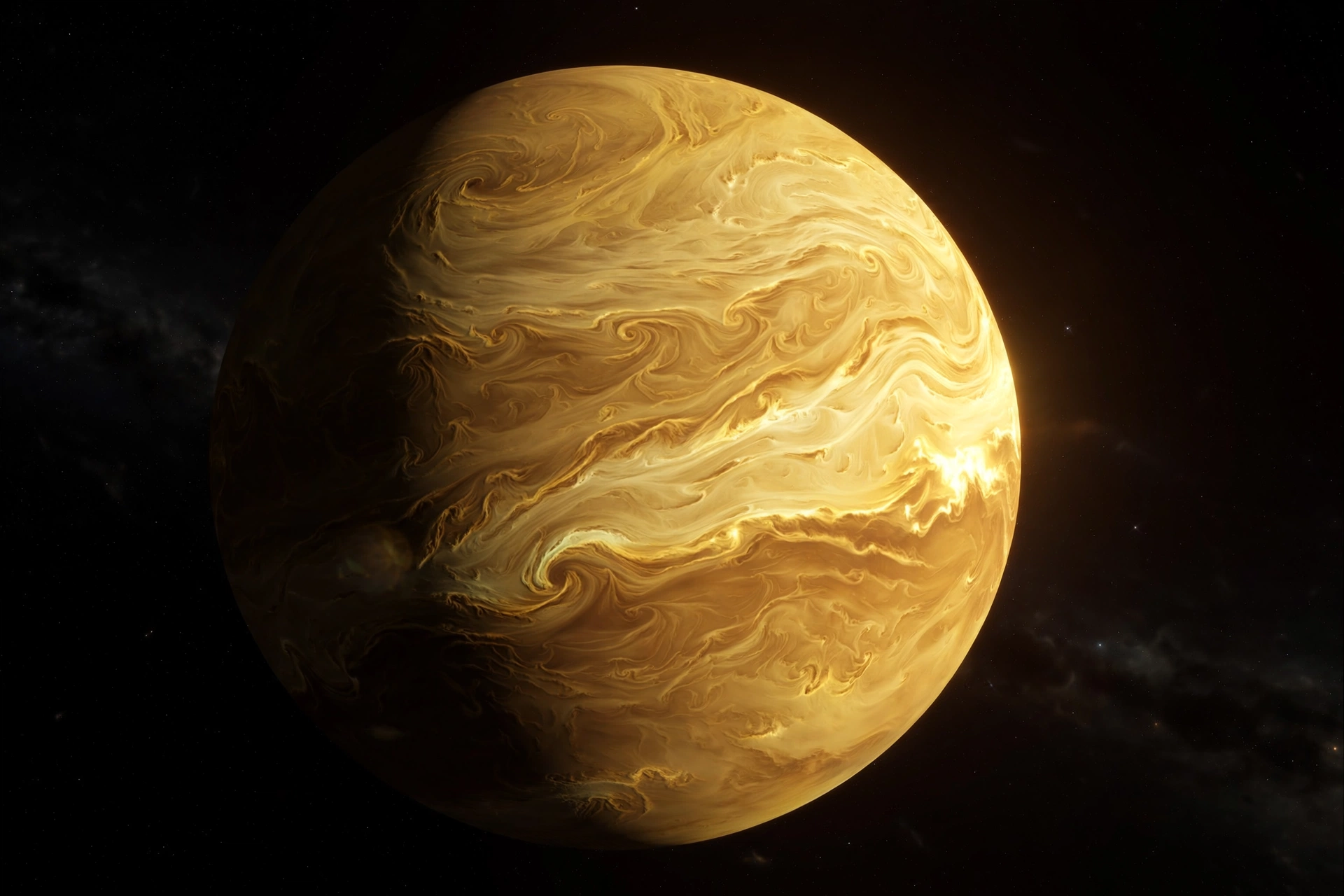
Venus turns backwards once every 243 days, slower than its own year. A 2026 model says no giant crash was needed: its thick air reversed it.
Dawn on Venus breaks in the west. If you could stand on its rock, under a sky that never clears, you would watch the Sun crawl up the wrong side of the sky, take about two months to cross it, and sink in the east. Then night would hold for about two more months. Everything about the scene feels like a planet running in reverse, because it is.
Here is the short answer. Venus spins backwards because two opposing torques from the Sun reached a standoff: gravity tides on the solid planet brake it toward lockstep, while tides in its dense, sun-heated atmosphere push the other way. A 2026 model shows that standoff can reverse a normal spin with no giant collision at all.
A day longer than its year
Venus turns once every 243 Earth days, backwards, and circles the Sun in about 225 days, so one full spin outlasts its year. Sunrise to sunrise takes about 117 Earth days, because the backward spin and the forward orbit partly cancel. Nobody knew any of this until the early 1960s, when radar pulses from Earth finally pierced the unbroken cloud deck and timed the surface turning beneath it. Venus shows no ground to a telescope. Its spin had to be eavesdropped.
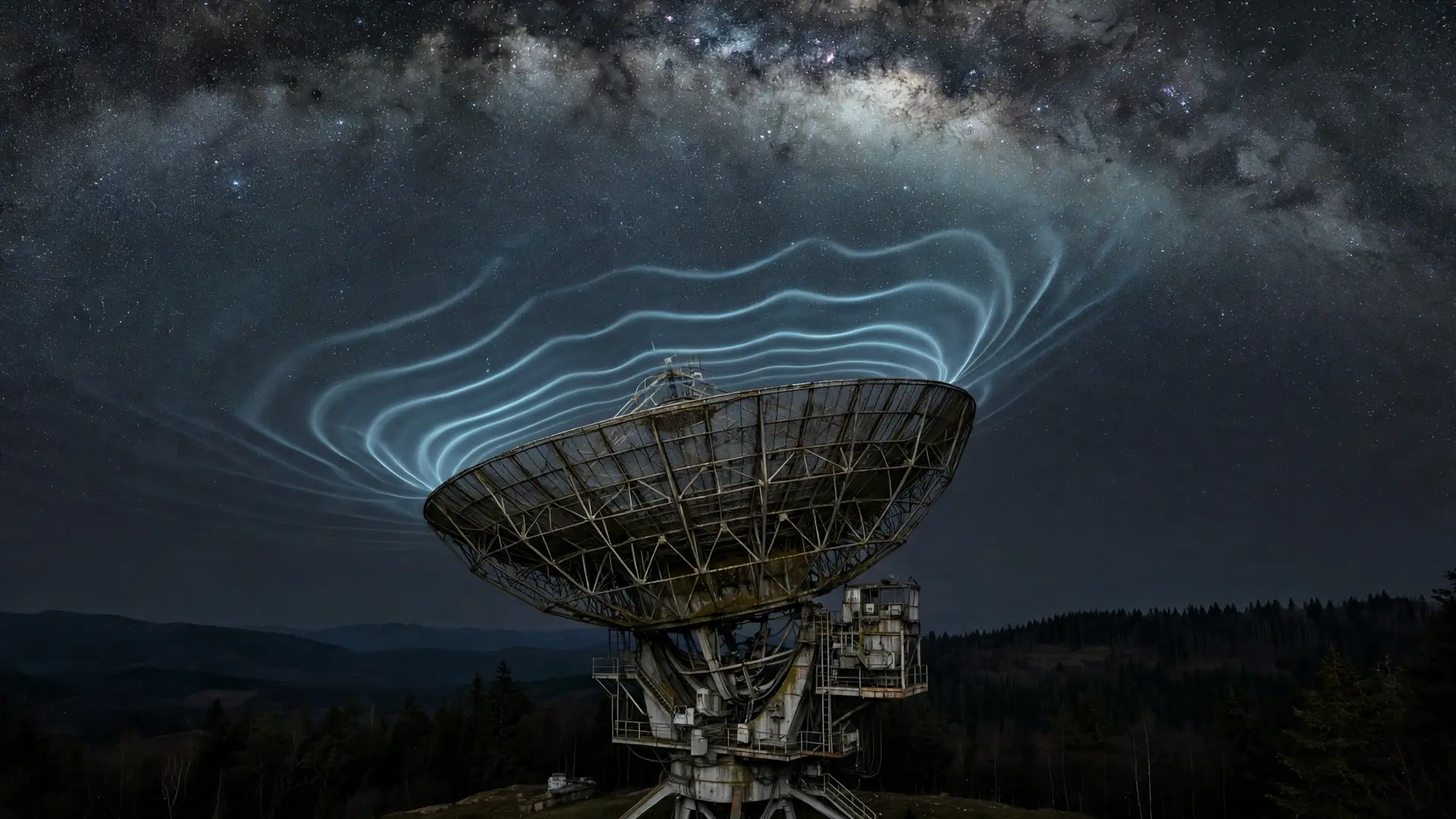
The modern numbers come from patience. Between 2006 and 2020, Jean-Luc Margot at UCLA and his colleagues bounced radar off Venus 21 times from the Goldstone antenna in California and read the echoes at Green Bank in West Virginia.
“Each individual measurement was obtained by treating Venus as a giant disco ball. We illuminated Venus with a giant flashlight, the radar at Goldstone, and observed the reflections as they swept over the surface of the Earth,”
Their average spin, 243.0226 days, came with a surprise: individual measurements varied by at least 20 minutes. The day on Venus breathes, because its massive atmosphere trades momentum with the rock below. An earlier mismatch told the same story. Maps from ESA's Venus Express orbiter, mapping in 2006 to 2008, only lined up with Magellan maps from the early 1990s if the average spin across the 16 years between the missions ran about 6.5 minutes per day longer than Magellan had measured. Venus does not keep perfect time, and the sloppiness is a clue: its air is heavy enough to shove the planet around.
Call it upside down, if you like. Measured the usual way, the tilt of the axis of Venus is 177.4 degrees, nearly flipped. Measured against its actual spin, the planet stands almost upright, tipped just 2.64 degrees, with almost no seasons. Both numbers describe the same fact: Venus rotates clockwise as seen from north of the solar system, opposite its orbit and opposite nearly every other planet. Uranus rolls on its side, but Venus alone crawls backwards this slowly.
The crash theory has an alibi problem
The oldest explanation is a catastrophe. Early in the history of the solar system, the story goes, a young Venus was struck by a body big enough to knock its spin over, or reverse it outright. Impacts were common then, and the idea has a clean appeal: one bad day explains four billion years of backwards.
The crash has a problem, and it is not the flip. It is the staying flipped. In 2026, Sylvio Ferraz-Mello at the University of São Paulo ran the numbers for a Venus stripped of its air, using a modern form of tidal theory. Without the atmosphere, the gravity tides of the Sun alone would undo a backwards spin in about 700,000 years, a blink against the age of the solar system, dragging the planet back to forward, Sun-locked rotation.
“If the reversal were caused by a sudden event, such as a collision, the planet would eventually start rotating in the correct direction again. Therefore, it can't be an instantaneous effect; it must be a continuous process,”
So even if a crash started the reversal, something has to hold Venus backwards today, every day, against the pull of the Sun. That something turns out to be the sky itself. Which raises a sharper question: if the sky can hold the spin backwards, could it have reversed the spin on its own?
Two torques, pulling opposite ways
Start with the brake. The gravity of the Sun raises a tidal bulge in the solid body of Venus, the way the Moon raises tides in the oceans of Earth. Venus turns too slowly for the bulge to keep up, so the bulge lags, and the Sun pulls on the lagging bulge like a hand dragging on a flywheel. Left alone, that drag would slow any spin toward lockstep, one face held toward the Sun forever, the way the Moon keeps one face toward Earth.

Now the accelerator. Sunlight heats the dayside of an atmosphere roughly 90 times as massive as the air of Earth, 92 bars of carbon dioxide pressing at the surface, the crushing blanket that makes terraforming Venus such a brutal engineering problem. Air takes time to warm, so the heated bulge sits offset from the noon point, leading the turn of the planet by roughly 30 degrees in the model of Ferraz-Mello. The gravity of the Sun grabs that offset bulge and hauls on it, and the haul points the other way: it pushes the spin away from lockstep. The air is no passenger. Its top layer races around Venus in about four days, some 60 times faster than the ground beneath it, a super-rotation that thermal tides help to maintain.
“The Sun's gravitational pull on the planet's solid part and on the atmosphere acts in opposite directions. One tends to slow the rotation; the other accelerates it in the opposite direction. Ultimately, the atmosphere prevails,”
This standoff is not a new idea. Thomas Gold and Steven Soter proposed in 1969 that the present spin of Venus sits near a balance between exactly these two torques. What changed is what the balance can explain. A balance can hold a spin in place. The work of Ferraz-Mello asks whether it can also create one.
The fork in the road
In 2001, Alexandre Correia and Jacques Laskar simulated the spin of Venus over billions of years and found that a planet with a dense atmosphere can settle into only four final spin states.
“We found that, due to the presence of the dense atmosphere, the rotation can only end in four possible spin states,”
Two of those routes end where Venus sits now. In one, the axis slowly tips toward upside down while the spin decays. In the other, the axis stays nearly upright, the spin slows to a stop, and then the atmospheric torque winds it up again in reverse. The Venus we measure today cannot tell us which road it took. Both arrive at the same backwards crawl.
The 2026 model of Ferraz-Mello fills in the second road as a story in three acts. First, a young Venus with a thin atmosphere spins the normal way, and gravity tides brake it toward lockstep with its year. Then the planet outgasses its thick blanket of air, and the atmospheric torque grows with it. At a threshold, the lockstep state stops being stable and splits in two, a pattern dynamicists call a pitchfork bifurcation: one branch spins a planet up, forward and faster than its orbit, and the other slows it through zero and into reverse. Venus took the slow branch. No crash, no rare alignment, just a fork that any similar planet can reach.
The case is not closed
Impact modelers are not conceding. At the European Geosciences Union meeting in Vienna in 2026, Cédric Gillmann of ETH Zurich and colleagues reported simulations in which a body about a tenth of the mass of Venus, arriving fast and at a steep angle within the first 50 million years of the planet, could drastically slow a fast-spinning young Venus, and in some glancing cases leave it turning backwards, though faster than today. The slow crawl we measure would then be the work of later evolution. Their work is a conference report, not yet a peer-reviewed paper, and it answers the origin question, not the maintenance one: an impact could still have supplied the first push, with the atmosphere then taking over the job of holding the spin in place. The honest summary is that the two camps are answering different halves of the question, and a hybrid history, an early shove plus four billion years of atmospheric grip, fits everything known so far.
What would settle it is better knowledge of the inside of Venus. The spin we measure is an average over a planet whose core, mantle stiffness, and early air are still guesses, and each guess moves the models. The VERITAS orbiter from NASA and the EnVision mission from ESA, both planned for the early 2030s, will pin down the spin, its wobble, and the interior far more tightly. If the spin is still drifting today, as the mismatched maps hint, that drift is the tug-of-war made visible, and measuring it would test the torque balance directly.
Backwards may be the normal way
The stakes leave the solar system quickly. The model of Ferraz-Mello needs only a rocky planet close enough to a Sun-like star for tides to nearly lock its spin before its atmosphere finishes forming, but not so close that starlight strips the air away. That is a description of the habitable zone. If he is right, backwards spins should be common among Earth-sized worlds around other stars, including worlds like K2-18 b, where astronomers are already reading the air of a distant planet. We cannot yet measure the spin of such small, distant worlds, so Venus is the one laboratory where the experiment has already run.
We used to read the backwards spin of Venus as a scar, the record of the worst day in its history. It may instead be a signature of the air itself: proof that a thick atmosphere is not decoration on a planet but a hand on its rotation, strong enough to stop a world and turn it around. Venus did not need to be hit to end up backwards. It needed only to grow a sky, and wait.
Frequently asked questions
Why does Venus spin backwards?
Its spin is held in a balance of two torques from the Sun. Gravity tides on the solid planet brake it toward lockstep with its orbit, while thermal tides in its dense, sun-heated atmosphere push the opposite way. A 2026 model by Sylvio Ferraz-Mello shows that as the atmosphere grew, that balance could slow a normal spin to a stop and reverse it, no giant impact required. An ancient impact may have helped, but it cannot by itself explain why the spin is still backwards today.
Is Venus upside down?
By the standard tilt measurement, yes: its axis is tilted 177.4 degrees, nearly flipped over. The same spin can be described the other way, as a planet tipped just 2.64 degrees from upright that rotates clockwise when seen from north of the solar system. Either description gives the same planet: almost no seasons, and a Sun that rises in the west.
How long is a day on Venus?
One full spin takes 243 Earth days, longer than the Venusian year of about 225 Earth days. Sunrise to sunrise takes about 117 Earth days, because the backwards spin and the forward orbit partly cancel, so a single stretch of daylight lasts about 58 Earth days. The exact spin also wobbles: radar measurements found the length of the day varying by at least 20 minutes.
Did a giant impact flip Venus?
Possibly, but it is not proven, and it is not required. Correia and Laskar showed in 2001 that most starting spins end at the present state without a large impact, and Ferraz-Mello showed in 2026 that a backwards spin caused by a crash alone would be undone by tides in under a million years unless the atmosphere held it in place. Impact simulations reported in 2026 show a big early hit could have supplied the first push. The present spin cannot distinguish the two histories.
Does any other planet spin backwards?
Uranus is the other case: tipped about 98 degrees, it rolls around the Sun on its side, which makes its spin retrograde by the tilt definition, most likely because of ancient impacts. Venus is different in kind. It is the slowest rotator of any planet, and the only one whose backwards spin is actively maintained today by the push of its own atmosphere.
Sources & Research
The primary studies and reporting behind this story, linked for readers who want to check our work.
- Ferraz-Mello, S. (2026), "Exoplanet Synchronization in the Habitable Zone: Learning from Venus' Retrograde Rotation" · The Astronomical Journal, 171, 206
- Arantes, J. T. (2026), "New physical model explains Venus's retrograde rotation as a natural result of planetary evolution" · Agência FAPESP
- Correia, A. C. M. & Laskar, J. (2001), "The four final rotation states of Venus" · Nature, 411, 767-770
- Margot, J.-L. et al. (2021), "Spin state and moment of inertia of Venus" · Nature Astronomy
- Mueller, N. T. et al. (2012), "Rotation period of Venus estimated from Venus Express VIRTIS images and Magellan altimetry" · Icarus, 217, 474-483
- Gillmann, C. et al. (2026), "Giant impacts on Venus: lasting consequences on interior dynamics and volcanism, or the lack thereof" · EGU General Assembly 2026, EGU26-10551
- NASA, "Venus: Facts" · NASA Science