Black Holes & Singularities
Are Primordial Black Holes Dark Matter?
Born in the first second of the universe, primordial black holes could be the dark matter. In 2026 the case narrowed sharply. One hiding place is left.
One second after the beginning, the universe was a soup of light and particles hotter than any star's heart. Somewhere in it, a patch of space was a fraction of a percent denser than its surroundings, and gravity grabbed it. In less than a blink, the patch folded inward and pinched off into a black hole, smaller than a single atom or heavier than a hundred billion Suns. Fifty-five years later, physicists are still asking whether the universe is full of them.
Primordial black holes are the oldest dark matter suspect we have: black holes born in the first second of the universe, needing no new particle to explain 85 percent of matter. In 2026 the case narrowed sharply: the heaviest candidates ruled out, the lightest squeezed tighter than ever, a claimed sighting debunked. One hiding place remains: asteroid-mass black holes.
The perfect suspect
The idea is older than most of the people working on it. In 1971, Stephen Hawking pointed out that the early universe was dense enough for black holes to form without any star at all: a patch of the primordial soup only slightly denser than its surroundings could collapse under its own weight. A black hole born before the first atomic nuclei formed is not ordinary matter, so it slips past every limit on normal stuff, and on galactic scales it would behave like dark matter: invisible, everywhere, and heavy.
The mass of a primordial black hole is set by its birthday: the earlier the collapse, the lighter the hole. Asteroid-mass holes were born in the first tiny fraction of a second; one born a full second in could outweigh tens of thousands of Suns. The suspect could be anything from a speck to a monster, so the hunt runs by mass, rung by rung. The light ones glow as they die, the middle ones bend starlight, the heavy ones warp the afterglow of the Big Bang. In 2026, detectives climbed every rung at once, and the ladder got a lot shorter.
The light end: death by glow
The lightest suspects give themselves away by dying. Stephen Hawking showed that black holes are not entirely black: the smaller they are, the hotter they burn, leaking particles until they evaporate. Any primordial black hole lighter than about 500 trillion grams would already have burned out. The ones just above that line are dying now, glowing in gamma rays.
In June 2026, a team led by Ilias Cholis at Oakland University took the sharpest look yet at that haze. They modeled the extragalactic gamma-ray background and subtracted the known contributors: blazars, radio galaxies, star-forming galaxies, and ultra-high-energy cosmic-ray cascades. Then they added the glow an evaporating population would produce, calculated with GammaPBHPlotter, which also tracks extra gamma rays from annihilating positrons. Black holes around 10^14 grams can make up at most about one part in ten billion of the dark matter. Slightly heavier ones, near 3×10^16 grams, are where the data show a faint hint, a best fit of about 6 percent of the dark matter, though far too weak to claim a detection.
Here is the catch. The tightest limits come from the MeV gamma rays where evaporating black holes should shine brightest, and the best MeV measurements we have are from EGRET and COMPTEL, instruments that flew on the Compton Gamma Ray Observatory in the 1990s. That satellite was deorbited in 2000, so Cholis and his colleagues are prosecuting a 2026 case with 1990s evidence. Two proposed telescopes, AMEGO-X and e-ASTROGAM, could close the MeV gap, but neither has been selected yet. Until one flies, the lightest black holes keep a sliver of doubt.
The middle: twelve flashes that weren't
The middle of the ladder is hunted with a magnifying glass made of gravity. When an invisible object drifts in front of a distant star, its gravity briefly bends and brightens the starlight, a flash called microlensing, and the heavier the lens, the longer the flash. A planet-mass black hole crossing a star in Andromeda would flash for a few hours, so the Subaru telescope in Hawaii photographed Andromeda every two minutes. In February 2026, a team led by Sunao Sugiyama reported the payoff: twelve candidate flashes shorter than five hours, four of them high-confidence. If the flashes were black holes, they pointed to planet-mass holes, a ten-millionth to a millionth of the Sun's mass, making up roughly a tenth of the dark matter. Within weeks, one paper wove the candidates together with the nanohertz gravitational-wave hum from pulsar timing arrays, proposing a single origin for both.
Then the rebuttal landed. On March 31, 2026, Przemek Mróz and Andrzej Udalski of the University of Warsaw re-analyzed the same Subaru data with an independent pipeline: every one of the twelve candidates was a familiar kind of variable star, not a lensing flash at all.
“We find no compelling evidence for short-timescale microlensing events among the candidates identified in the Subaru data set, nor for a significant population of planetary-mass PBHs as dark matter components.”
Ten of the twelve were RR Lyrae stars, old stars that pulse on a regular beat. One was an eclipsing binary, and one was an unclassified variable star. A microlensing flash is symmetric, brightening and fading the same way, but these light curves were lopsided, and several stars kept varying on other nights, which a one-off lensing event cannot do. The paper's title says it in Italian, a nod to Galileo: Eppur non si trovano, and yet they are not found.
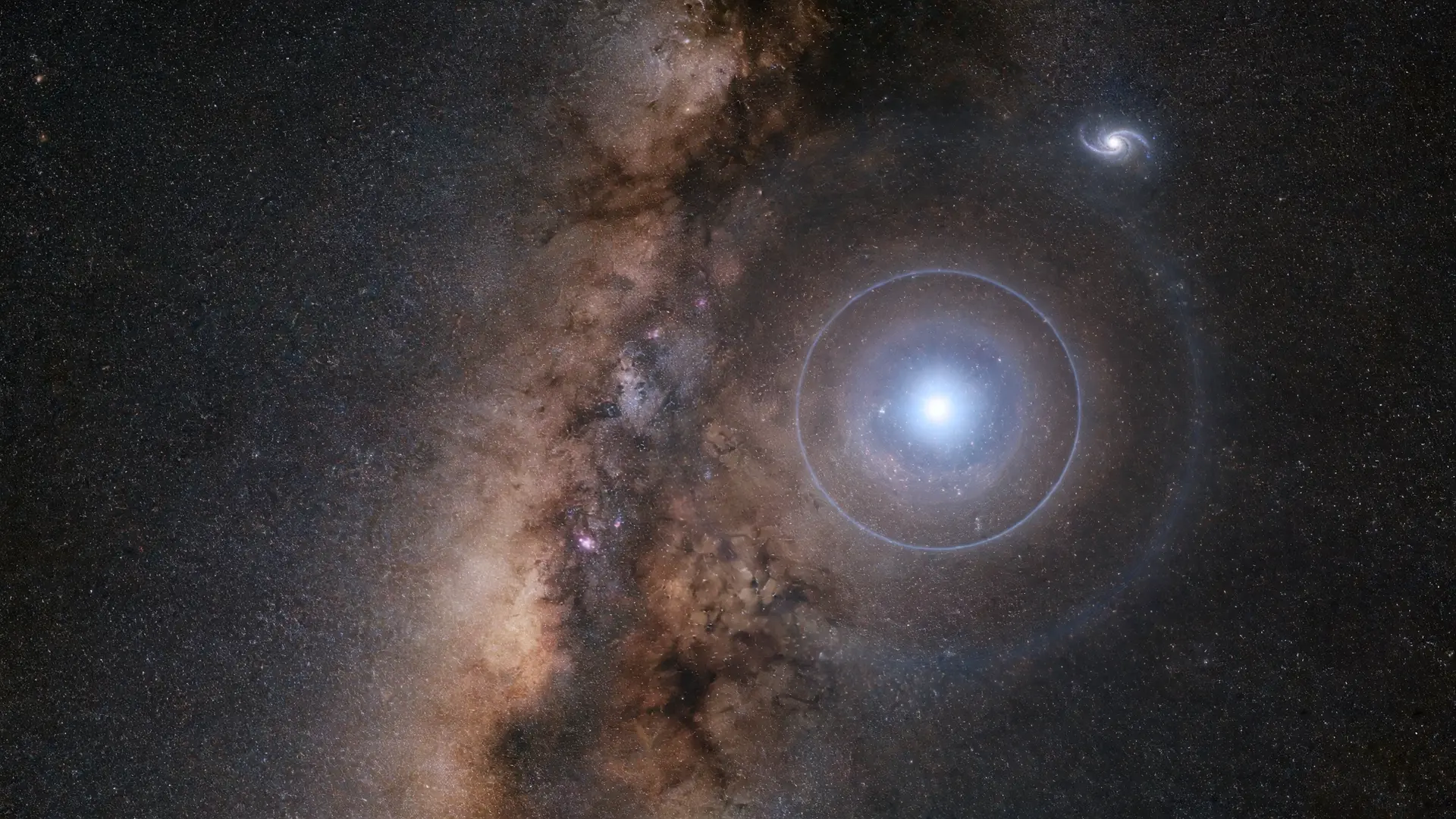
The same team had already closed the middle rung from the other side. OGLE's twenty-year watch of the Large Magellanic Cloud, nearly 80 million stars, turned up only 16 lensing events, far too few for a halo full of compact objects. With its Small Magellanic Cloud survey added in, the verdict is that compact objects from a hundred-millionth of a solar mass to a thousand Suns cannot be a substantial share of the Milky Way's dark matter halo. A separate high-cadence OGLE survey, watching 35 million stars, found no short-timescale flashes at all, capping planet-mass holes at 1 percent of the dark matter. The six ultrashort flashes OGLE did see toward the galactic bulge turned out to be free-floating planets, not black holes. Between the Subaru rebuttal and OGLE's long stare, the planet-mass rung is closed, and the paper unifying the Subaru candidates with the pulsar-timing hum predates the rebuttal, so its foundation is gone.
The heavy end: the grainy sky that isn't
At the top of the ladder sit the monsters: stupendously large black holes, or SLABs, each heavier than a hundred billion Suns, more massive than the largest known black holes. Too heavy to live inside galaxies, they could still drift through intergalactic space carrying a share of the dark matter, tested by the oldest light in the universe.
The argument, published in Physical Review Letters on October 26, 2026, by a Mainz team, runs on statistics. If stupendously large black holes were scattered randomly through space, some regions would hold more than others purely by chance, each surplus matched by a slight shortage of radiation. As the universe expanded and the radiation thinned, that imbalance would grow into patchy variations that would leave the cosmic microwave background looking grainy. The Planck satellite mapped that afterglow to one part in a hundred thousand, and the grain is not there.
“A possible solution to the puzzle of dark matter was that it might have collected shortly after the Big Bang in giant black holes with masses ranging from 100 million to 10 billion billion times that of the sun.”
“If these SLABs had existed in large numbers and contained significant amounts of dark matter, they would have left a characteristic imprint on the CMB through their unique perturbations, or, in a word, making it grainy.”
The ruling is narrow. The team assumed every black hole had the same mass, so a population spread across many masses still needs checking, and the paper rules the monsters out as a significant share of dark matter, not out of existence. It also dents the idea that primordial black holes seeded the surprisingly massive early galaxies the James Webb Space Telescope keeps finding. LiteBIRD and the Simons Observatory, the next CMB telescopes, should tighten the limits further, and the team hopes to push to even heavier holes by listening for the gravitational waves from their formation.
The last hiding place
So where does that leave the oldest suspect in the book? Cornered, but alive, in one mass range: the asteroid-mass window, black holes weighing between 10^17 and 10^22 grams. Picture a black hole with the mass of a five-kilometer asteroid, crushed into a speck smaller than an atom. In that range a black hole is too cold to shine, its Hawking glow too faint for any telescope, and too light to lens, its magnification washed out because the star it crosses is bigger than the lens.
The window is narrowing, though it has not closed. Matthew Gorton and Anne Green at Nottingham recalculated the limits for realistic mass distributions and found the window narrows but stays open, unless the spread is wider than formation models expect. And Hubble photographs of three ultra-faint dwarf galaxies took the first bite: in Triangulum II, black holes near 10^19 grams cannot be all of the dark matter, ruled out at 3.7 sigma, because captured black holes would have destroyed stars and reshaped its stellar mass function.
What would settle it
So why still bet on a suspect that has spent fifty-five years losing ground? Because the case has never been about belief, only addresses: every rung that closes is a place dark matter is not. The list of places it could be is now short enough to search completely. The Rubin Observatory in Chile will sweep the Large Magellanic Cloud wider than any survey before. And if the asteroid window closes too, the verdict is final: dark matter is not black holes. If something is found there instead, a single microlensing flash or a gamma-ray excess with the right fingerprint, it would be the biggest cosmology discovery in a generation: the dark matter holding our galaxy together would predate every star.
The universe has been hiding its missing mass for almost a century. For fifty-five of those years, the prime suspect was a black hole older than the stars, and 2026 nearly finished the case. What survived is not a vague hope but a single address: asteroid-mass black holes, too dim to glow and too small to lens, waiting where no telescope has yet learned to look, and the next decade will look there. Either the suspect is home, or the case closes for good, and after fifty-five years of maybe, a final answer either way is a triumph.
Frequently asked questions
What is a primordial black hole?
A black hole born in the first second after the Big Bang, when the universe was dense enough for patches of the primordial soup to collapse under their own gravity, no dying star required. Unlike the black holes astronomers observe today, which form from collapsed stars, primordial black holes could have any mass, from a speck to a hundred billion Suns, depending on when they formed.
Could a primordial black hole be passing through Earth right now?
Possibly, and you would almost certainly never notice. An asteroid-mass black hole is smaller than an atom, so it would slip through ordinary matter without colliding with anything. But do not mistake small for weak: a 10^17-gram black hole a meter away would pull at roughly 680 times Earth's gravity, so at close range it would be anything but negligible. The saving grace is distance: for a 10^17-gram black hole, the nearest one is probably a few times farther away than the Earth is from the Sun, and a passage through our planet is effectively impossible on human timescales.
How would we ever prove primordial black holes are the dark matter?
By catching one in the act: a microlensing flash with the right duration and shape that no star can explain, a gamma-ray glow matching Hawking evaporation, or a gravitational-wave signal from the early universe. A single confirmed detection at asteroid mass would settle it, because no star could ever make a black hole that small.
Why not just assume dark matter is a new particle?
Most physicists do favor a particle, and experiments like XENON and the Large Hadron Collider keep searching. Primordial black holes stay in the race for one reason: they need no new physics at all, only gravity and the hot early universe we already know existed. If the particle searches keep coming up empty and the asteroid window stays open, the black hole answer gets harder to ignore.
What happens if the asteroid-mass window closes too?
Then primordial black holes are finished as the dark matter, and the answer has to be a particle, or something stranger still. That would still be progress: a fifty-five-year-old idea, tested to destruction, would leave the field with a shorter list and sharper questions.
Sources & Research
The primary studies and reporting behind this story, linked for readers who want to check our work.
- Gerlach, C. et al. (2026), "Closing the Mass Window for Stupendously Large Black Holes" · Physical Review Letters, 137, 181401
- Cholis, I., Krommydas, I. & Carlini, J. (2026), "Limits on primordial black holes from the extragalactic gamma-ray background; current status and future projections" · arXiv:2606.10013
- Gorton, M. & Green, A. M. (2024), "How open is the asteroid-mass primordial black hole window?" · SciPost Physics, 17, 032
- Sugiyama, S. et al. (2026), "Microlensing constraints on Primordial Black Hole abundance with Subaru Hyper Suprime-Cam observations of Andromeda" · arXiv:2602.05840
- Mróz, P. & Udalski, A. (2026), "Eppur non si trovano Vol. 2: No Planetary-mass Primordial Black Holes toward the Andromeda Galaxy" · Acta Astronomica
- Mróz, P. et al. (2024), "Limits on planetary-mass primordial black holes from the OGLE high-cadence survey of the Magellanic Clouds" · arXiv:2410.06251
- Mróz, P. et al. (2024), "No massive black holes in the Milky Way halo" · arXiv:2403.02386
- Mróz, P. et al. (2025), "Microlensing optical depth, event rate, and limits on compact objects in dark matter based on 20 yr of OGLE observations of the Small Magellanic Cloud" · arXiv:2507.13794
- Esser, N. et al. (2025), "Constraints on asteroid-mass primordial black holes in dwarf galaxies using Hubble Space Telescope photometry" · arXiv:2503.03352
- Domènech, G., Pi, S. & Wang, A. (2026), "A Unified Origin of Primordial Black Hole Dark Matter and Nanohertz Gravitational Waves" · arXiv:2602.24061