Cosmic Mysteries
Why the Moon Keeps Falling and Never Lands
The Moon falls toward Earth every second and never lands. Newton’s cannonball, Apollo’s mirrors, and a slow theft of Earth’s spin explain the trick.
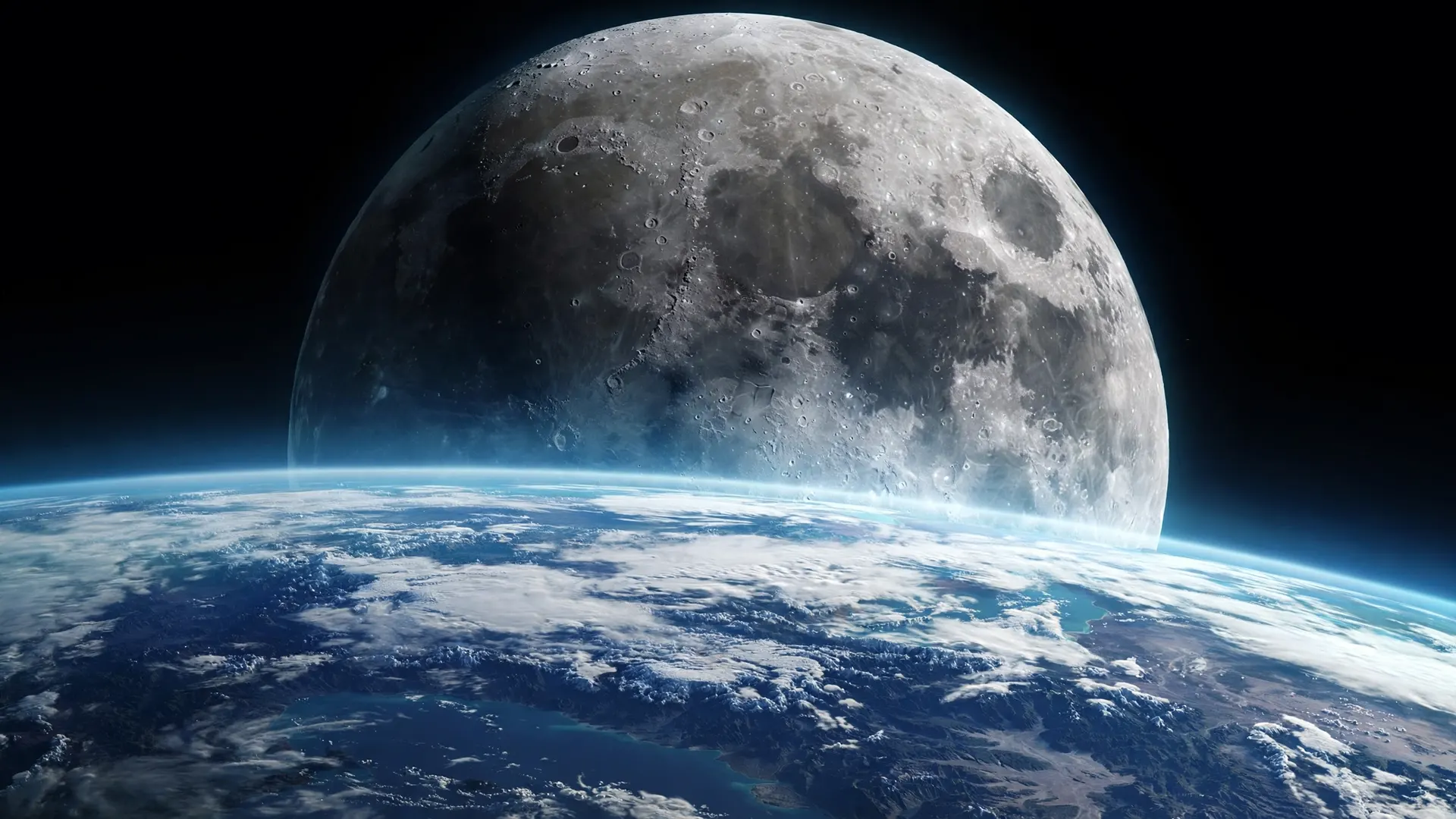
The Moon looks nailed to the sky. It hangs there night after night, calm and permanent, the one thing up there that never seems to move. But the Moon is falling toward Earth right now, at this very second. It has been falling for more than four billion years. It has never landed.
The short answer is this. Gravity pulls the Moon toward Earth without pause, so the Moon falls toward us constantly. At the same time it races sideways at about a kilometre every second, fast enough to keep missing. Fall, miss, fall, miss. That endless loop is the trick, and it has a name, which we will come to.
Start smaller. Drop a stone and it falls straight down. Throw it, and it still falls, but it travels sideways while it drops, so it lands a few metres away. Throw it harder and it lands farther off. The falling never changes. What changes is how much ground the stone covers before the fall wins. Now give the stone a planet that curves. Earth’s surface bends away beneath a fast enough throw, dropping out from under the stone as it falls. Match the two rates, fall against curve, and the stone never reaches the ground at all.
Newton’s cannon on the mountain
Isaac Newton saw this in the 1680s, armed with nothing but a quill and the laws he had just written down. He pictured a cannon on top of a very high mountain, firing a lead ball level with the horizon. A weak charge and the ball arcs down and lands nearby. More powder and it flies farther before the ground catches it. Keep adding powder, Newton wrote, and at some point the ball would travel so far that the curve of its fall would match the curve of the Earth itself.
“And by increasing the velocity, we may at pleasure increase the distance to which it might be projected, and diminish the curvature of the line which it might describe, till at last it should fall at the distance of 10, 30, or 90 degrees, or even might go quite round the whole earth before it falls.”
The Moon is that ball, fired by no one. It sits, on average, 384,400 kilometres away, about thirty Earths laid side by side. It moves sideways at 1.02 kilometres per second, roughly 3,700 kilometres per hour. In each of those seconds, gravity bends its path toward Earth by about 1.4 millimetres. A millimetre and a half of fall, a kilometre of sideways travel, repeated without pause. The two balance so neatly that the distance between us barely changes. This balanced fall, a fall that never ends and never arrives, is what the word orbit means. Nothing holds the Moon up. It is falling around us.
The mirrors that caught it leaving
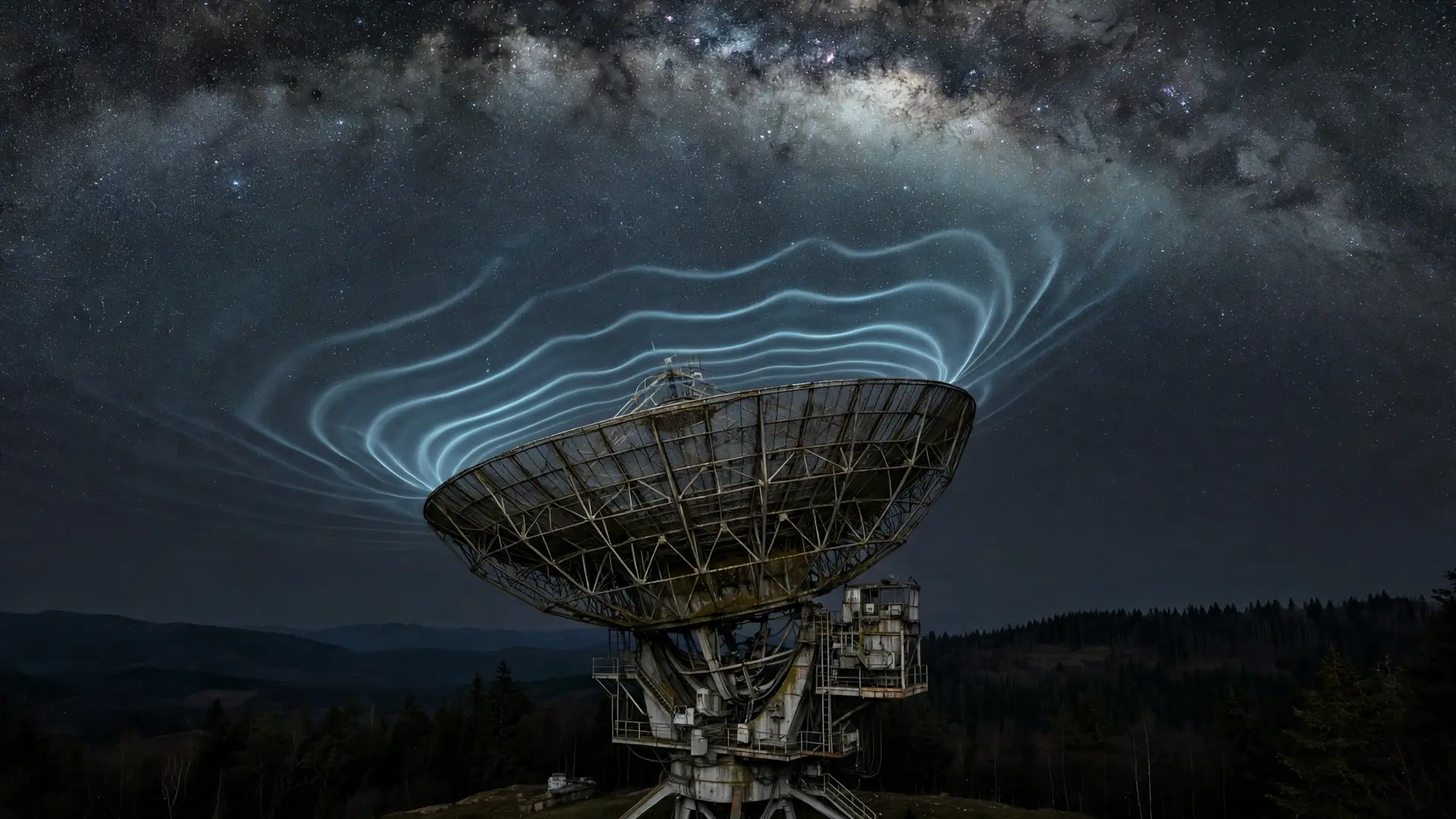
Falling around us is only half the story, because the Moon is also slipping away, and we know this to a precision that borders on the absurd. Between 1969 and 1971, astronauts on Apollo 11, 14 and 15 set out panels of small mirrors on the lunar surface and left them there. The panels need no power and have no moving parts. They just sit in the dust, waiting for someone to shine a light at them. Observatories on Earth do exactly that, firing short pulses of laser light at the mirrors and timing how long the light takes to come back. The round trip lasts about two and a half seconds. Light alone needs about 1.3 seconds for the journey out, a delay you can watch ticking live on our signal timer.
Half a century of those timings has pinned the Moon’s distance down to within a few millimetres, and it has produced one of the strangest facts in astronomy. The distance grows. Every year, the Moon is about 3.8 centimetres farther away than the year before, roughly the speed at which your fingernails grow. The mirrors also told us the Moon has a liquid core, wobbling slightly as it turns. Why the next Artemis flight will not land on the Moon is a separate puzzle, but the program that left those mirrors is the same one now heading back.
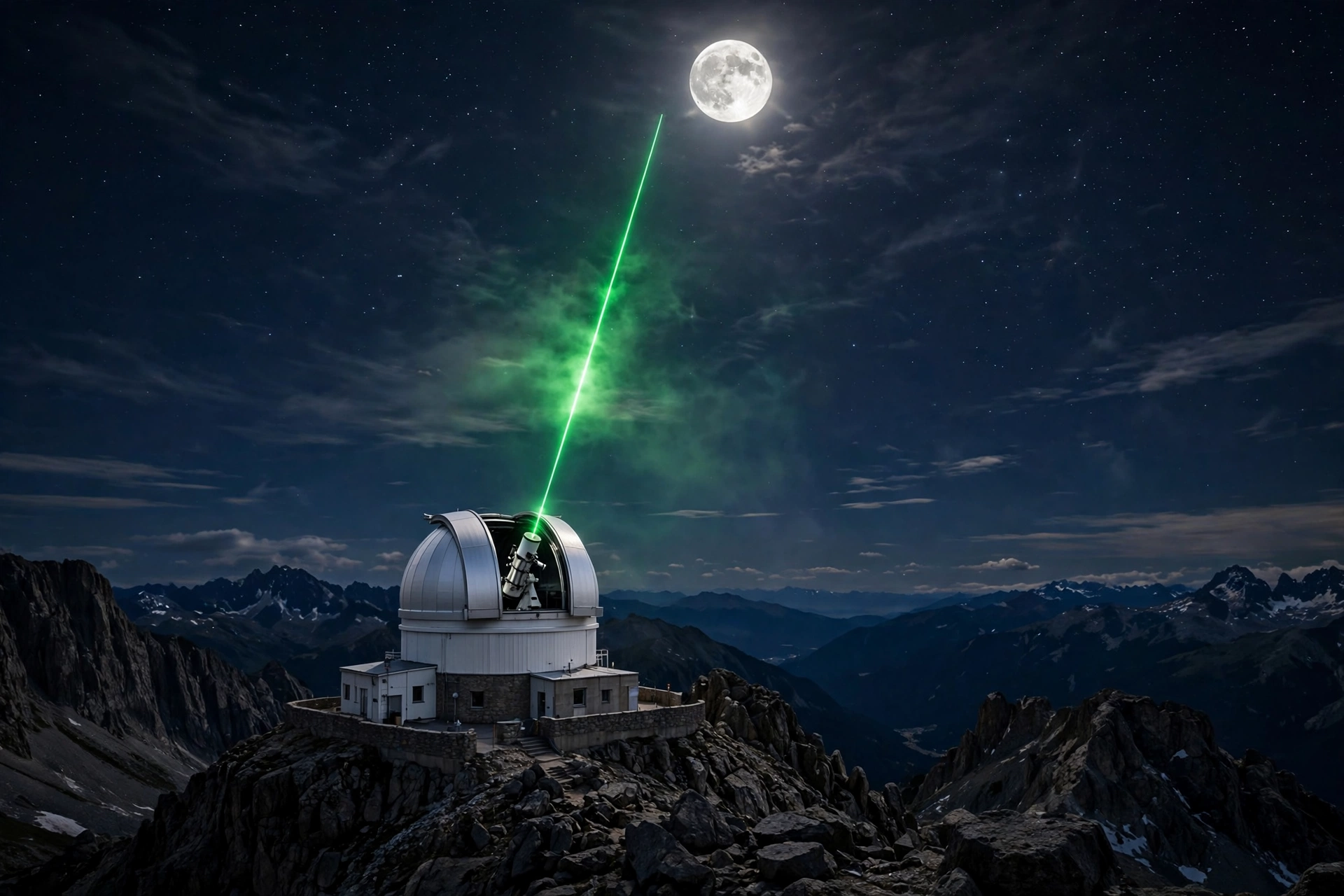
“We also have strong evidence that the Moon has a liquid core, and laser ranging has allowed us to determine with great accuracy the rate at which the Moon is gradually receding from the Earth.”
Why a falling Moon is also leaving
The thief is the tide. The Moon’s gravity pulls on Earth’s oceans and raises two bulges of water, one facing the Moon and one on the far side. Earth spins once every 24 hours, far faster than the Moon completes its 27-day circuit, and that spin drags the near bulge a little ahead of the Moon. The bulge has gravity of its own, so it tugs the Moon forward, in the direction it is already travelling. A forward tug speeds the Moon up, and a faster Moon climbs into a wider path. The energy for the climb comes out of Earth’s spin, so our day slowly stretches. Nothing is free. The Moon’s escape is paid for in milliseconds, taken from every day on Earth.
Ancient seashells keep the receipts. A fossil clam that lived in a warm sea 70 million years ago, when the last dinosaurs still walked, grew its shell in daily layers, one fine ridge for every turn of the Earth. In 2020, researchers counted those ridges and found 372 of them in each yearly band. Seventy million years ago, a year held 372 days, which means each day lasted about 23 and a half hours. The Moon was closer then, the tides stronger, the theft faster. It has been backing away ever since it formed, and the laser mirrors simply caught it in the act.
“We can basically look at a day 70 million years ago. It’s pretty amazing.”
The last total eclipse
The retreat has a deadline written into the sky. A total solar eclipse works because of a coincidence so neat it feels staged: the Sun is about 400 times wider than the Moon and about 400 times farther away, so the two discs look the same size from here. As the Moon drifts outward, its disc shrinks in our sky. NASA’s eclipse scientists have done the maths: once the Moon is about 23,500 kilometres farther out than it is today, it will never again be big enough to cover the Sun completely. At the current rate of retreat, that point arrives a little over 600 million years from now. Every total eclipse between now and then is drawn from a shrinking account. The annular eclipses we already see, when the Moon sits near its farthest point and leaves a ring of sunlight standing, are a preview of the only kind left at the end.
Everything we send Moonward rides the same falling road Newton mapped. The tankers that will one day refuel a Starship in orbit before it lights out for the Moon are, in the end, cannonballs with engines, thrown hard enough to keep missing the Earth below them. And above them all hangs the original. Tonight the Moon will cross your sky exactly as it crossed Newton’s: mid-fall, mid-miss, held up by nothing but its own sideways speed. It will still be falling when the last total eclipse fades, and long after. Four billion years into the longest fall we know, the Moon has never been anywhere but on its way down, and on its way around.
Frequently asked questions
Is the Moon really falling?
Yes. Gravity pulls the Moon toward Earth without pause, so it drops about 1.4 millimetres toward us every second. It never gets closer because it is also moving sideways at about a kilometre per second. The fall bends its path into a closed loop around Earth.
Why does the Moon not crash into Earth?
Because of its sideways speed. At about a kilometre per second, the Moon covers ground as fast as its fall curves it downward, so the two cancel out. Slow the Moon down and it would spiral in. Speed it up enough and it would leave altogether.
How fast is the Moon moving away from Earth?
About 3.8 centimetres a year, roughly the speed at which fingernails grow. The drift is driven by Earth’s tides and has been measured directly since the Apollo missions.
How do we measure the Moon’s distance so exactly?
Astronomers fire laser pulses at reflector panels left on the Moon by Apollo 11, 14 and 15, then time the returning light. The round trip takes about 2.5 seconds, and the timing is precise enough to fix the distance to within a few millimetres.
Will total solar eclipses end one day?
Yes. The Moon looks the same size as the Sun only because it sits at just the right distance. As it drifts away it shrinks in our sky, and in a little over 600 million years it will be too small to cover the Sun. Only ring-shaped annular eclipses will remain.
Sources & Research
The primary studies and reporting behind this story, linked for readers who want to check our work.
- NASA Science, "Moon Facts" · NASA
- NASA National Space Science Data Center, "Moon Fact Sheet" · NASA NSSDC
- "Measuring the Moon’s Distance: Apollo Laser Ranging Experiments Yield Results", LPI Bulletin No. 72 (1994) · NASA Goddard Eclipse Website
- NASA Science, "Eclipses and the Moon" · NASA
- de Winter, N. J. et al. (2020), "Subdaily-Scale Chemical Variability in a Torreites sanchezi Rudist Shell", Paleoceanography and Paleoclimatology, doi:10.1029/2019PA003723 · Vrije Universiteit Brussel (study announcement)
- Newton, I. (1687), "Philosophiæ Naturalis Principia Mathematica" (Motte translation, 1729) · Project Gutenberg